Insult to Hindu sentiments: Christian pamphlets denigrating Hinduism to advance religious conversions found in Rajasthan
 Udaipur, Rajasthan, India
  23 September, 2025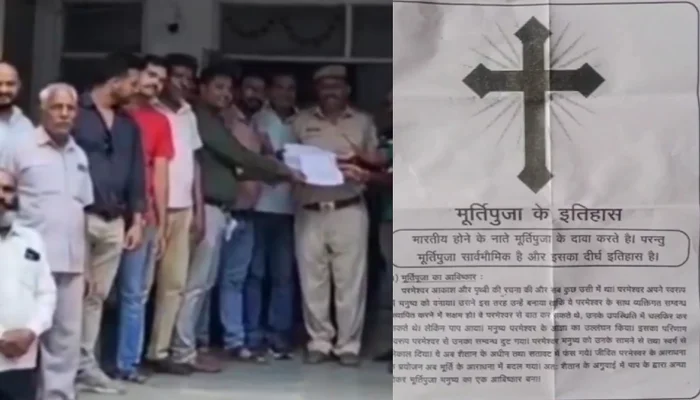
Case Summary
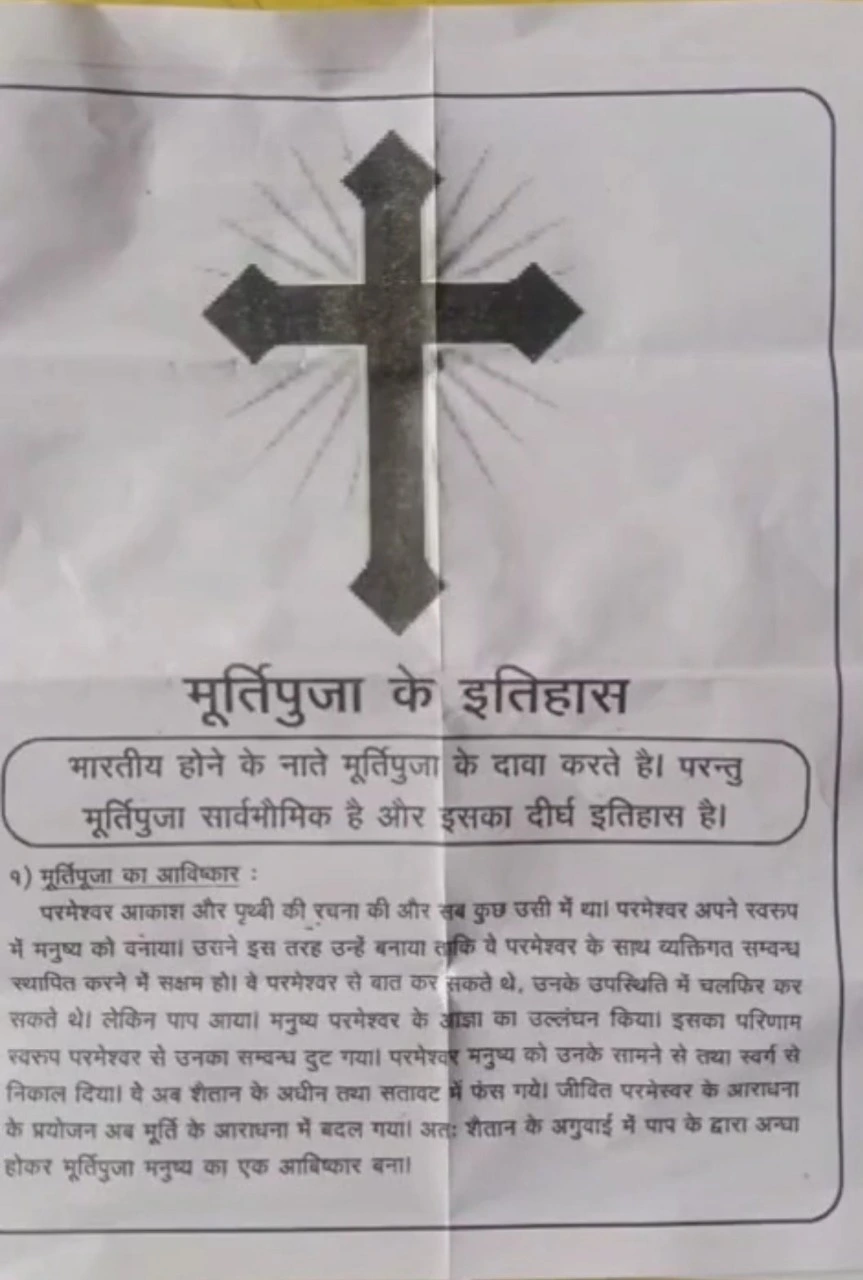
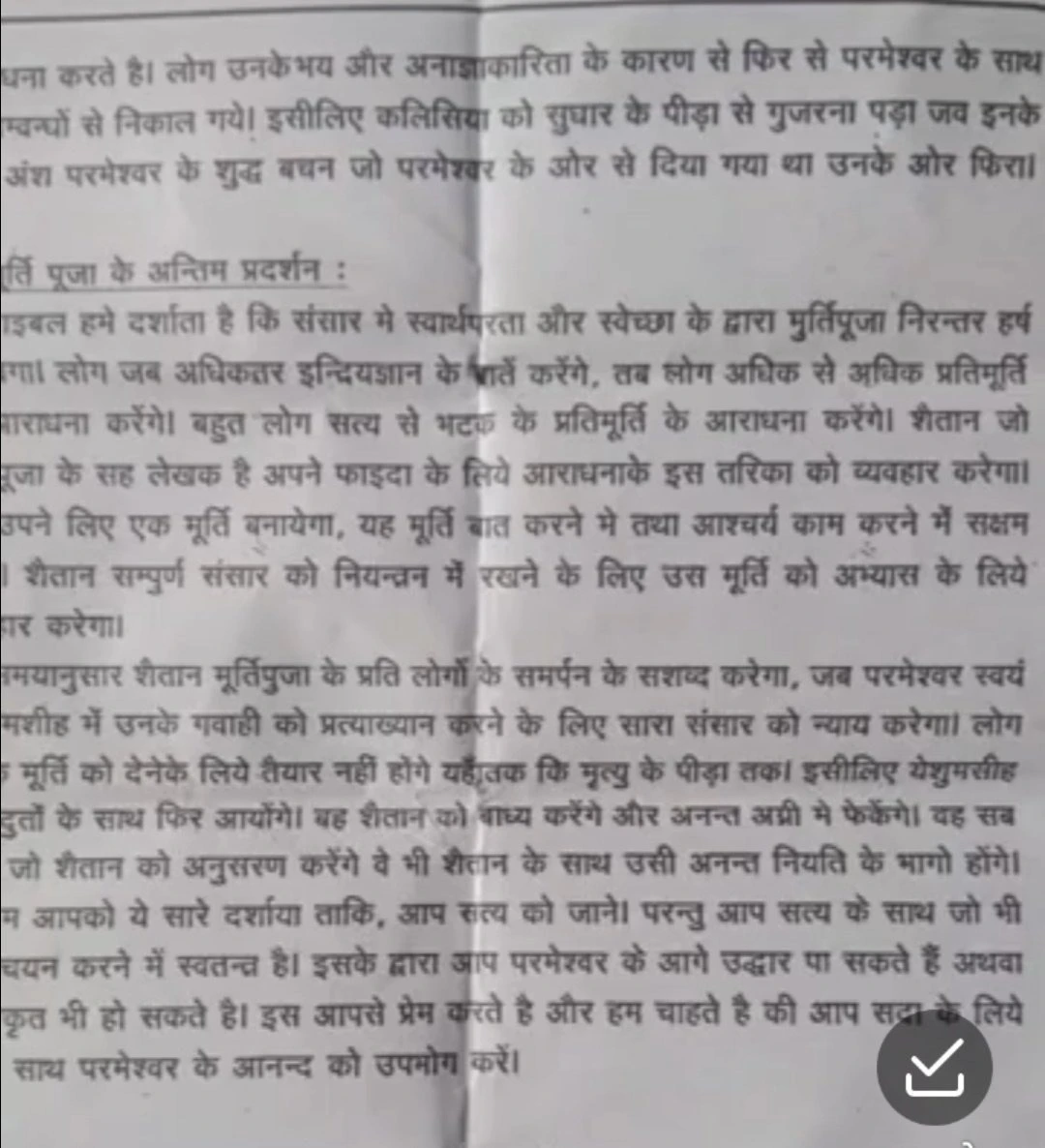
In the Dabok area of Udaipur, Rajasthan, offensive pamphlets were found denigrating Hinduism and promoting Christianity. According to reports, the pamphlets were found outside some shops in the Dabok area, marked with a cross symbol and the name “Christian Cultural Centre Jalpaiguri.” The material carried inflammatory statements that claimed idol worship was the work of Satan. It claimed that “the purpose of worshipping the living God was now changed to the worship of idols. Therefore, led by Satan, blinded by sin, idol worship became a creation of man.” The pamphlet further claimed that Satan would create an idol of his own, which people would worship, and that this was how he would control the world. It then promoted Christianity by claiming that “that’s why the church had to go through the pain of reformation when a part of them, and then the pure word of God which was given by God, was taken from them.” It concluded with the assertion that Jesus Christ would return to bind Satan and consign both him and idol worshippers to “the eternal fire.” At the end, it rhetorically gave readers an option, saying that, “But you are free to choose whatever you want with the truth. Through this, you can find salvation before God or be condemned.” These provocations, targeting Hindu practices during the Navratri festival, sparked widespread anger among local residents. Representatives of the Sarva Hindu Samaj filed a case at Dabok police station, demanding accountability. As of the date of writing this report, the police had registered a case and begun examining CCTV footage to identify those responsible. Authorities also appealed to the public to maintain peace and assured that strict action would be taken against the perpetrators.
Case Images
Why it is Hate Crime ?
This case has been added to the tracker under the primary category of - Hate speech against Hindus. Within it, the sub-category selected is - Anti-Hindu slurs, mocking faith, Anti-Hindu slurs and the deliberate mocking of the Hindu faith owing to religious animosity involve the usage of derogatory terms, stereotypes, or offensive references to religious practices, symbols, or figures. One of the common anti-Hindu slurs used against Hindus is “cow-worshipper” and “cow piss drinker”. The intention of using this term is to demean and mock Hindus as a group and their religious beliefs since Hindus consider the cow holy. Additionally, some symbols and the slurs attached to them have a historical context that exacerbates the insult, hate, stereotyping, dehumanisation and oppression against Hindus. Cow worship has been used for centuries to denigrate Hindus, insult their faith and oppress Hindus specifically as a religious group. There has been overwhelming documentation about how cow slaughter has been used to persecute Hindus with cow meat being thrown in temples and places of worship. There has also been overwhelming documentation where cow meat (beef) has been force-fed to Hindus to either forcefully convert them to Islam or denigrate their faith. Apart from cow worship, the Swastika – which holds deep religious significance for the Hindus – has also been misinterpreted and distorted to use as a slur against Hindus. Similarly, the worship of the Shivling has been used by supremacist ideologies and religions to denigrate Hindus owing to religious animosity. Such slurs and denigration stem out of inherent animosity and hate towards Hindus and their faith, therefore, it is categorised as hate speech targeted at Hindus specifically owing to their religious identity. The second primary category selected here is - Predatory Proselytisation. Within it, the sub-category selected is - Attempting to convert/converting by denigrating Hinduism. In several cases, Hindus are converted or an attempt is made to convert Hindus by denigrating their faith, Hinduism. In such cases, the Hindus associate with the non-Hindu perpetrators often by choice and then, the attempt to convert them by insulting their faith, showing the faith down etc begins. An example of this would be a non-Hindu gathering where the Hindus are attending the gathering of their own free will. However, once they attend the gathering, there is an explicit attempt to convert them by abusing their faith and hailing the faith of the perpetrator. The denigration of the Hindu faith is often based on misrepresentation of the Hindu faith, its doctrine and scriptures and insult to espoused traditions if not blatant lies about Hindu beliefs and ways. Such conversions or attempts at conversions are driven by animosity towards the Hindu faith and are therefore documented as religiously motivated hate crimes. This case has been added to the tracker because Hindu religious sentiments were insulted after pamphlets denigrating Hinduism were found outside shops in the Dabok area of Udaipur. Such actions were not isolated provocations but part of a broader pattern of hate speech, where Hindu faith and its practices were deliberately mocked in order to demean the Hindu community and present Hinduism as impure or demonic. The language in the pamphlets directly claimed idol worship or polytheistic religion, such as Hinduism, as the work of Satan and condemned eternal damnation for those who refused to abandon this faith. This was not simply an expression of religious opinion but a calculated attack on Hindu identity designed to undermine their dignity and instil fear. Such claims sought to ridicule and dehumanise Hindus as “followers of Satan,” so as to generate a sense of inferiority complex in the mind of the Hindu community. The claims made in the pamphlet were deliberate misrepresentations of Hindu traditions and theology, portraying idol worship as a creation of Satan and Hindus as blind followers of evil. This characterisation ignored the profound philosophical basis of Murti Puja in Hinduism, where the idol is not worshipped as a mere object but revered as a medium through which the devotee connects with the divine. It is a way for people to connect with God, an act that is rooted in Hindu philosophy. By dismissing this practice as demonic and presenting Jesus as the sole saviour from eternal fire, the pamphlet sought to demean Hindu faith and elevate Christianity as inherently superior. By asking a rhetorical question in the end, this strategy of denigrating Hinduism while glorifying Christ functioned as a proselytising tool, aiming to shake Hindu confidence in their own faith and present conversion to Christianity as the only path to salvation. The Christian faith, by its very theological foundations, places a strong emphasis on proselytisation. In pursuit of conversion objectives, Christian evangelists often employ unethical means, ranging from misrepresentation and misinformation to direct denigration of Hinduism and Hindu practices. Christian theology rejects idol worship and frames it as sinful. Christian evangelists often emphasise the need to save non-believers, especially followers of polytheistic faiths, by urging them to abandon what they describe as false faith. The pamphlets distributed in Udaipur were rooted in this very worldview, portraying Hindu practices as satanic while presenting conversion to Christianity as the only path to salvation. Such messaging sought to coerce Hindus into converting to Christianity, not by reasoned dialogue, but by instilling fear of divine punishment and eternal hellfire. Such acts were deeply rooted in religious animosity towards Hindu victims, and thus, this case was added to the tracker. Furthermore, by choosing the Navratri festival as the day for such activities, the Christian perpetrators sought to exploit a Hindu festival to launch their propaganda, thereby insulting a Hindu religious occasion. This act was neither spontaneous nor benign; it was part of a systemic effort to erode Hindu traditions and replace them with a Christian identity by discrediting Hindu worship as satanic. This amounts to anti-Hindu speech and, therefore, it is being added to the hate crime database of the Hinduphobia Tracker.


Case Status
Complaint registered


Perpetrators Details
Perpetrators
Christian Extremists
Perpetrators Range
Unknown
Perpetrators Gender
unknown
 Sources




