Hindu man's vehicle torched for bearing religious symbols by Muslim man in Bijnor; accused part of a gang who aimed to target Hindu vehicles
 Bijnor, Uttar Pradesh, India
  3 March, 2026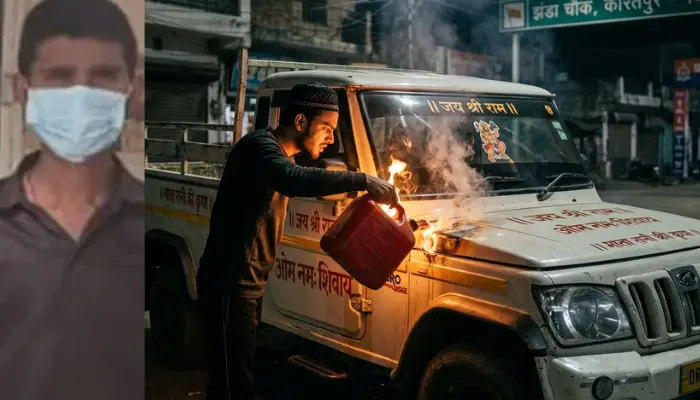
Case Summary
In Kiratpur, Bijnor, Uttar Pradesh, a Hindu man, Nimish Rastogi, had his vehicle selectively torched by a Muslim man, Abuzar alias Rain, because it bore Hindu religious symbols such as the names of Hindu deities. The accused was paid by other Muslim men to burn several Hindu vehicles displaying such Hindu religious symbols. According to media reports, the accused, Abuzar, worked in a salon in Gurugram, but was troubled by illness and financial difficulties. He asked his cousin Zaid, who lives in Mumbai, for help of 5,000 rupees. Zaid introduced him to a Muslim man named Abubakar on Telegram. He also told him that Abubakar helps members of the Muslim community. Abubakar, in exchange for his help, stipulated that he would set fire to vehicles bearing Hindu religious symbols, like the names and inscriptions of Hindu deities. The accused was lured with the promise of a large sum of money for sending the video. As part of this conspiracy, Abuzar doused a pickup truck of a Hindu man named Nimish Rastogi with petrol and set it ablaze at Jhanda Chowk in Kiratpur on the night of 4 March 2026. Reports confirmed that the accused targeted the truck because it had "Hindu" written on it. After the incident, Abuzar fled back to Gurugram. When the police examined closed-circuit television footage and digital evidence, Abuzar's identity was revealed. As soon as he returned to Kiratpur on 12 March 2026, the police arrested him. His mobile phone contained several crucial clues and Telegram chats. Following this, the police had also arrested Zaid in this case on 20 March 2026. Subsequently, the police have arrested Mohammad Mannan, a friend of Zaid and a resident of Mohalla Lukmanpura. Mannan was working as a painter in Morna a year and a half ago, where he met Zaid. About a year and a half ago, the two moved to Panvel, Mumbai, and began working in a salon. Mannan also became associated with Abubakar's group through Zaid. Police confirmed that the accused, Abubakar, was inciting religious sentiments among young Muslim men through a Telegram group and preparing them to carry out such incidents. At the time of writing this report, the police are investigating and are searching for more than a dozen other young men associated with Abubakar whose names have surfaced.
Why it is Hate Crime ?
This case has been added to the tracker under the primary category- Attack not resulting in death. The subcategory selected is- Attacked for Hindu identity. In several cases, Hindus are attacked merely for their Hindu identity without any perceived provocation. A classic example of this category of religiously motivated hate crime is a murder in 2016. 7 ISIS terrorists were convicted for shooting a school principal in Kanpur because they got ‘triggered’ seeing the Kalava on his wrist and tilak that he had put. In this, the Hindu victim had offered no provocation except for his Hindu religious identity. The motivation for the murder was purely religious, driven by religious supremacy. Such cases where Hindus are targeted merely for their religious identity would be documented as a hate crime under this category. Another primary category selected is- Attack on Hindu religious symbols. The subcategory selected is- Desecration of Hindu religious symbols. Icons and symbols or a religious representation of a spiritual ideal are widely revered in Hinduism. Iconography is of vital significance in the Hindu milieu. It helps connect people’s spiritual beliefs with the real world. Iconography within the Hindu faith takes several shapes and forms. Murtis are of most significance to Hindus, to which daily rituals, prayers and offerings are done. Besides the murtis, there are several other symbols which have deep significance in the Hindu faith – the Om and Swastika for example. Since these Hindu religious symbols hold paramount importance in Hinduism, any desecration of symbols, icons, murtis, religious representations and manifestations, is driven by animosity towards the faith itself which manifests itself through these murtis, icons and symbols. Therefore, any desecration of these Hindu religious symbols and representations is considered religiously motivated hate crimes under this category. In this case, the deliberate selection of a Hindu person's vehicle for torching in Kiratpur, Bijnor, Uttar Pradesh, solely because it bore Hindu religious symbols like the names of Hindu deities, constitutes a clear hate crime rooted in religious identity. Abuzar, alias Rain, chose this vehicle over others in the area, ignoring non-Hindu vehicles without such markings, which demonstrates targeted discrimination based on the owner's evident Hindu faith. This act of arson was not random vandalism but a calculated attack motivated by religious animosity, as the other Muslim perpetrator, Abubakar, paid him specifically to burn Hindu vehicles displaying Hindu symbols. Such selective violence instils fear within the Hindu community, signalling that overt expressions of their faith make them vulnerable to destruction and harm. By focusing exclusively on symbols of Hinduism, the crime escalates from property damage to an assault on religious identity, fulfilling the definition of a hate crime driven by bias against Hindus. Torching vehicles inscribed with the sacred names of Hindu deities, such as those of prominent gods like Rama, Krishna, or Shiva, amounts to direct desecration of deeply revered religious symbols, inflicting profound emotional injury on the Hindu community. In Hinduism, these names and inscriptions hold immense spiritual significance; they invoke divine protection, express devotion (bhakti), and serve as constant reminders of faith during daily life, often written on vehicles as protective mantras or omens of safe journeys. Burning these sacred names and inscriptions is akin to profaning holy scriptures or idols, an act that Hindus view as sacrilege equivalent to temple vandalism, which historically provokes widespread outrage and communal tension. This desecration was intentional, as Abubakar conditioned financial aid on targeting such symbols, revealing religious animosity that seeks to humiliate and erase visible Hindu piety. The resulting hurt pierces the sentiments of several Hindus, fostering a sense of violation and insecurity among Hindus who practise their faith openly. Zaid, Mannan, and Abubakar orchestrated this gang-like operation via Telegram, directing Abuzar and potentially others to burn and target Hindu vehicles with religious symbols for desecration, which exposes a systematic attempt to selectively attack Hindus and spread fear and distress within their community. By leveraging community networks, Zaid in Mumbai introduced Abuzar to Abubakar, who positioned himself as a helper for Muslims. The duo created a funded network aimed at religious provocation, promising large sums for video proof of the acts. This coordinated effort transcends individual crime, resembling organised hate activity designed to intimidate Hindus from displaying their faith publicly, much like targeted pogroms or symbol-based persecutions. The religious animosity is evident in the exclusive focus on Hindu symbols, excluding others, which aims to create psychological terror, erode communal harmony, and assert religious dominance through fear, hallmarks of a hate crime based on anti-Hindu animosity. Since this case met several parameters of a religiously motivated offence, it is being added to the hate crime database of the Hinduphobia Tracker. Disclaimer: In this case, since a Hindu person's vehicle was torched for bearing religious symbols, we keep the victim count at 1 even though there was no direct attack on a Hindu person. It is also important to state that since the crime involved Abuzar, Zaid, Mannan, and Abubakar, the perpetrator count is selected as 4.
Victim Details
Total Victim
1
Deceased
0
Gender
- Male 1
- Female 0
- Third Gender 0
- Unknown 0
Caste
- SC/ST 0
- OBC 0
- General 1
- Unknown 0
Age Group
- Minor 0
- Adult 1
- Senior Citizen 0
- Unknown 0


Case Status
Case sub-judice


Perpetrators Details
Perpetrators
Muslim Extremists
Perpetrators Range
From 2 To 5
Perpetrators Gender
male
 Sources




