Hindu woman subjected to repeated coercion for religious conversion and nikah by Muslim men in Aligarh
 Aligarh, Uttar Pradesh, India
  11 March, 2026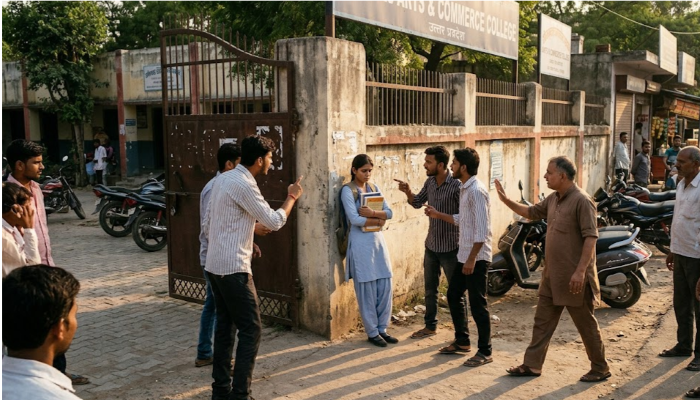
Case Summary
A Hindu woman studying at a college in Aligarh, Uttar Pradesh, endured persistent harassment from three Muslim youths, Sameer, Zuber and Shahid, who constantly pressured her to convert to Islam and do nikah (Islamic marriage). Near her college premises, the perpetrators repeatedly approached her, pressuring her to abandon her faith and marry one of them. Their relentless intimidation in public spaces linked to her daily routine caused her profound distress and fear. The harassment unfolded near the gates of the college where the Hindu victim was pursuing her studies in Aligarh city. The three Muslim youths repeatedly followed her, intercepted her near the college premises, and pressured her to agree to the marriage and religious conversion. Their relentless approach and insistence placed the victim under sustained pressure while she attempted to attend her classes. The victim was repeatedly confronted and pressured against her will. The situation escalated when the woman’s family learned of the harassment she had been enduring. Her uncle arrived at the college gate on 12 March 2026 after becoming aware of the repeated intimidation directed at his niece. When the perpetrators again approached the Hindu woman near the entrance, the uncle confronted them and restrained the three Muslim youths on the spot. The confrontation drew the attention of local residents and passers-by, who gathered near the gate as the Muslim men were finally stopped from continuing their harassment of the student. Police personnel later took the three Muslim youths into custody following the incident. Authorities initiated legal action against the perpetrators after the woman’s family brought the matter to the attention of law enforcement. The three Muslim men were arrested, and an investigation into the harassment and coercion faced by the victim was set in motion, while the police proceeded with legal proceedings against the individuals involved in pressuring the woman for marriage and conversion.
Why it is Hate Crime ?
The primary category for this case is "Predatory Proselytisation". The sub-category for this case is "Harassment, threats, coercion for conversion". Harassment covers a wide range of behaviours of an offensive nature. It is commonly understood as behaviour that demeans, humiliates, and intimidates a person, including threats and coercion. Harassment and threats, in this case, find their root on discriminatory grounds which has the effect of nullifying a person’s rights or infringing upon his freedom to exercise his right specifically owing to the victim’s religious identity. Verbal and physical threats and psychological or physical harassment are often used against Hindu victims because they choose to practice their professed religion. Religious harassment also includes forced and involuntary conversions by harassment, threats or coercion. Coercion includes intimidatory tactics like force-feeding a Hindu victim beef to convert to another religion, forceful circumcision etc. In several cases documented, non-Hindu perpetrators or those who harbour specific animosity towards Hinduism, harass victims simply based on their religious identity. Such cases often also include harassment to ensure the Hindu victim abandons his/her professed religion and adopts the religion of the perpetrator. Such cases where Hindu victims are harassed to convert to the perpetrator’s religion are rooted in animosity towards the victim’s religious identity and are therefore documented as religiously motivated hate crimes. This case qualified as a religiously motivated hate crime because a Hindu woman studying at a college in Aligarh, Uttar Pradesh, became the target of sustained harassment and coercion from three Muslim youths who repeatedly pressured her to abandon her Hindu faith and enter a nikah (Islamic marriage ceremony). The perpetrators specifically targeted her Hindu identity, following and confronting her near college premises to compel religious conversion as a precondition for marriage, thereby violating her fundamental right to religious autonomy and freedom of religion enshrined in the Indian Constitution. Their relentless insistence showcased a religious zeal to convert her at any cost, using intimidation to strip her of her faith rather than allowing free choice. The forced attempt to convert and marry her constituted a direct assault on her religious identity, as the youths persistently intercepted her at the college gate, demanding she adopt Islam. This coercive pattern demonstrated anti-Hindu animosity, treating her Hindu beliefs as inferior and expendable, and aimed to erase them through marriage-linked pressure. Such religiously motivated harassment breached her personal security and dignity, imposing an Islamic supremacist agenda that prioritised the perpetrators' faith over the victim's consent. The circumstances revealed a deliberate strategy to undermine Hindu women through conversion tactics disguised as romantic pursuit. By conditioning marriage on abandoning Hinduism, the perpetrators exposed their deep-seated religious prejudice, fostering fear in educational spaces and signalling broader threats to Hindu religious freedom. The sustained nature of these acts amplified the hate crime element, as they sought not just personal gain but the systematic diminishment of her faith. The harassment instilled pervasive fear around her college, deterring her studies and creating insecurity for other Hindu women facing similar pressures. This extended the harm beyond one victim, contributing to communal unease where religious identity becomes a target for coercion. Given the clear link between the persistent harassment, direct demands for conversion tied to her Hindu identity, and violation of her religious rights, this met all parameters of a religiously motivated hate crime driven by anti-Hindu animosity. Therefore, it has been added to the tracker's hate crime database. Disclaimer: The Hinduphobia Tracker records incident dates based on when the crime occurred, or the victim's ordeal began, rather than when the media reported it. In this case, media reports did not specify the exact date when the victim's ordeal began. The only date provided is 12 March 2026, when the victim's uncle arrived at the college. Henceforth, this date is selected as the indicative incident date for documentation purposes only.
Victim Details
Total Victim
1
Deceased
0
Gender
- Male 0
- Female 1
- Third Gender 0
- Unknown 0
Caste
- SC/ST 0
- OBC 0
- General 0
- Unknown 1
Age Group
- Minor 0
- Adult 1
- Senior Citizen 0
- Unknown 0


Case Status
Arrested


Perpetrators Details
Perpetrators
Muslim Extremists
Perpetrators Range
From 2 To 5
Perpetrators Gender
male
 Sources




