Hindu woman abducted and coerced for conversion by Muslim man; minor son pressured for circumcision
 Ghazipur, Uttar Pradesh, India
  12 March, 2009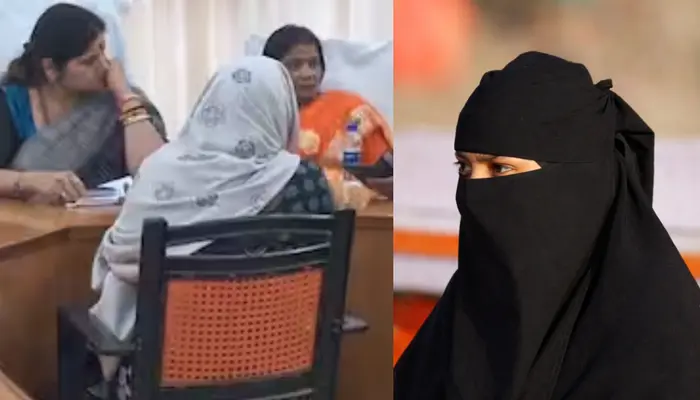
Case Summary
In Ghazipur district of Uttar Pradesh, a Hindu woman was abducted and coercion for religious conversion by a Muslim man named Afsar Hussain. The accused also exerted pressure on minor children to convert, including demands for the minor son to undergo circumcision. The incident came to light when the victim approached the State Women’s Commission during a public hearing and described her ordeal. The victim stated that she was kidnapped in 2009 by the Muslim accused, Afsar Hussain, from Mohammadabad tehsil and taken to a village in Maharashtra, where she was held captive for several years. After she eventually managed to return to her village, social pressure from the local community compelled her to marry the same man who had abducted her. Following the marriage, she gave birth to two children, a daughter who is now around 14 years old and a son about eight years old. Over time, Hussain subjected her to physical abuse and repeatedly pressured her to convert to Islam. In 2018, he pronounced triple talaq and divorced her, after which the woman began living separately while pursuing legal remedies. Despite the divorce, Hussain later attempted to re-establish control over her and insisted that their children be converted to Islam, including demanding that their son undergo circumcision according to Islamic religious practices. During the years following the divorce, the victim continued approaching the police and the courts in pursuit of protection and justice, and her statement was recorded under Section 164 as part of the legal proceedings. She also reported that some of her written complaints later disappeared from official records. Furthermore, Hussain also attacked her with a knife, leaving a visible injury on her head. After the attack, she again sought intervention and appeared before the State Women’s Commission when Chairperson Babita Singh Chauhan held a public grievance hearing in Ghazipur. During the proceedings, the victim described the history of abduction, forced marriage, domestic violence, the triple talaq pronounced in 2018, and the ongoing pressure to convert the children. Taking note of the injuries and the seriousness of the allegations, the Commission chairperson reprimanded local police officials present at the hearing and directed the Additional Superintendent of Police (City) to ensure that the woman received immediate medical examination and that appropriate action was taken so that justice could be delivered in the case.
Why it is Hate Crime ?
This case is being added to the tracker under the primary category- Crimes against women in relationships and other sexual crimes. The subcategory selected is- Forced conversion after marriage. In such cases, a non-Hindu man marries a Hindu woman, and the force/pressure to convert to any Abrahamic faith, like Islam, begins after marriage. In such cases, typically, two patterns emerge. First, when the relationship is consensual, and the religious identity of the perpetrator is known to the Hindu woman in the relationship. The marriage could be under the Special Marriages Act, where neither parties are required to convert their religion for the marriage to be considered legitimate. While the victim in such cases enters matrimony assuming that religious identity is not a barrier, the non-Hindu man starts to pressure the woman to convert her religion after marriage. The second is when the woman gets into a marriage with the man, pretending to share her faith. Later, when the truth is revealed, the man starts pressuring the woman to convert her religion and give up her religious identity. In both situations, there is application of force by the perpetrator, including the denial of the woman’s religious rights. Some of the means by which the woman is forced/pressured to convert include force-feeding beef, being forced to read the Kalma, being forced to wear a hijab, forced to undergo Halala, etc. There are several instances where, after marriage, the woman voluntarily converts to Islam. Such cases are often argued to be a result of religious brainwashing, however, for the purpose of documenting religiously motivated hate crimes, in the absence of the victim complaining of forced conversion, such cases do not form a part of the database. The other subcategory selected is- Brainwashed and/or Groomed. The tertiary category selected is- Conversion of minor. In our database, we have not added incidents where women have converted to another religion of their free will and no allegations of forced/involuntary conversion have been made. However, there are certain cases of conversion where the consent itself is a result of the brainwashing or grooming of a minor by the non-Hindu perpetrator trying to victimise a woman for her Hindu religious identity. The phenomenon of grooming points to non-Hindu perpetrators identifying their Hindu victims’ vulnerabilities and exploiting them over months and sometimes years, to extract the supposed ‘consent’ in order to convert their religion. In most cases of grooming, the victims are minors or the grooming started when the victim was a minor. In other cases of grooming, the non-Hindu perpetrator brainwashes and grooms a minor victim to extract their trust and then proceeds to rape them repeatedly with the intent of converting them to their faith. It is pertinent to understand here that when the victim is a minor, the ‘consent’ to convert or enter into a romantic relationship with an adult itself is redundant – addressed by POCSO. While every case of conversion of a minor and incidents of establishing a physical relationship with a minor by an adult is a crime, for the purpose of this database, a case would be considered a hate crime only if there is a distinct religious angle to the grooming. For example, in the UK, if a Hindu minor is targeted by Pakistani grooming gangs, it would be considered a hate crime because the victims are specifically targeted owing to their non-Muslim religious identity with the perpetrators being Muslim. In other cases, if a Hindu minor is brainwashed into entering a physical relationship with the non-Hindu adult perpetrator and the family alleges grooming/brainwashing of the minor to convert her religion, it would form a part of this database. If the victim is a Hindu adult, the case would form a part of this database only if the victim herself says that she was brainwashed/groomed to convert her religion. However, if the victim is deceased (murdered or otherwise), the case would form a part of this database if her family/friends provided testimony that the victim was brainwashed/groomed to convert her religion. Since these crimes have a distinct religious angle where the victim is being targeted owing to her Hindu religious identity, these cases are considered a hate crime. The second primary category selected here is - Predatory Proselytisation. Within it, the sub-category selected is - Harassment, threats, coercion for conversion. Harassment covers a wide range of behaviours of an offensive nature. It is commonly understood as behaviour that demeans, humiliates, and intimidates a person, including threats and coercion. Harassment and threats, in this case, find their root on discriminatory grounds which has the effect of nullifying a person’s rights or infringing upon his freedom to exercise his right specifically owing to the victim’s religious identity. Verbal and physical threats and psychological or physical harassment are often used against Hindu victims because they choose to practice their professed religion. Religious harassment also includes forced and involuntary conversions by harassment, threats or coercion. Coercion includes intimidatory tactics like force-feeding a Hindu victim beef to convert to another religion, forceful circumcision etc. In several cases documented, non-Hindu perpetrators or those who harbour specific animosity towards Hinduism, harass victims simply based on their religious identity. Such cases often also include harassment to ensure the Hindu victim abandons his/her professed religion and adopts the religion of the perpetrator. Such cases where Hindu victims are harassed to convert to the perpetrator’s religion are rooted in animosity towards the victim’s religious identity and are therefore documented as religiously motivated hate crimes. The other sub-category selected here is - Proselytisation by grooming, brainwashing, manipulation or subtle indoctrination, with tertiary category being - Conversion of minor. Religious brainwashing essentially means the often subtle and forcible indoctrination to induce someone to give up their religious beliefs to accept contrasting regimented ideas. Religious grooming or brainwashing also involves propaganda and manipulation. It involves the systematic effort, driven by religious malice and indoctrination, to persuade “non-believers’ to accept allegiance, command, or doctrine to and of a contrasting faith. Cases of such grooming or brainwashing are far more nuanced than direct threats, coercion, inducement and violence. In such cases, it is often seen that there is repeated, subtle and continual manipulation of the victim to induce disaffection towards their own faith and acceptance of the contrasting faith of the perpetrator. While subtle indoctrination is widely acknowledged as predatory, an element which is often understated in such conversions or the attempts of such conversion is the role of loyalty and trust which might develop between the perpetrator and the victim. Fiduciary relationships are often abused to affect such religious conversion. For example, an educator transmitting religious doctrine of a competing faith to a Hindu student. The Hindu student is likely to accept what the teacher is transmitting owing to existence of the fiduciary relationship. The exploitation of the fiduciary relationship to religiously indoctrinate victims would also be included in this category. Since the underlying animosity towards the victim’s faith forms the basis of predatory proselytization, such cases are considered religiously motivated hate crimes. This case has been added to the tracker because a Hindu woman was abducted by a Muslim man, Afsar Hussain, and subjected to a prolonged pattern of coercion, forced marriage, violence, and pressure to abandon her religious identity, which demonstrates a clear religiously motivated targeting of a Hindu victim. Firstly, the sequence of events reflects the targeting of a Hindu woman for abduction and subsequent control. In 2009, Afsar Hussain kidnapped the victim and took her to a village in Maharashtra, where she was confined for several years. The abduction was aimed at removing the victim from her social environment and support system, placing her in a position of extreme vulnerability and dependence. The targeting of a Hindu woman in such a manner demonstrates that the act was not merely a personal dispute but involved the subjugation of a Hindu woman within a religiously unequal dynamic. These exploitations were not random acts of crime; rather, they functioned as religiously motivated tools aimed at humiliating and dominating a Hindu girl because of her faith. Secondly, after the marriage, the accused subjected the victim to sustained physical abuse and pressure to convert to Islam. In this case, the victim faced repeated violence and intimidation alongside the insistence that she convert, showing that the pressure to abandon her Hindu identity formed a central part of the abuse she endured. Pressuring and assaulting a Hindu individual to discard her religious faith and embrace another was a direct attack on her religious identity and dignity. It was not a matter of personal choice; it was coercion rooted in hostility towards the victim's Hindu identity. Such an attempt reflects religious animosity because the act was not simply about personal differences but about erasing the victim’s Hindu faith, making it a religiously motivated crime. Thirdly, the accused also attempted to extend this coercion to the couple’s children by demanding that they be raised according to Islamic practices and insisting that their minor son undergo circumcision, with the intention of converting them to Islam. It is important to note here that both children were minors, which means the element of consent and genuine change of conscience was missing ab initio. Minors, due to their young age and lack of maturity, are particularly vulnerable to manipulation and coercion. They may not have the ability to fully understand the implications of converting to another religion. Since this case exemplifies the use of coercion and manipulation to achieve religious conversion, it is a blatant act of religious hate. Fourthly, the accused was also planning to circumcise the minor son. The forced circumcision is another deeply disturbing element that underlines the religious animosity of the act. Circumcision is irreversible. For a Hindu boy, it is not a cultural or religious practice and carrying it out without his consent is a direct attack on his religious identity. By doing so, the accused ensured that the child bears the lifelong physical and symbolic marker of forced Islamic conversion. This was not only an assault on his bodily autonomy but also on his Hindu faith, demonstrating a targeted act of hatred against his religion, Hinduism. Attempting to impose religious conversion or religious rites on children, particularly when the mother objected, reflects an effort to erase the Hindu identity of the family and ensure religious assimilation. The children were minors and, therefore, incapable of making an informed or voluntary decision regarding religious conversion, making the pressure to impose such practices particularly coercive. Fifth, the pattern of coercion did not end with the marriage. In 2018, the accused pronounced triple talaq and divorced the victim. Despite the divorce, he later attempted to regain control over her and continued to pressure her regarding the children’s religious identity. When the victim resisted these demands and refused to comply with the pressure to abandon her faith or allow the forced religious imposition on her children, she faced further violence, including a knife attack that left visible injuries. Often in such cases, violence or threats serve a dual purpose: physical subjugation and religious humiliation. The intention was to break the victim down, emotionally, physically, and spiritually, so that she and her children could be converted. This was not random violence; it is systematic, targeted, and rooted in religious animosity. Such actions stem from inherent hostility towards the victim's professed faith, since Abrahamic faiths believe that any non-adherent to the faith is subject to being dehumanised until they convert. Such predatory actions stem from doctrinal animosity towards the Hindu faith and its adherents. Since the victim was targeted as a Hindu woman, pressured to convert, and subjected to violence when she resisted the erasure of her religious identity and that of her children, this case is being documented as a religiously motivated hate crime. Disclaimer: It is important to clarify that none of the media sources covering this case has specified the exact date when the victim's ordeal began, though it is mentioned that she was abducted by the accused in 2009. Since Hinduphobia Tracker records the incident based on when the victim’s ordeal began and not when it was reported, we have considered the date of the incident as 13 March 2009, though the media reported the incident on 13 March 2026.
Victim Details
Total Victim
3
Deceased
0
Gender
- Male 1
- Female 2
- Third Gender 0
- Unknown 0
Caste
- SC/ST 0
- OBC 0
- General 0
- Unknown 3
Age Group
- Minor 2
- Adult 1
- Senior Citizen 0
- Unknown 0


Case Status
Complaint filed


Perpetrators Details
Perpetrators
Muslim Extremists
Perpetrators Range
One Person
Perpetrators Gender
male
 Sources




