Hindu youth assaulted, villagers attacked, properties vandalised by Muslim mob over WhatsApp message lauding Chhatrapati Sambhaji Maharaj
 Kolhapur, Maharashtra, India
  11 March, 2026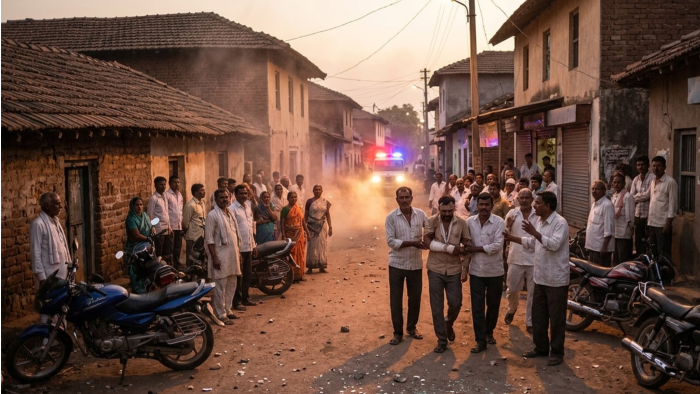
Case Summary
A Hindu youth in Karanur village, Kolhapur district, Maharashtra, became the target of violence by a mob of Muslim men after sharing a religious message regarding Chhatrapati Sambhaji Maharaj in a WhatsApp group. The young man circulated a shloka (a category of Sanskrit verse) praising the Maratha ruler, who is deeply revered in Maharashtra for his defiant resistance against Mughal tyranny. The message provoked a wave of anger among members of the local Muslim community, leading to a violent confrontation directed at the youth and other Hindu individuals present in the vicinity. The situation rapidly escalated into mob violence, during which Hindu villagers faced physical assault, and the surrounding property was damaged as unrest gripped the village. The incident unfolded on 12 March 2026 in Karanur, located within the Kagal Taluka (an administrative sub-division) of Kolhapur district. The youth had posted the tribute in a community WhatsApp group that included residents from various backgrounds. This message triggered immediate hostility from several Muslim individuals in the group, who soon confronted him in person. The dispute over the digital message turned physical as a mob gathered and began attacking the young man, transforming a private disagreement into a broader communal clash involving numerous people in the area. As tensions peaked, the violence spread through the locality. Muslim men threw stones and bricks, resulting in significant damage to several vehicles, including motorbikes and cars parked nearby. Hindu residents were caught in the crossfire as the mob attack intensified. The stone-pelting created a sense of panic across the neighbourhood and led to multiple injuries among those caught in the fray, while homes and property in the surrounding area suffered damage during the chaos. Police personnel arrived at the scene shortly after the violence erupted and intervened to separate the warring groups. Additional forces were deployed to Karanur village to seize control of the situation and prevent a further escalation of communal friction. Several people sustained injuries during the rioting and stone-pelting, including police officers who were hurt while attempting to disperse the crowd and restore order. Authorities maintained a heavy security presence in the area following the incident to discourage further disturbances and to stabilise the village.
Why it is Hate Crime ?
The primary category for this case is "Attack not resulting in death". The sub-category for this case is "Attacked for Hindu identity". In several cases, Hindus are attacked merely for their Hindu identity without any perceived provocation. A classic example of this category of religiously motivated hate crime is a murder in 2016. 7 ISIS terrorists were convicted for shooting a school principal in Kanpur because they got ‘triggered’ seeing the Kalava on his wrist and tilak that he had put. In this, the Hindu victim had offered no provocation except for his Hindu religious identity. The motivation for the murder was purely religious, driven by religious supremacy. Such cases where Hindus are targeted merely for their religious identity would be documented as a hate crime under this category. Another sub-category this case qualifies for is "Communal clash/attack". Communal clash is a form of collective violence that involves clashes between groups belonging to different religious identities. For a communal clash between Hindus and non-Hindus to qualify as a religiously motivated hate crime, the trigger of the violence itself would have to be anti-Hindu in essence. For example, if there is a Hindu religious procession that comes under attack from a non-Hindu mob and after the initial attack, Hindus retaliate in self-defence, leading to a communal clash between the two religious communities. While at a later stage, both communities are involved in the clash/violence, the initial trigger of the violence was by the non-Hindu mob against the Hindus and therefore, it could safely be termed as an anti-Hindu violence. Further, the trigger would also have to be religiously motivated. In the cited example, the attack by the non-Hindu mob was against religious processions and therefore, can be concluded to be religiously motivated. In some cases, the trigger may be non-religious, however, it develops into religious violence against Hindus at a later stage. In such cases too, the foundational animosity towards Hindus becomes the motivating factor of the crime and therefore, it would be classified as a religiously motivated hate crime against Hindus under this category. This case qualifies as a religiously motivated hate crime because the violence was triggered by the expression of Hindu historical reverence associated with Chhatrapati Sambhaji Maharaj. The Hindu youth shared a devotional message praising Sambhaji Maharaj, a figure deeply embedded in the religious and cultural memory of Hindus in Maharashtra. Sambhaji Maharaj, the son of Chhatrapati Shivaji Maharaj, is remembered for his resistance to Mughal imperial expansion and for refusing to abandon his faith despite severe persecution by the Mughal tyrants. His legacy has therefore come to symbolise steadfast commitment to Hindu identity and resistance to religious domination. In this context, expressions of reverence toward Sambhaji Maharaj function not only as historical remembrance but also as a marker of Hindu civilisational pride. The reaction to the message must also be understood within the broader ideological conflict surrounding historical narratives of Mughal rule. For many Hindus, figures such as Sambhaji Maharaj represent resistance against the religious persecution and imperial ambitions of the Mughal Empire. However, for some Islamist groups or individuals who view Mughal rulers as part of a broader legacy of Islamic political power in the subcontinent, glorification of figures who fought against that authority can be interpreted as a challenge to that legacy. Within this ideological framework, praise for historical resistance figures may be perceived not simply as historical commemoration but as criticism of Islamic rule, which can provoke hostility among individuals who strongly identify with that historical narrative. This dynamic is further influenced by the concept of the Ummah, the idea of a global community of believers that transcends national and ethnic boundaries. Within certain interpretations of this concept, historical events involving Muslim rulers or empires may be viewed through the lens of collective religious identity rather than regional history. As a result, narratives that celebrate resistance to Islamic rule can be interpreted by some individuals as affronts to a shared religious heritage. This perspective can intensify reactions to historical figures such as Sambhaji Maharaj, particularly when they are presented as symbols of defiance against Islamic authority. The violent reaction to the devotional message, therefore, reflects more than a spontaneous disagreement over a digital post. The hostility directed at the Hindu youth indicates that the expression of reverence for a Hindu historical figure associated with resistance to Mughal rule was interpreted as a provocation within a communal framework shaped by competing historical memories and religious identities. The subsequent attack on the youth and the escalation into mob violence demonstrate how ideological sensitivities tied to historical narratives can translate into physical hostility toward individuals expressing those narratives. The broader impact of such incidents extends beyond the immediate victims. When violence occurs in response to the expression of Hindu historical reverence, it creates a climate in which members of the community may fear expressing aspects of their cultural or religious identity. This can have a chilling effect on the open discussion of historical memory and religious heritage, particularly in regions where communal tensions already exist. Given that the violence was triggered by the expression of reverence toward a Hindu historical figure associated with resistance to Mughal rule, and that the attack targeted individuals expressing this religious and cultural identity, the incident demonstrates hostility directed toward Hindu identity and historical memory. Given that this case meets the parameters of a religiously motivated hate crime, it is being added to the hate crime database of the Hinduphobia tracker. Disclaimer: The victim count has been recorded as 1 because the primary target of the violence was the Hindu youth who shared the message. Although the confrontation later escalated into broader unrest that caused injuries and property damage in the locality, available reports identify only the youth as the direct victims targeted due to the expression of Hindu religious and historical reverence. Therefore, for the purposes of classification in the tracker, the victim count has been kept as 1.
Victim Details
Total Victim
1
Deceased
0
Gender
- Male 1
- Female 0
- Third Gender 0
- Unknown 0
Caste
- SC/ST 0
- OBC 0
- General 0
- Unknown 1
Age Group
- Minor 0
- Adult 1
- Senior Citizen 0
- Unknown 0


Case Status
Unknown


Perpetrators Details
Perpetrators
Muslim Extremists
Perpetrators Range
Unknown
Perpetrators Gender
unknown
 Sources




