Sacred 300 year old Hindu temple renovation obstructed by Muslims despite Madras High Courts order in Madurai, Tamil Nadu
 Madurai, Tamil Nadu, India
  13 March, 2026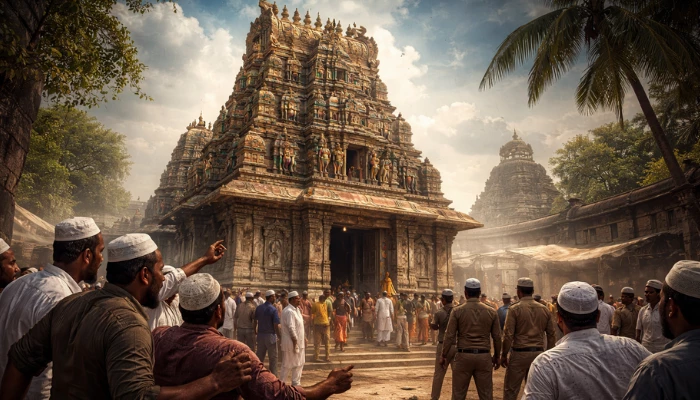
Case Summary
In the Thummanayakkanpatti village of Madurai, Tamil Nadu, a 300-year-old Hindu temple was obstructed from being renovated by Muslims, despite the renovation receiving approval from the Madras High Court. The opposition created tension in the locality as temple authorities attempted to proceed with restoration work at the historic shrine. The temple in question is the Vinayagar and Karuppannasamy Temple located in Thummanayakkanpatti village in Peraiyur taluk of Madurai district. The temple is around three centuries old and is spread across approximately 2 acres and 40 cents of land. It is managed by hereditary trustees and falls under the supervision of the Hindu Religious and Charitable Endowments (HR&CE) Department. Temple authorities had obtained the required approvals from the relevant state and district expert committees to carry out renovation works at the temple. However, Sakul Hameed, a local Muslim man, filed a petition before the Madurai Bench of the Madras High Court opposing the renovation of the temple. In January 2026, the Madras High Court permitted the renovation of the temple to proceed. Following the order, another petition was filed seeking police protection to ensure that the renovation work and the planned kumbabhishekam ceremony could take place without obstruction. The High Court also directed the police to protect the temple authorities and workers during renovation. After the court’s direction, the temple’s hereditary trustee, Maheswaran and several villagers submitted a petition to the Madurai Superintendent of Police requesting security until the completion of the renovation and the kumbabhishekam ceremony. Residents stated that a mosque had been constructed near the temple nearly a century ago. When temple authorities began taking steps to implement the High Court’s order and start renovation work, groups of local Muslims entered the temple premises and staged protests. They opposed the renovation and demanded that the temple be relocated to another location instead of being restored at its original site. Furthermore, they recounted that the Muslim settlement had begun with a small number of Muslim families, which later expanded significantly, leading to disputes over land ownership and usage. Residents further stated that access to traditional pathways used for temple processions, including routes for Vinayagar idol immersion, had been obstructed, and that restrictions had been imposed on conducting religious activities in areas considered part of temple land. They maintained that all necessary permissions for renovation had been obtained from authorities and the court, yet attempts to begin reconstruction had been repeatedly halted, with temporary structures dismantled. Police officials attempted to persuade the protesters not to obstruct the court-approved renovation work. Despite the intervention of the police and the existence of a High Court order permitting the renovation, the opposition from the Muslim group stalled the restoration work and created tension in the village. The situation caused concern among the temple authorities and Hindu residents of the area, who repeatedly appealed to the administration to enforce the High Court’s order and ensure that the renovation of the historic temple and the associated religious ceremonies could proceed without obstruction.
Why it is Hate Crime ?
The primary category selected is: 'Attack on Hindu religious representations'. Under this, the sub-category selected is 'Attack on temples'. In Hinduism, a temple is the abode of the Deity. The Deity in the Temple is consecrated, thereby making it a real, breathing entity. Hindus believe that not just the Deity but the temple premises itself are sacred to Hindus since Hindus hold the faith that the entire Temple space is an amalgamation of the divine energy of the deity. Given the central significance of Temples in Hindu Dharma, any attack against a Hindu Temple or its peripheral premises is an attack on the faith itself and is born out of animosity towards the faith, of which the Temple is a central tenet. Any manner of attack against a Temple and/or its premises would therefore be considered a religiously motivated hate crime. The other sub-category selected is 'Encroachment or illicit takeover of temple land/land near temple'. In Hinduism, a temple is the abode of the Deity. The Deity in the Temple is consecrated, thereby making it a real, breathing entity. Hindus believe that not just the Deity but the temple premises itself are sacred to Hindus since Hindus hold the faith that the entire Temple space is an amalgamation of the divine energy of the deity. Not only the Temple but the Temple premises in its entirety are considered sacred by Hindus. In several cases, the premises of the Temple and/or religious centre are illicitly taken over by institutions belonging to other faiths, like the Waqf board or the Church. Other times, the temple property, land or the property of religious centres are illicitly encroached upon by non-Hindu groups. Any illicit takeover or encroachment is a crime an initio; however, when non-Hindu groups illicitly take over or encroach on the sacred land of Hindus, it is an affront to the Hindu community and is therefore classified as a religiously motivated hate crime under this category. The second primary category selected here is - Restriction/ban on Hindu practices. Within it, the sub-category selected is - Restriction on expression of Hindu identity. An example of the state-affected prejudicial and targeted orders against the Hindu community would be a government denying the right of a Hindu or a group of Hindus to hold a religious procession owing to the animosity of non-Hindu groups. Denial of the religious right of the Hindus to assuage the non-Hindu group which harbours animosity to a point where it could lead to violence against Hindus is not only a failure of law and order but is a prejudicial order against Hindus, denying them their fundamental rights to express their religious identity. An example of a hate crime against Hindus by a non-Hindu would be a non-Hindu institution forcing its Hindu employees to abandon religious symbols that a Hindu would wear as an expression of faith owing to inherent prejudice against the faith professed by the victim or a non-Hindu group of people restricting a Hindu group from constructing a place of worship simply because the demography of the area in which the temple is being built is dominated by non-Hindus. Such actions are driven by religious animosity and/or prejudice against Hindus and their faith and would therefore be categorized as a hate crime. This case was recorded because the obstruction targeted a 300-year-old Hindu temple, a historic place of worship that had existed in the village for generations. A temple of such antiquity is not merely a structure but a centre of spiritual continuity where generations of devotees have practised their faith, conducted rituals, and preserved their religious traditions. The attempt to obstruct the renovation of such a shrine raised serious concerns about interference with the Hindu community’s right to maintain and practise their religion at their own sacred site. When opposition emerges against the preservation of a centuries-old temple, it reflects hostility not only towards the structure but towards the religious identity and heritage it represents. The Vinayagar and Karuppannasamy Temple holds religious and cultural significance for the local Hindu population. Temples dedicated to Lord Vinayagar (Ganesha) and Karuppannasamy hold an important place in Tamil Hindu traditions, serving as centres for communal worship, festivals, and ritual observances that structure the village's religious life. Renovation of such temples is a common and necessary practice in Hindu tradition, undertaken periodically to preserve the shrine's sanctity and prepare it for rituals such as Kumbabhishekam, a consecration ceremony that renews the temple's spiritual energy. Preventing renovation, therefore, amounts to obstructing the continuation of established religious practices and the preservation of a sacred space that has served the community for centuries. The obstruction was particularly serious because the renovation had already received legal approval from the Madras High Court, which had permitted the restoration work and directed the authorities to provide police protection so that the renovation and the associated religious ceremonies could proceed without interference. Despite this clear judicial directive, groups of Muslims entered the temple premises and opposed the work. By occupying the temple premises and preventing renovation despite a lawful court order, the protesters effectively interfered with temple property and obstructed its lawful use. Preventing restoration under such circumstances amounts not only to interference with religious practice but also to encroachment upon temple land and unlawful trespass, since the court had authorised the renovation and the protesters had no legal authority to obstruct activities taking place within the temple property. An additional and deeply concerning dimension of the incident was the obstruction of long-standing temple processions, including the traditional routes used for carrying idols during important religious observances such as Vinayagar immersion and other ritual events associated with the temple. These processions are not incidental activities but form a core component of Hindu religious practice, symbolising the public expression of faith and the collective participation of the community in sacred traditions that have been followed for generations. By preventing devotees from carrying out these processions along customary routes, the obstruction extended beyond the physical temple structure and into the broader religious life of the community. Such interference effectively curtailed the community’s ability to perform essential religious rites in their entirety, as temple worship in Hinduism is intrinsically linked with processional practices, festivals, and public rituals. The denial of access to these routes not only disrupted specific events but also created a climate in which Hindus were unable to freely express and practise their faith in public spaces. The targeted nature of this obstruction, directed specifically at Hindu religious processions underscored that the restriction was not merely administrative or incidental but was rooted in religious animosity towards Hindu practices. In effect, preventing such processions represented a deliberate attempt to suppress visible expressions of Hindu faith, further reinforcing the pattern of interference with the community’s religious rights and traditions. Another concerning aspect was the manner in which the obstruction unfolded even after the High Court’s direction. Instead of the court order being firmly implemented to ensure the renovation proceeded, the situation devolved into the police attempting to persuade the protesting group rather than decisively enforcing the directive. This created the impression that a group could openly challenge a lawful order of the court and still prevent Hindus from exercising their religious rights. Such circumstances reinforced a sense among Hindu residents that their ability to maintain and restore their places of worship could be curtailed through intimidation and pressure. Taken together, the obstruction of a centuries-old temple, the challenge to a court-approved renovation, and the continued interference despite legal protection highlighted a pattern where the Hindu community’s religious rights were directly targeted. For these reasons, the incident was recorded as a hate crime reflecting hostility towards the Hindu community and its right to preserve and practise its faith.


Case Status
Unknown


Perpetrators Details
Perpetrators
Muslim Extremists
Perpetrators Range
Unknown
Perpetrators Gender
both
 Sources




