Hindu families targeted, stone-pelted and houses vandalised over petty ball accident by Muslim mob in Gaya, Bihar
 Gaya, Bihar, India
  4 March, 2026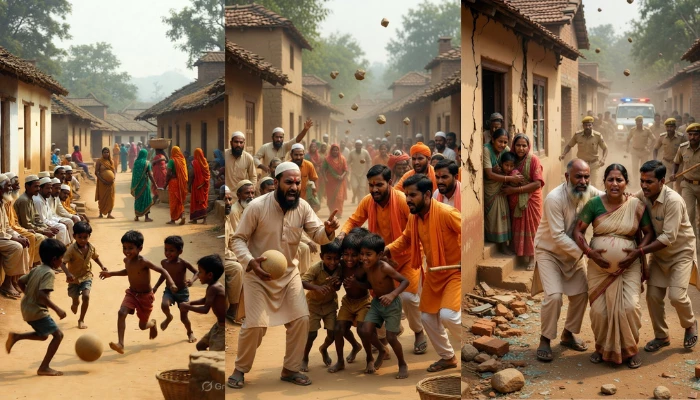
Case Summary
In Gaya, Bihar, Hindus were stoned, and houses were vandalised by Muslim men over a minor issue. Multiple Hindus, including a pregnant woman, were injured during the stone pelting. The incident began when Hindu children were playing in the locality, and a ball accidentally touched a Muslim man passing through the area. The man objected to the incident and raised a dispute, which quickly escalated into a confrontation in the neighbourhood. Soon after the altercation, several Muslim men gathered in the area and began pelting stones at Hindu residents and their houses. The stone pelting created panic in the locality as families rushed indoors while stones were thrown across the neighbourhood, and property was vandalised. During the attack, multiple Hindu residents sustained injuries. Among those injured were 21-year-old pregnant Lalita Devi, who suffered serious injuries after being struck by stones, 60-year-old Sindhu Devi, and Vinod Sao, who were also injured during the stone pelting. Upon receiving information about the violence, the Belaganj police team immediately reached the spot and brought the situation under control. The injured were admitted to the Belaganj Community Health Centre for treatment. After primary medical care, doctors referred Sindhu Devi to a hospital in Gaya for further treatment due to the seriousness of her condition. Residents of the village stated that the dispute did not erupt suddenly and that tensions had been building for several days. Around a week earlier, during an Akhand Kirtan in the village, members of the Muslim community had stopped Hindus from taking the ritual Kalash procession through the village. Since that incident, tensions had persisted between the two sides. The earlier dispute resurfaced when the argument over the children’s game broke out and escalated into violence. Belaganj Station House Officer Manoj Kumar Pandey stated that the police reached the location immediately after receiving information and brought the situation under control. He said that the injured were sent to the hospital for treatment and that efforts were underway to identify the anti-social elements involved in the incident. Police also stated that strict action would be taken against anyone attempting to disturb the peace. Following the clash, police presence in the village was increased, and authorities continued to monitor the situation closely.
Why it is Hate Crime ?
This case is being added to the tracker under the primary category "Attack not resulting in death". The subcategory selected under it is "Communal Clash/Attack". Communal clash is a form of collective violence that involves clashes between groups belonging to different religious identities. For a communal clash between Hindus and non-Hindus to qualify as a religiously motivated hate crime, the trigger of the violence itself would have to be anti-Hindu in essence. For example, if there is a Hindu religious procession that comes under attack from a non-Hindu mob and after the initial attack, Hindus retaliate in self-defence, leading to a communal clash between the two religious communities. While at a later stage, both communities are involved in the clash/violence, the initial trigger of the violence was by the non-Hindu mob against the Hindus, and therefore, it could safely be termed as an anti-Hindu violence. Further, the trigger would also have to be religiously motivated. In the cited example, the attack by the non-Hindu mob was against religious processions and therefore can be concluded to be religiously motivated. In some cases, the trigger may be non-religious; however, it develops into religious violence against Hindus at a later stage. In such cases, too, the foundational animosity towards Hindus becomes the motivating factor of the crime, and therefore, it would be classified as a religiously motivated hate crime against Hindus under this category. The other sub-category selected is “Attacked for Hindu identity.” In several cases, Hindus are attacked merely for their Hindu identity without any perceived provocation. A classic example of this category of religiously motivated hate crime is a murder in 2016. 7 ISIS terrorists were convicted for shooting a school principal in Kanpur because they got ‘triggered’ seeing the Kalava on his wrist and the tilak that he had put. In this, the Hindu victim had offered no provocation except for his Hindu religious identity. The motivation for the murder was purely religious, driven by religious supremacy. Such cases where Hindus are targeted merely for their religious identity would be documented as a hate crime under this category. This case was recorded because a trivial and accidental act during a children’s game escalated into organised violence directed at Hindu residents. The trigger point was a ball accidentally touching a man during play. In no civil setting could such an incident reasonably be considered a trigger for violence. Yet the Muslim man became agitated, and the situation escalated into collective aggression directed at Hindu homes and residents. The scale and nature of the retaliation demonstrated that the violence was grossly disproportionate to the initial trigger and indicated that the response was not a spontaneous reaction but an organised act of hostility. The violence that followed was not limited to those involved in the initial disagreement but was directed broadly at Hindu residents in the locality. Stones were thrown at homes and individuals, and multiple members of the Hindu community were injured. Among those harmed was a pregnant Hindu woman, which underscored the reckless nature of the attack and the absence of restraint in the use of violence. The fact that aggression could erupt even in the presence of children who were merely playing in the neighbourhood illustrated how deeply hostility had taken root. When such violence is triggered in a setting where minor children are present, and uninvolved individuals become victims, it reflects the extent to which communal animosity overrides ordinary social boundaries. The assertion of power by the Muslim group was not a one-time occurrence. The area had witnessed similar incidents earlier, reflecting a pattern of hostility towards Hindu religious practices. Just days before the violence, Muslims in the village had stopped Hindus from taking out the Kalash associated with an Akhand Kirtan through the village. An Akhand Kirtan holds deep religious significance in Hindu tradition, where devotional chanting continues uninterrupted for long durations as an expression of collective faith and spiritual devotion. Preventing the movement of the Kalash during such a sacred observance was therefore not a minor disagreement but an act that interfered with the community’s ability to practise its religion. Such repeated obstruction created an atmosphere of intimidation in which Hindus were made to feel that their religious practices could be restricted at will. This history of intolerance in the locality helped create the conditions in which even a trivial incident could trigger a disproportionate reaction. The mobilisation of a mob over a minor accident involving a ball reflected how deeply entrenched this hostility had become, allowing a routine occurrence to escalate into organised violence against Hindu residents. The incident instilled fear among the Hindu residents of the village and reinforced the perception that they were not free to practise their religion without intimidation. When a routine and harmless act involving children playing in their own neighbourhood escalated into organised violence, it sent a chilling message to the community. The attack created a deeper sense of insecurity among Hindus living in the locality, suggesting that even ordinary daily activities in a shared space with Muslims could provoke hostility. Such an atmosphere discouraged open religious expression and everyday social life, leaving Hindus feeling vulnerable within their own neighbourhood. For these reasons, the case was recorded as a hate crime reflecting hostility directed towards the Hindu community.
Victim Details
Total Victim
3
Deceased
0
Gender
- Male 1
- Female 2
- Third Gender 0
- Unknown 0
Caste
- SC/ST 0
- OBC 0
- General 0
- Unknown 3
Age Group
- Minor 0
- Adult 0
- Senior Citizen 0
- Unknown 3


Case Status
Complaint filed


Perpetrators Details
Perpetrators
Muslim Extremists
Perpetrators Range
Unknown
Perpetrators Gender
male
 Sources




