Hindu family brutally attacked and threatened with death by Muslims over playing Hanuman Chalisa on loudspeakers
 Ghaziabad, Uttar Pradesh, India
  9 March, 2026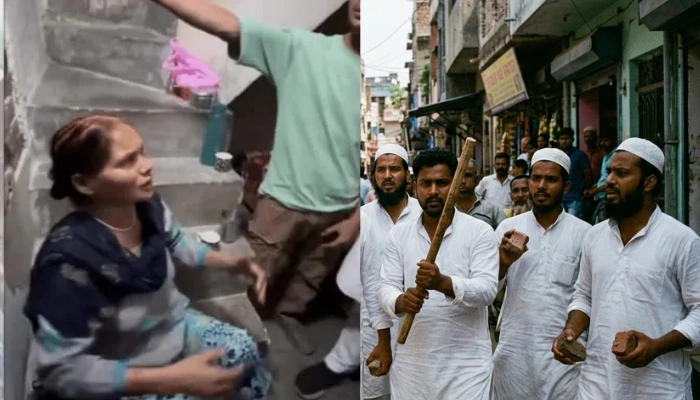
Case Summary
In Ghaziabad, Uttar Pradesh, a Hindu family suffered a brutal attack by Muslim men over playing Hanuman Chalisa on a loudspeaker. The crime occurred on 10 March 2026. The incident took place in the Nandgram locality, where Hindu residents said tensions escalated between the Hindu family and the Muslim neighbours over a disagreement regarding the playing of devotional music through loudspeakers. Videos circulating on social media showed injured family members describing the attack and raising concerns about their safety. In one of the videos, Pooja, a resident of Nandgram, stated that the confrontation began when a neighbouring Muslim family objected to the use of loudspeakers to play the Hanuman Chalisa. According to her, the argument soon escalated into a physical attack. The Muslim perpetrators also struck Pooja's daughter with a hammer. She came home to celebrate Holi and take care of her ailing father. The Hindu family stated the accused first targeted Pooja's husband when he stepped out of the house to buy juice from a nearby shop. They stated that the attackers later entered the house and assaulted other members of the family, threatening them during the incident. The case sparked strong reactions on social media, with several users demanding strict action from the government led by Yogi Adityanath and local authorities. Confirming the incident, Nandgram Station House Officer (SHO) Umesh Kumar said the dispute was linked to loud music and a First Information Report had been registered. “The dispute related to playing music on loudspeakers. A First Information Report was registered for assault and forcefully entering the house. All three accused are in custody, and the investigating officer examined the case,” Kumar said. Another Hindu victim, Ritwik, stated, "We now plan to sell our house because they threatened to kill me. When the police release them, they say they will return and kill us. The police provided us no protection." A video of the incident that went viral on social media also showed a Hindu youth stating, "Muslim men beat my father badly, and they said Hindus cannot live in this area."
Why it is Hate Crime ?
This case has been added under the primary category- Attack not resulting in death. The subcategory selected is- Attacked for Hindu identity. In several cases, Hindus are attacked merely for their Hindu identity without any perceived provocation. A classic example of this category of religiously motivated hate crime is a murder in 2016. 7 ISIS terrorists were convicted for shooting a school principal in Kanpur because they got ‘triggered’ seeing the Kalava on his wrist and tilak that he had put. In this, the Hindu victim had offered no provocation except for his Hindu religious identity. The motivation for the murder was purely religious, driven by religious supremacy. Such cases where Hindus are targeted merely for their religious identity would be documented as a hate crime under this category. The other primary category selected is- Hate Speech against Hindus. The subcategory selected is- Violent Threats. Violent threats, explicit, implicit or implied, is the most dangerous form of hate speech since it goes beyond discriminatory and prejudicial language to express the intent of causing harm to an individual or a group of people based on their religious identity and faith. There could be several different kinds of threats that are issued to Hindus based on religious animosity. An explicit threat would mean the direct threat of violence towards an individual Hindu, a group of Hindus or Hindus at large. Physical violence, death threats, threats of destruction of property belonging to Hindus and threats of genocide would mean explicit threats against Hindus for their religious identity. Implicit threats may not be a direct threat but implied through the use of symbols of actions – for example – in the Nupur Sharma case, other than explicit threats, there were also implicit threats when Islamists took to the streets to burn and beat her effigies. It implies that they want to do the same to Nupur Sharma – thereby is considered an implicit threat. Violent threats can be delivered in person, through letters, phone calls, graffiti, or increasingly through social media and other online platforms. It would be important to understand that a threat – explicit or implicit, online or offline – to an individual who happens to be a Hindu does not qualify as a religiously motivated threat. Such a threat, while vile and dangerous, could be owing to non-religious reasons and/or personal animosity. To qualify as a religiously motivated threat, it would need to exhibit an indication that the individual is being targeted for religious reasons and/or owing to his/her religious identity as a Hindu. This case stands as a stark example of a religiously motivated hate crime, where a Hindu family in Ghaziabad endured brutal assault and death threats from Muslim men simply for playing Hanuman Chalisa on loudspeakers. The violence erupted not from mere noise but from the perpetrators' rejection of the family's open expression of Hindu devotion. This targeted attack on innocent Hindus for practising their faith transforms a domestic dispute into undeniable religious persecution, marking it unequivocally as a hate crime fuelled by bigotry. Hanuman Chalisa holds profound significance in Hinduism as a sacred hymn honouring Lord Hanuman, symbolising strength, devotion, and protection against evil. Hindu families recite it daily for spiritual solace, especially during festivals like Holi. Here, the family played it on loudspeakers, a common devotional practice, yet faced savage retaliation. Had the Muslim neighbours objected solely to noise, they could have politely asked to lower the volume or pursued legal recourse through the police or courts. Instead, they chose unprovoked brutality, invading the home and beating family members, including a young woman with a hammer. This disproportionate response exposes their true motive: to punish and intimidate Hindus for their religious identity, not for disturbance. Attacking a family for playing Hanuman Chalisa reveals raw bigotry against Hindu faith practices, elevating the incident to a clear religiously motivated hate crime and signalling peril for the Hindu community. The perpetrators' savagery underscores premeditated malice, not impulsive rage. They first ambushed the father as he stepped out innocently to buy juice, pummelling him mercilessly. Emboldened, the armed Muslim men, wielding hammers and other weapons, stormed the house, assaulting the entire family, including vulnerable women and the elderly ailing father. The daughter's hammer blow exemplifies their intent to maim for life. Arming themselves in advance proves this was no spontaneous scuffle but calculated violence, planned to terrorise Hindus and assert religious dominance. Such ferocity against a peaceful family devotedly playing Hanuman Chalisa lays bare deep-seated animosity towards the Hindu community. The Muslim perpetrators escalated their hatred with explicit threats declaring "Hindus cannot live in this area," vowing murder upon release from custody. These chilling words amount to ethnic cleansing rhetoric, aiming to expel Hindus through fear and force from their own neighbourhood. By framing the family as unwelcome intruders unfit to exist alongside Muslims, the threats reveal Islamic supremacist ideology that tolerates no Hindu presence. This overt communal posturing cements the religious motive, transforming physical assault into psychological warfare designed to uproot Hindu lives and instil communal terror. Given that this case fulfils all parameters of a hate crime, it has been added to the hate crime database of the Hinduphobia Tracker. Disclaimer: The Hinduphobia Tracker records five victims in this case: Pooja, Pooja's daughter, Pooja's husband, the Hindu youth who shared the video, and his father. The victim count is therefore set at 5.
Victim Details
Total Victim
5
Deceased
0
Gender
- Male 3
- Female 2
- Third Gender 0
- Unknown 0
Caste
- SC/ST 0
- OBC 0
- General 0
- Unknown 5
Age Group
- Minor 0
- Adult 4
- Senior Citizen 0
- Unknown 1


Case Status
Arrested


Perpetrators Details
Perpetrators
Muslim Extremists
Perpetrators Range
From 2 To 5
Perpetrators Gender
male
 Sources




