Hindu temples broken in, shrines vandalised, gold ornaments looted and donations stolen in Satkhira, Bangladesh
 Satkhira District, Bangladesh
  12 March, 2026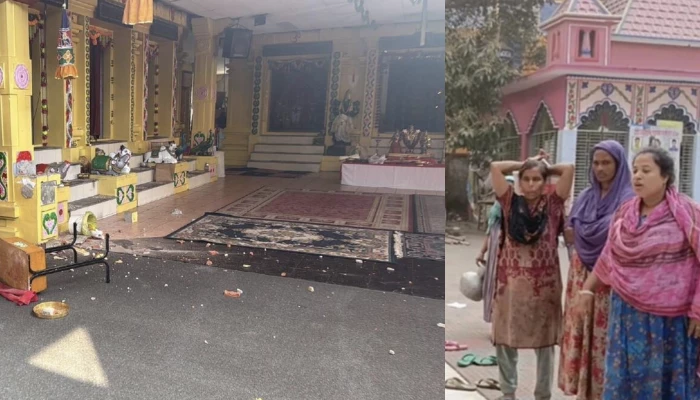
Case Summary
In Bangladesh, Hindu temples were broken into, idols desecrated, and lakhs of donations looted in Satkhira. It triggered an alarm among the local Hindu minority community. The incident occurred late at night at the central temple complex locally known as “Mayer Bari” in Satkhira town. According to temple authorities, the perpetrators broke the locks of several temples within the compound and entered the premises during the night. The attackers forced their way into multiple shrines located within the complex, including the Kali Temple, Annapurna Temple, Radha-Gobinda Temple, and Jagannath Temple, and looted valuables from the premises. Nityananda Amin, General Secretary of the Satkhira District Temple Association, described how the crime unfolded. He stated, “They broke the locks and entered the temples. The attackers removed gold ornaments from the idols and broke open donation boxes to take the cash.” Temple authorities said the stolen items included two pairs of gold bangles weighing around four bhori, two pairs of gold shankha weighing about one bhori, a pair of gold earrings, a gold chain, a nose ring, and nearly five bhori of silver ornaments. Cash kept in donation boxes was also stolen. The total value of the stolen valuables was estimated at more than 1.8 million Bangladeshi taka (over 18 lakh). Members of the temple committee and the local Hindu community expressed concern over the incident. Deepa Sindhu Torofdar, an executive member of the temple committee, stated that another temple in the city’s Katia area had also been robbed two days earlier, raising fears among the minority Hindu community. Temple official Asim Das Sona said that CCTV cameras installed on the temple premises had captured several clues which could help identify those responsible for the break-in. Meanwhile, resident Chandan Chowdhury stated that the crime might be part of a broader organised network targeting Hindu religious sites in the region. The repeated targeting of temples and the theft of ornaments from idols created anxiety among the Hindu minority community in Satkhira, with community members demanding that authorities identify the perpetrators and strengthen protection for Hindu places of worship. This attack comes at a time when Hindus are facing a fresh wave of attacks in Bangladesh following the 13th National Parliamentary Election 2026 in Bangladesh, reinforcing a recurring pattern of post-poll violence targeting Hindu minorities. Within days of the announcement of results, Hindu families in districts such as Noakhali, Rangpur, Nilphamari, Sylhet, Thakurgaon, and Dinajpur reported coordinated attacks involving arson, looting, assault, and vandalism of temples and homes. In several instances, Hindu homes were selectively targeted, looted, and families were threatened with displacement. This escalation of violence against Hindus in Bangladesh unfolded in three distinct phases: first, following the ouster of Sheikh Hasina’s government in August 2024; second, after the death of Sharif Osman Bin Hadi in December 2025; and third, in the immediate aftermath of the 13th National Parliamentary Election 2026. This electoral violence unfolded against the broader backdrop of sustained anti-Hindu hostility that had persisted since the ouster of the Sheikh Hasina government in August 2024. During that period, multiple reports documented attacks on Hindu homes, temples, and religious institutions, alongside intimidation campaigns, arson, and mob assaults targeting minority neighbourhoods. The Hinduphobia tracker has recorded 336 such incidents against the Hindu minority, underscoring the scale and persistence of anti-Hindu violence during this period. A further escalation occurred following the death of Sharif Osman Bin Hadi, a Muslim political activist and student leader known for his anti-Hindu and anti-India rhetoric. Hadi had been involved in political unrest after the fall of the Hasina government and was killed in Dhaka on 18 December 2025 during clashes. In the aftermath of his death, Hindu communities were blamed and subsequently targeted in retaliatory violence. Hindu homes were selectively set ablaze in multiple localities, forcing families to flee and leaving many displaced. The attacks appeared patterned rather than sporadic, with Muslim mobs focusing on Hindu neighbourhoods, properties, and religious symbols. Among the victims was Dipu Chandra Das, who was lynched to death and his body was set ablaze by a Muslim mob over false blasphemy allegations. The Hinduphobia tracker documented 51 incidents of anti-Hindu violence in the period following Hadi’s death alone. Such incidents underscore the vulnerability of the Hindu minority amid rising communal hostility and the weaponisation of religious accusations. Reports further indicated that posters and written materials calling for the extermination of Hindus were displayed in public spaces, signalling an alarming normalisation of genocidal rhetoric. When combined with acts of arson, vandalism, assault, and targeted intimidation, these developments suggest a coordinated environment of hostility aimed at terrorising the Hindu community and reinforcing majoritarian dominance.
Why it is Hate Crime ?
This case has been added to the tracker under the primary category of - Attack on Hindu religious representations. Within it, the sub-category selected is- Attack on Temples. In Hinduism, a temple is the abode of the Deity. The Deity in the Temple is consecrated, thereby making it a real, breathing entity. Hindus believe that not just the Deity but the temple premises itself are sacred to Hindus since Hindus hold the faith that the entire Temple space is an amalgamation of the divine energy of the deity. Given the central significance of Temples in Hindu Dharma, any attack against a Hindu Temple or its peripheral premises is an attack on the faith itself and is born out of animosity towards the faith, of which the Temple is a central tenet. Any manner of attack against a Temple and/or its premises would therefore be considered a religiously motivated hate crime. The other sub-category selected is - Defiling religious customs. Sanatan Dharma is not a religion of one book, which is to say that while it has religious scriptures that form the central tenets of the faith, there are several traditions followed through thousands of years, mostly passed from generation to generation orally. There are several such customs and traditions that are followed by various Hindus and Hindu sects. Defiling of these traditions and customs is a breach of an individual or group’s religious practices. Such practices can range from dietary restrictions like not eating non-vegetarian food for a certain period of the year, not eating non-vegetarian food at all, not eating beef since the cow is considered holy in Hinduism, the sanctity of religious customs followed in the house (like many ISCKON devotees), etc. Any malicious action leading to the breach of such traditions or defilement of these traditions owing to animosity towards the faith or for the sake of activism stems not only from the lack of faith in the religion itself but also from disregard for the faith of the devotees who follow the customs/traditions and implicit bias against the faith, the tradition itself. Since these specific traditions are central to the faith of the devotees of that specific sect of Hindus, any non-compliance with these traditional rules would be considered a religiously motivated hate crime. This case constituted a religiously motivated hate crime because the target of the crime was a Hindu temple belonging to a vulnerable religious minority community in Bangladesh. Hindu temples are central institutions of faith where devotees gather to worship, offer prayers, and maintain religious traditions. When such spaces are deliberately broken into and violated, the act extends beyond ordinary criminal activity and strikes at the religious identity and sacred institutions of the Hindu community. For Hindus, idols installed within temples are consecrated representations of the divine and are treated with deep reverence. Acts that involve interfering with these sacred objects represent a violation of the sanctity of the temple itself. When criminals enter a temple and remove ornaments that have been offered to the deities by devotees, the act symbolically intrudes upon a space considered holy and inviolable within the Hindu faith. Such actions, therefore, carry a deeper religious significance, as they undermine the dignity and sanctity associated with Hindu places of worship. The impact of such crimes is particularly severe in countries where Hindus constitute a small minority. In Bangladesh, the Hindu community has historically faced episodes of violence, intimidation, and attacks on their religious institutions. Within such a context, incidents targeting temples generate fear that extends beyond the immediate crime, reinforcing the insecurity experienced by minority Hindus while practising their faith and maintaining their religious spaces. This incident also occurred in a broader environment where violence against Hindus has repeatedly been reported in Bangladesh. Following the death of Hadi, several incidents were documented in which Hindus were attacked, killed, and their homes and temples were targeted across different areas. When crimes against Hindu religious institutions take place within such a context of ongoing hostility, they cannot be viewed as isolated criminal acts but instead form part of a continuing pattern of violence directed at the Hindu minority. Taken together, the violation of a Hindu temple and the broader pattern of violence against Hindus in the country demonstrate that the act carried communal and religious implications. As the incident involved the targeting of a Hindu place of worship within an environment where Hindus have faced repeated hostility, it met the parameters of a religiously motivated hate crime and was therefore recorded in the Hinduphobia Tracker database. In this case, although the miscreants were unknown, the action stemmed from hatred against Hinduism and resulted in the disruption of the puja ceremony. Therefore, this case is being categorised under the hate crime database of the Hinduphobia Tracker.


Case Status
Complaint filed


Perpetrators Details
Perpetrators
Unknown
Perpetrators Range
From 2 To 5
Perpetrators Gender
male
 Sources




