Hindu adivasi woman targeted through forced marriage and conversion for illegal land acquisition by Muslim man in Sonbhadra, Uttar Pradesh
 Dudhi, Uttar Pradesh, India
  4 March, 2026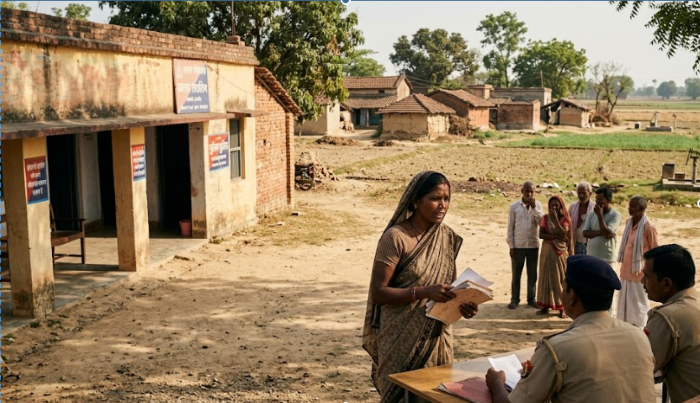
Case Summary
A Hindu Adivasi woman from the Dudhi area of Sonbhadra district in Uttar Pradesh was forcibly converted and married by Bahadur Ali after being subjected to sexual violence and coercion. Following the marriage, Ali changed her name and began using her identity to acquire land across multiple locations in the region. The case later exposed a broader pattern of exploitation involving Hindu Adivasi women, forced marriages, conversion pressure, and illegal land acquisition. The incident occurred in the Dudhi region of Sonbhadra, around 440 kilometres from Lucknow. Local inquiries revealed that Bahadur Ali, who was serving as a police constable in the area at the time, raped the Hindu Adivasi woman and married her only after she approached authorities and lodged a complaint against him. After the marriage, he allegedly changed her identity details and started purchasing land in her name in different villages and localities. Investigations later revealed that land parcels had been acquired in approximately nineteen locations using the woman’s identity. However, in official land records, Ali reportedly entered the name of the woman’s father instead of his own, allegedly to bypass legal restrictions associated with transfer and ownership of Adivasi land. Authorities and local residents further stated that Ali later attempted to settle his relatives on the land acquired through these transactions. Individuals linked to him gradually occupied several of the plots registered in the woman’s name, raising concerns regarding organised misuse of marriage and identity manipulation for land acquisition in tribal areas. The matter drew wider attention after another Hindu Adivasi woman from the same region came forward and stated that she had faced pressure to convert her religion and marry, along with death threats when she refused. Bahadur Ali’s name also surfaced in connection with that complaint, intensifying fears among local residents regarding a broader pattern involving coercion, conversion pressure, and exploitation of Hindu Adivasi women for land-related purposes. Following the growing number of complaints, authorities began examining land transactions and cases of coercion across the Dudhi region and nearby villages. Officials stated that more than 100 complaints related to land disputes and coercive activities were under investigation. Authorities further confirmed that legal action would be taken wherever illegal land acquisition, coercion, or exploitation was established through the investigation.
Why it is Hate Crime ?
The primary category for this case is- Crimes against women in relationships and other sexual crimes. The sub-category for this case is- Forced conversion before marriage, and the tertiary category is- Forced to do Nikah. In such cases, a non-Hindu man is in a relationship with a Hindu woman when the pressure to convert her religion begins to manifest. In such cases, typically, two patterns emerge. First, when the relationship is consensual, and the religious identity of the perpetrator is known to the Hindu woman in the relationship, however, at some point during the relationship, the non-Hindu man starts to force the victim to convert her religion and give up her Hindu religious identity. The second is when the woman gets into a marriage with the man pretending to share her faith. Later, when the truth is revealed, the man starts pressuring the woman to convert her religion and give up her religious identity. In both situations, the methods used to force the victim to convert her religion often revolve around force-feeding beef, forcing her to wear hijab, forcing her to read the Kalma or even pressurising the victim to do ‘Nikah’, which is marriage under Islamic law, with a prerequisite being conversion to Islam. Cases where a Hindu woman consensually converts to Islam in a relationship will be left out of the hate crime database, even though it could be argued in several cases that the conversion was a result of religious brainwashing. The other subcategory is- Brainwashed and/or groomed. The tertiary category selected is- Rape and sexual assault/harassment. In our database, we have not added incidents where women have converted to another religion of their free will and no allegations of forced/involuntary conversion have been made. However, there are certain cases of conversion where the consent itself is a result of the brainwashing or grooming of a minor by the non-Hindu perpetrator trying to victimise a woman for her Hindu religious identity. The phenomenon of grooming points to non-Hindu perpetrators identifying their Hindu victims’ vulnerabilities and exploiting them over months and sometimes years, to extract the supposed ‘consent’ in order to convert their religion. In most cases of grooming, the victims are minors or the grooming started when the victim was a minor. In other cases of grooming, the non-Hindu perpetrator brainwashes and grooms a minor victim to extract their trust and then proceeds to rape them repeatedly with the intent of converting them to their faith. It is pertinent to understand here that when the victim is a minor, the ‘consent’ to convert or enter into a romantic relationship with an adult itself is redundant – addressed by POCSO. While every case of conversion of a minor and incidents of establishing a physical relationship with a minor by an adult is a crime, for the purpose of this database, a case would be considered a hate crime only if there is a distinct religious angle to the grooming. For example, in the UK, if a Hindu minor is targeted by Pakistani grooming gangs, it would be considered a hate crime because the victims are specifically targeted owing to their non-Muslim religious identity with the perpetrators being Muslim. In other cases, if a Hindu minor is brainwashed into entering a physical relationship with the non-Hindu adult perpetrator and the family alleges grooming/brainwashing of the minor to convert her religion, it would form a part of this database. If the victim is a Hindu adult, the case would form a part of this database only if the victim herself says that she was brainwashed/groomed to convert her religion. However, if the victim is deceased (murdered or otherwise), the case would form a part of this database if her family/friends provided testimony that the victim was brainwashed/groomed to convert her religion. Since these crimes have a distinct religious angle where the victim is being targeted owing to her Hindu religious identity, these cases are considered a hate crime. This case carried strong religious markers because a Hindu Adivasi woman was not only subjected to sexual exploitation but was subsequently forced into marriage and conversion, after which her identity was used to facilitate illegal land acquisition. The sequence showed that the victim was not treated as an individual with agency and dignity, but as a means to achieve both religious and economic objectives through coercion and manipulation. The religious dimension became evident from the forced marriage and conversion that followed the assault. Instead of facing legal consequences after the woman filed a complaint, the accused married her and changed her identity. This reflected an attempt to absorb the Hindu Adivasi woman into a different religious and social identity through pressure and coercion rather than free consent. The conversion and marriage were therefore not incidental developments but central to the exploitation itself. Another important aspect was the deliberate targeting of a Hindu Adivasi woman from a vulnerable tribal background. Tribal Hindu communities in several regions have historically faced organised targeting through conversion pressure, fraudulent marriages, and land related exploitation. In this case, the victim’s religious and tribal identity made her especially vulnerable to manipulation and dispossession. The case also reflected a broader pattern where relationships, forced marriages, and religious conversion are used as tools to gain control over land and resources belonging to vulnerable Hindu communities. The subsequent use of the woman’s identity to acquire land across multiple locations demonstrated that the exploitation extended beyond personal abuse and became linked to systematic economic encroachment through coercive assimilation. The emergence of another complaint involving conversion pressure and threats further strengthened concerns that the conduct was not isolated but part of a recurring pattern targeting Hindu Adivasi women in the region. Such acts stem from hostility towards the victim’s religious and community identity and treat vulnerable Hindu women as instruments through which demographic, religious, and economic control can be expanded. Taken together, the sexual violence, forced marriage, coercive conversion, identity manipulation, and land exploitation established the religiously aggravating nature of the offence. The conduct directly targeted a Hindu Adivasi woman’s faith, identity, and social vulnerability and therefore qualifies as a religiously motivated hate crime.
Victim Details
Total Victim
1
Deceased
0
Gender
- Male 0
- Female 1
- Third Gender 0
- Unknown 0
Caste
- SC/ST 1
- OBC 0
- General 0
- Unknown 0
Age Group
- Minor 0
- Adult 1
- Senior Citizen 0
- Unknown 0


Case Status
Complaint filed


Perpetrators Details
Perpetrators
Christian Extremists
Perpetrators Range
One Person
Perpetrators Gender
male
 Sources




