Holika Dahan celebrations repeatedly disrupted by Muslim man, leading to religious tensions in Nainital, Uttarakhand.
 Naini Tal, Uttarakhand, India
  2 March, 2026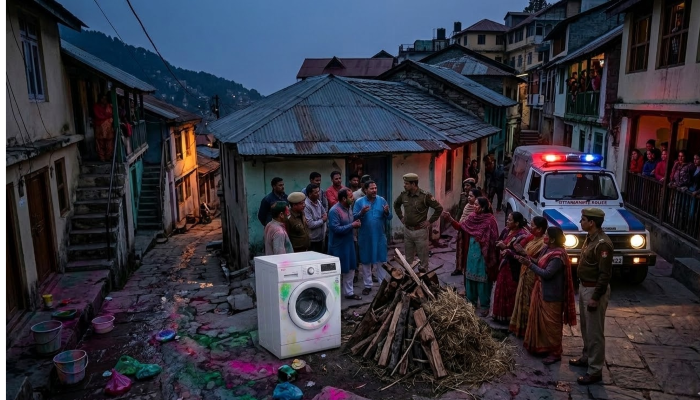
Case Summary
Hindu residents in the Tallital area of Nainital district, Uttarakhand, faced a deliberate disruption while preparing for Holika Dahan, a sacred Hindu ritual bonfire performed on the eve of Holi to symbolise the victory of good over evil. The preparations were underway in the Dhobighat locality when a dispute was engineered over the placement of a washing machine at the exact site where the Hindu residents were arranging the ritual. This disagreement escalated into a tense confrontation between the local Hindu community and the Muslim man who refused to move the machine from the area designated for the religious ceremony, causing significant unrest during the festival preparations. According to media reports, local Hindu residents gathered in Dhobighat on 3 March 2026 to prepare for the Holika Dahan ritual and requested that the washing machine be removed so that the ceremonial arrangements could proceed without obstruction. The machine belonged to a resident of the same locality identified as Mohammad Rafi. When the Hindu residents asked him to shift the machine from the spot being used for their religious preparations, Mohammad Rafi refused to comply. This refusal sparked an argument that quickly escalated into a heated dispute. Following this, the police arrived at the scene after receiving information about the situation and intervened to prevent the matter from deteriorating further. The police eventually ensured that the washing machine was removed from the site to restore order and allow the atmosphere to calm. However, the following morning, Mohammad Rafi placed the washing machine back at the very same location, a move that reignited the dispute with the local Hindu residents. This renewed provocation increased tensions in the locality and took on a communal dimension during the Holi celebrations. Police personnel again reached the location to manage the situation and spoke with both sides to prevent a further outbreak of religious tensions. Considering the gravity of the situation and the disturbance caused during the sacred festival period, the police arrested Mohammad Rafi under Section 172 of the Bharatiya Nagarik Suraksha Sanhita (BNSS), which pertains to actions that disturb public order and create disruption. The arrest was carried out by Sub Inspector Satish Upadhyay of Tallital Police Station. Authorities confirmed that further legal proceedings in the matter are ongoing. In view of the Holi festival, the police also conducted flag marches and intensified verification drives across the town, including the Mallital market area, to maintain public order and prevent any communal disturbances during the celebrations.
Why it is Hate Crime ?
The primary category for this case is "Attack on Hindu religious representations". The sub-category here is "Defiling religious customs". Sanatan Dharma is not a religion of one book, which is to say that while it has religious scriptures that form the central tenets of the faith, there are several traditions followed through thousands of years, mostly passed from generation to generation orally. There are several such customs and traditions that are followed by various Hindus and Hindu sects. Defiling of these traditions and customs is a breach of an individual or group’s religious practices. Such practices can range from dietary restrictions like not eating non-vegetarian food for a certain period of the year, not eating non-vegetarian food at all, not eating beef since the cow is considered holy in Hinduism, the sanctity of religious customs followed in the house (like many ISCKON devotees), etc. Any malicious action leading to the breach of such traditions or defilement of these traditions owing to animosity towards the faith or for the sake of activism stems not only from the lack of faith in the religion itself but also from disregard for the faith of the devotees who follow the customs/traditions and implicit bias against the faith, the tradition itself. Since these specific traditions are central to the faith of the devotees of that specific sect of Hindus, any non-compliance with these traditional rules would be considered a religiously motivated hate crime. The incident in the Tallital area of Nainital district, Uttarakhand, qualifies as a religiously motivated hate crime because Hindu residents preparing for Holika Dahan, a sacred ritual bonfire performed on the eve of Holi to symbolise the victory of good over evil, faced targeted disruption and hostility. Holika Dahan preparations require gathering materials and arranging a specific site in advance so the ceremony can proceed according to ancient Hindu customs. During these preparations, a washing machine belonging to a Muslim man, Mohammad Rafi, was placed exactly where the Hindu residents were organising the ritual. When they requested the temporary removal of the machine to allow their annual religious ceremony to proceed, he refused, triggering a confrontation that escalated into communal tension during the sacred festival period. The conduct in this case demonstrates a clear disruption of Hindu religious traditions during a major festival. The request made by the Hindu residents was both limited and temporary; they merely sought the removal of the obstruction for the duration necessary to prepare the ceremonial bonfire. Such requests are standard in community settings where shared spaces are used for annual religious observances. The refusal to cooperate with this modest request and the deliberate decision to maintain an obstruction at the ritual site directly hindered the Hindu community’s ability to perform its religious customs, amounting to desecration of sacred Holi customs. The situation escalated further when the washing machine was again placed at the same location the following morning, even after police had previously intervened to remove it and restore order. This provocative act reignited the dispute and intensified tensions within the locality during an already sensitive time. The repeated placement of the machine at the ritual site created an atmosphere of confrontation and significantly increased the risk of communal tensions during the Holi celebrations. This repeated act showcases the perpetrator's deliberate and premeditated attempt to disrupt Holika Dahan celebrations at all costs. It was done to provoke Hindu sentiments, making it a hate crime. The context of this incident is vital. Holi is among the most significant Hindu festivals, and Holika Dahan is its central opening ritual. The preparations are a collective effort by local residents who gather to sanctify and arrange the site. When a dispute is engineered in the midst of such preparations, it strikes at the heart of the community's right to practice its traditions peacefully. In this instance, a simple request to clear a path for a religious ritual was met with a level of obstruction that fractured the festival environment and stoked communal fire. This case illustrates how the deliberate obstruction of religious customs can be used to provoke a broader religious conflict. The Hindu residents had gathered for a routine annual observance and sought only the cooperation necessary to proceed. The refusal to accommodate them, followed by the reappearance of the obstruction after police intervention, aggravated the situation and heightened local anxieties. The resulting confrontation showed how interfering with Hindu customs during significant festivals can quickly transform into a serious communal incident. The response from the authorities confirms the gravity of the matter. Police intervened promptly to remove the obstruction and prevent a full-scale outbreak of violence. Mohammad Rafi was subsequently arrested under Section 172 of the Bharatiya Nagarik Suraksha Sanhita (BNSS) for actions that disturbed public order and created unrest. The deployment of additional police personnel, the conduct of flag marches, and verification drives across Nainital demonstrate that the authorities treated this as a sensitive communal matter requiring an escalated security response. Ultimately, the disruption of Holika Dahan preparations, the refusal to temporarily clear the ritual space, and the subsequent escalation during a major Hindu festival demonstrate a clear interference with religious customs. These actions created communal hostility during a period of sacred observance. The facts establish that the disruption of a Hindu ritual contributed to a communal incident targeting the Hindu community. Consequently, as this case meets the parameters of a religiously motivated hate crime, it is recorded in the Hinduphobia Tracker's hate crime database.


Case Status
Arrested


Perpetrators Details
Perpetrators
Muslim Extremists
Perpetrators Range
One Person
Perpetrators Gender
male
 Sources




