Hindus attacked with stone pelting by Muslims during Holi celebrations in Munger, Bihar
 Munger, Bihar, India
  3 March, 2026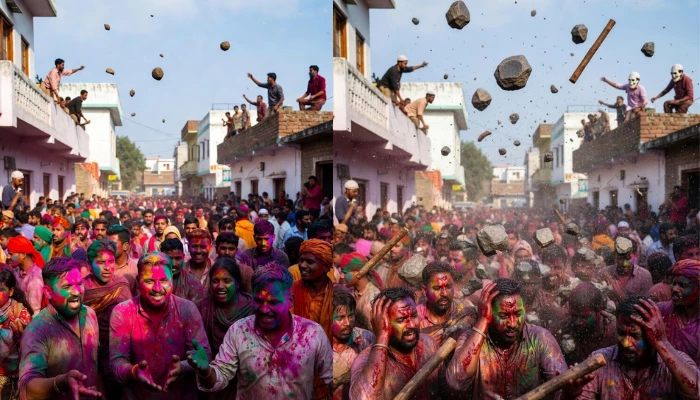
Case Summary
In Munger, Bihar, Hindus were attacked and stone-pelted by Muslims while celebrating the festival of Holi. The incident took place on 4th March, 2026, in Jamalpur, Munger district of Bihar, during Holi festivities. While people were celebrating by applying colours, a dispute arose near the railway path connecting Sadar Bazaar and Rampur Colony. The dispute was regarding gulal 'colour'. What began as an argument over colour application quickly escalated into stone pelting. Local Muslims pelted stones at Hindus while they were celebrating the festival of colours. The violence forced the celebratory gathering to disperse abruptly. One Hindu man was seriously injured in the stone pelting, while several others sustained minor bruises and cuts. Panic spread among the crowd, and women and children present at the site ran for safety. The police, alerted to the situation, rushed to the spot under the leadership of SDPO Abhishek Anand. Forces were deployed from multiple stations, and a police camp was established in the area to prevent further escalation. Officers formed barricades and dispersed the violent groups, bringing the situation under control before it spread to adjoining neighbourhoods. Five individuals were detained in connection with the violence.
Why it is Hate Crime ?
This case is being added to the tracker under the primary category "Attack not resulting in death". The subcategory selected is- “Attacked for Hindu identity.” In several cases, Hindus are attacked merely for their Hindu identity without any perceived provocation. A classic example of this category of religiously motivated hate crime is a murder in 2016. 7 ISIS terrorists were convicted for shooting a school principal in Kanpur because they got ‘triggered’ seeing the Kalava on his wrist and the tilak that he had put. In this, the Hindu victim had offered no provocation except for his Hindu religious identity. The motivation for the murder was purely religious, driven by religious supremacy. Such cases where Hindus are targeted merely for their religious identity would be documented as a hate crime under this category. The other sub-category selected is Communal Clash/attack. Communal clash is a form of collective violence that involves clashes between groups belonging to different religious identities. For a communal clash between Hindus and non-Hindus to qualify as a religiously motivated hate crime, the trigger of the violence itself would have to be anti-Hindu in essence. For example, if there is a Hindu religious procession that comes under attack from a non-Hindu mob and after the initial attack, Hindus retaliate in self-defence, leading to a communal clash between the two religious communities. While at a later stage, both communities are involved in the clash/violence, the initial trigger of the violence was by the non-Hindu mob against the Hindus, and therefore, it could safely be termed as an anti-Hindu violence. Further, the trigger would also have to be religiously motivated. In the cited example, the attack by the non-Hindu mob was against religious processions and therefore can be concluded to be religiously motivated. In some cases, the trigger may be non-religious; however, it develops into religious violence against Hindus at a later stage. In such cases, too, the foundational animosity towards Hindus becomes the motivating factor of the crime, and therefore, it would be classified as a religiously motivated hate crime against Hindus under this category. This case constituted a clear instance of a religiously motivated hate incident in which a routine Holi celebration involving colours escalated into hostility directed at Hindus during the festival. Holi is traditionally celebrated by throwing colours and gulal in a spirit of joy and social harmony. Hindus were celebrating Holi in the customary manner, where the playful throwing of colours forms the central element of the festival. During these celebrations, colours were splashed in the surrounding area and on people nearby, which is a common and expected part of Holi festivities. The incident escalated when this act became the subject of objection, leading to a heated exchange and eventually stone pelting. What began as a routine festive activity rapidly turned into a hostile confrontation directed at those celebrating the Hindu festival. The escalation into stone pelting demonstrated how quickly religious celebrations by Hindus can become flashpoints in localities where hostility towards such expressions exists. Stones were thrown during the confrontation, and at least one person sustained injuries, creating panic and forcing people to disperse from the area. The attack transformed a festive environment into one marked by fear and physical danger for those participating in the Hindu celebration. The violence targeted the procession itself, indicating that the presence of Hindus celebrating their festival had become the focal point of aggression. Moreover, the severity of the assault highlights the religious hostility underlying the attack. The willingness to direct such indiscriminate violence at a religious gathering, including vulnerable participants, demonstrates the depth of animosity towards the Hindu festival and those observing it. Rather than a spontaneous altercation, the brutality of the attack reflects a deliberate attempt to disrupt and intimidate a community engaged in a peaceful act of religious celebration. Taken together, the incident demonstrates how Hindus celebrating their religious festival became the focal point of aggression once the festivities entered a sensitive locality. The hostility was triggered by the very practices that define Holi, throwing colours and celebrating publicly. When a routine element of a Hindu religious festival provoked violence and stone pelting against those celebrating it, the attack reflected intolerance towards the public expression of the Hindu faith. For these reasons, the incident met the criteria for documentation as a religiously motivated hate incident in the Hinduphobia Tracker. Disclaimer: Media reports stated that multiple Hindu victims were targeted by Muslim perpetrators; however, the total number of victims was not specified. Only one victim was specified. Therefore, the victim count was kept at one (1). This is a conservative estimate, as the total number of victims could be higher.
Victim Details
Total Victim
1
Deceased
0
Gender
- Male 0
- Female 0
- Third Gender 0
- Unknown 1
Caste
- SC/ST 0
- OBC 0
- General 0
- Unknown 1
Age Group
- Minor 0
- Adult 0
- Senior Citizen 0
- Unknown 1


Case Status
Arrested


Perpetrators Details
Perpetrators
Muslim Extremists
Perpetrators Range
From 2 To 5
Perpetrators Gender
male
 Sources




