Hindus in West Bengal publicly threatened with violence, given an 'vote or die ultimatum' by Chief Minister ahead of 2026 State elections
 Kolkata, West Bengal, India
  8 March, 2026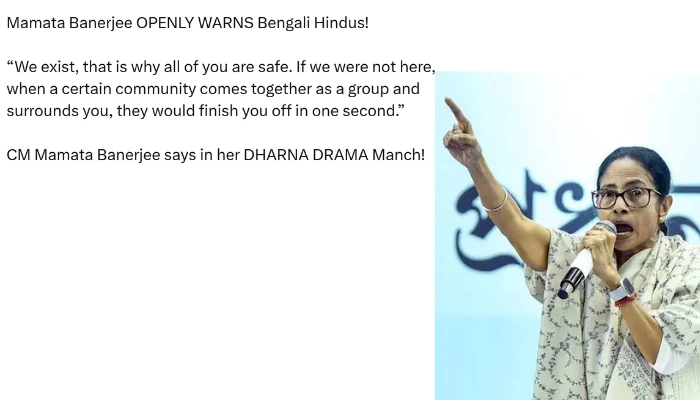
Case Summary
On 9th March 2026, in West Bengal, Hindus were threatened in a speech publicly addressed by the Chief Minister of West Bengal, Mamata Banerjee. A controversy erupted after a video clip of Chief Minister Mamata Banerjee’s speech went viral. In the video clip posted on BJP spokesperson Pradeep Bhandari's X handle (@pradip103), Banerjee was heard stating, “We exist, that is why all of you are safe. If we were not here, when a certain community comes together as a group and surrounds you, they would finish you off in one second.” He described the remark as an "open threat" to Bengali Hindus, claiming it reflected desperation amid Trinamool’s slipping ground support. Bhandari further accused the ruling Trinamool Congress (TMC) of resorting to "open Bengali Hindu hate" through such statements, framing it as part of a broader pattern of polarisation. BJP leader Sambit Patra compared her remarks to those of AIMIM leader Akbaruddin Owaisi, describing them as divisive and worrisome. The party framed Banerjee’s words as evidence of appeasement politics and hostility towards Hindus, using the viral clip to mobilise political support. The controversy quickly spread across social media, where the clip was widely circulated and debated. Hindus all over the media argued that Banerjee’s statement revealed communal bias.
Why it is Hate Crime ?
The primary category selected is: Hate Speech against Hindus. The sub-category selected is Violent threats. Violent threats, explicit, implicit or implied, are the most dangerous form of hate speech since it goes beyond discriminatory and prejudicial language to express the intent of causing harm to an individual or a group of people based on their religious identity and faith. There could be several different kinds of threats that are issued to Hindus based on religious animosity. An explicit threat would mean the direct threat of violence towards an individual Hindu, a group of Hindus or Hindus at large. Physical violence, death threats, threats of destruction of property belonging to Hindus and threats of genocide would mean explicit threats against Hindus for their religious identity. Implicit threats may not be a direct threat but implied through the use of symbols of actions – for example, in the Nupur Sharma case, other than explicit threats, there were also implicit threats when Islamists took to the streets to burn and beat her effigies. It implies that they want to do the same to Nupur Sharma, which is considered an implicit threat. Violent threats can be delivered in person, through letters, phone calls, graffiti, or increasingly through social media and other online platforms. It would be important to understand that a threat – explicit or implicit, online or offline – to an individual who happens to be a Hindu does not qualify as a religiously motivated threat. Such a threat, while vile and dangerous, could be owing to non-religious reasons and/or personal animosity. To qualify as a religiously motivated threat, it would need to exhibit an indication that the individual is being targeted for religious reasons and/or owing to his/her religious identity as a Hindu. This case constituted a clear instance of hate speech directed at Hindus by a constitutional authority holding executive power in the state. During a public address, the Chief Minister of West Bengal stated, “We exist, that is why all of you are safe.” Such a statement, when made by the head of a state government, carried far greater weight than ordinary political rhetoric. By framing the safety of citizens in this manner, the remark effectively conveyed that the physical security of Hindus depended on the continued presence and political authority of her leadership. The structure of the statement implied that Hindus would be unsafe if the current leadership did not remain in power. Instead of affirming that law, institutions, and the Constitution guarantee the safety of all citizens, the speech suggested that security existed only because of the ruling leadership. This formulation placed Hindus in a position of dependency and vulnerability. It communicated that their safety was conditional and could disappear if political circumstances changed. Such messaging functioned as a form of intimidation directed at a specific religious community. At a deeper level, the remark implied that Hindus in the state could face violence from Muslim groups if Mamata Banerjee and her government were not in power. By stating that people were safe because “we exist,” she effectively acknowledged the presence of such threats. Yet instead of condemning or firmly rejecting the possibility of attacks on Hindus, the statement framed her leadership as the only barrier preventing them. This created the impression that the safety of Hindus was conditional on her political authority rather than guaranteed by the rule of law. In doing so, the remark appeared less like a commitment to justice and more like a warning that without her protection, violence could occur, thereby placing Hindus in a position where their security seemed tied to political loyalty rather than constitutional assurance. Such rhetoric also carried an implicit message of political coercion. When the safety of a community is portrayed as dependent on the continued rule of a particular leader or party, it creates pressure on that community to remain politically compliant. This transforms a political speech into a warning, where Hindus are made to feel that their survival and dignity depend on supporting the existing authority. In a democratic society governed by constitutional safeguards, no religious community should ever be told that its safety rests on the existence of a particular political figure. When such statements originate from a Chief Minister, they carry institutional legitimacy and the potential to influence public attitudes. The remark did not merely express political disagreement or policy criticism; it conveyed a threatening message directed at a specific religious community. By suggesting that Hindus would only remain safe under her rule and implying that hostile forces could otherwise target them, the speech fostered fear and reinforced communal divisions. Taken together, the content, context, and implications of the statement demonstrated that it functioned as hate speech against Hindus. It portrayed their safety as conditional, indirectly legitimised the threat posed by hostile groups, and created an atmosphere of intimidation by linking the community’s security to political allegiance. Such messaging undermined the principle of equal protection under the law and targeted Hindus as a vulnerable community whose safety was being used as a political instrument. For these reasons, the incident was documented as hate speech against Hindus in the Hinduphobia Tracker.


Case Status
Unknown


Perpetrators Details
Perpetrators
State and Establishment
Perpetrators Range
One Person
Perpetrators Gender
female
 Sources




