Holi procession attacked; Hindu participants assaulted by Muslims after colours accidentally spilt on mosque wall in Bundi, Rajasthan.
 Bundi, Rajasthan, India
  3 March, 2026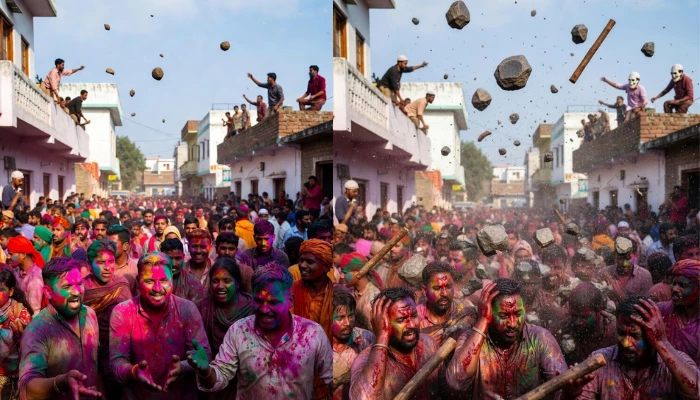
Case Summary
In Bundi, Rajasthan, on 4 March 2026, Hindus conducting a Holi Juloos (procession) faced stone and brick attacks from Muslim men after colours accidentally fell on a mosque's walls. According to media reports, the incident occurred during Holi celebrations as the procession passed a mosque, where colours unintentionally spilt onto its walls. This triggered immediate communal violence against the Hindus. Local Muslim men gathered aggressively near the mosque and pelted stones from rooftops and narrow lanes, halting the procession abruptly. Attackers also launched physical assaults with sticks and direct blows. Several Hindus suffered injuries, including head wounds and bruises from the stone-pelting. Panic ensued as women and children in the procession fled for safety. Police rushed forces from multiple stations, deployed heavily to form barricades, and dispersed the violent groups, containing the clash before it spread. Injured participants received medical treatment, though exact casualty figures remained unconfirmed. The village had a history of communal tensions; during a prior Ram Navami procession, Muslims attacked over the DJ music played near the mosque. This background heightened sensitivities, with the accidental colour spill igniting renewed violence.
Why it is Hate Crime ?
This case is being added to the tracker under the primary category "Attack not resulting in death". The sub-category selected is - Attack on religious procession. The outward celebration and display of religious symbols is an intrinsic part of Hinduism. Religious processions on various festivals are age-old traditions and a way to manifest faith and form a part of the religious practices of Hindus. On several occasions, such religious processions come under attack by non-Hindu mobs, in a manifestation of their animosity towards Hinduism and its practices. The reasons cited for such violent attacks are many and range from crossing a non-Hindu resident-dominated area to playing loud music, crossing from an area where there is a religious structure of another faith, etc. The violent attacks are triggered by the outward display of religiosity by Hindus. The attacks are mainly a manifestation of religious supremacist doctrine, which believes that idolatry, essentially the Hindu faith, deserves to be annihilated since the very tenets of Hinduism, its practices and traditions are considered a sin in those doctrines. Since these attacks emanate from intrinsic and doctrinal animosity towards Hindus and Hinduism, it is considered a religiously motivated hate crime under this category. The other subcategory selected is: Attacked for crossing a Muslim area. One of the reasons that Hindus get attacked unprovoked, specifically by Islamists, is for crossing ‘Muslim areas’. Essentially, Muslim mobs often attack Hindus crossing or present in certain areas that have a majority Muslim population. It has often been cited as one of the reasons to blame Hindus for attacks against themselves, signalling that Hindus displaying religious symbols, taking our religious processions or crossing any area which is dominated by Muslim residents is a provocation in and of itself. These areas are mostly ghettoised areas where mobs mobilise quickly to attack Hindus for a variety of reasons, like playing music during a religious procession, crossing a mosque, wearing a tilak or any other religious symbol in a Muslim-dominated area, praying at a local temple in that area, etc. There have been cases where the few local Hindus of that area have been attacked on their way to the Temple for prayers as well, simply because the area is considered a Muslim-dominated area. Several times, it is entirely possible that the immediate trigger for the violence against Hindus was non-religious in nature; however, the violence became religiously motivated in nature because the area was Muslim-dominated and the residents, on the whole, harboured animosity towards Hindus, evidenced from the actions of the mob, the slogans, and the nature of the attack. Such crimes are motivated by the religious identity of the victims and are therefore classified as hate crimes under this category. The other subcategory selected is: Attacked for Hindu identity. In several cases, Hindus are attacked merely for their Hindu identity without any perceived provocation. A classic example of this category of religiously motivated hate crime is a murder in 2016. 7 ISIS terrorists were convicted for shooting a school principal in Kanpur because they got ‘triggered’ seeing the Kalava on his wrist and the tilak that he had put. In this, the Hindu victim had offered no provocation except for his Hindu religious identity. The motivation for the murder was purely religious, driven by religious supremacy. Such cases where Hindus are targeted merely for their religious identity would be documented as a hate crime under this category. This case constituted a clear instance of a religiously motivated hate crime in which Hindu devotees participating in a Holi procession were violently attacked while publicly participating in their religious traditions. The victims were not engaged in any confrontation or provocation. They were carrying out a festive religious procession, a customary practice during Holi where participants celebrate with music, colours and collective devotion. The sudden violence erupted while the procession passed through the village, demonstrating that the attack was directed at Hindus precisely when they were visibly celebrating their faith in a public space. During Holi processions, throwing coloured powder and water into the air is a natural expression of joy and celebration. Participants routinely splash colours on one another and into the surroundings as a symbol of festivity and unity. In this instance, colour accidentally landed on the outer wall of a mosque while the procession was passing. This unintended act immediately triggered hostility. Local Muslim residents quickly gathered and launched an organised assault on the Hindu participants. Stones were hurled from rooftops and narrow lanes, turning what had been a peaceful religious celebration into a violent ambush. The manner in which the attack unfolded indicated preparation rather than a spontaneous reaction. Stones were thrown from rooftops overlooking the procession route, which suggested that large quantities of stones had already been collected and positioned in advance. Rooftop pelting requires forethought and coordination, since individuals must first assemble materials and occupy elevated positions before the procession arrives. This pointed towards a premeditated plan to target the procession the moment it passed through the locality. The attack, therefore, did not arise suddenly from the accidental spill of colour but reflected readiness to launch violence against the Hindu gathering. The Hindus were struck by stones and beaten with sticks, causing head injuries and multiple bruises. Panic spread through the crowd as participants attempted to shield themselves from the barrage. Women and children who had joined the procession in celebration were forced to run for safety while the assault continued. The violence targeted the procession itself, indicating that the presence of Hindus celebrating their festival had become the focal point of aggression. The pattern of violence also showed that the victims were attacked while passing through a locality dominated by the other community, where Hindu religious processions had repeatedly faced hostility. The mere act of Hindus crossing such areas while displaying their religious symbols, music and festivities has often been treated as a provocation by hostile groups. In this case, the procession became vulnerable precisely because it entered a locality where organised mobs could quickly gather and attack participants who were easily identifiable as Hindus engaged in a religious celebration. The incident was not an isolated outburst but part of a recurring pattern of hostility towards Hindu religious observances in the same village. During a previous Ram Navami procession, Hindu devotees had faced a similar violent reaction when music was played while the procession passed near the mosque. The repetition of such attacks across different Hindu festivals demonstrated a continuing intolerance towards public expressions of Hindu faith. The Holi procession, therefore, became another occasion where the celebration of a Hindu festival was met with aggression and collective punishment. Taken together, the facts demonstrated that the victims were attacked while celebrating a Hindu festival, during a religious procession that formed an intrinsic part of their faith. The violence erupted not because of any deliberate provocation but because the public display of Hindu religiosity was met with organised hostility. The accidental spill of colour during a joyous celebration was used as a pretext to unleash an assault on Hindu devotees. Combined with the history of similar attacks during earlier Hindu processions in the same area, the incident clearly reflected targeted aggression against Hindus for practising their religion openly. For these reasons, the case met the criteria of a religiously motivated hate crime and was included in the Hinduphobia Tracker.


Case Status
Unknown


Perpetrators Details
Perpetrators
Muslim Extremists
Perpetrators Range
Unknown
Perpetrators Gender
unknown
 Sources




