Hindu students playing Holi targeted in Ratlam as Muslim man attempts to run them over with car
 Ratlam, Madhya Pradesh, India
  3 March, 2026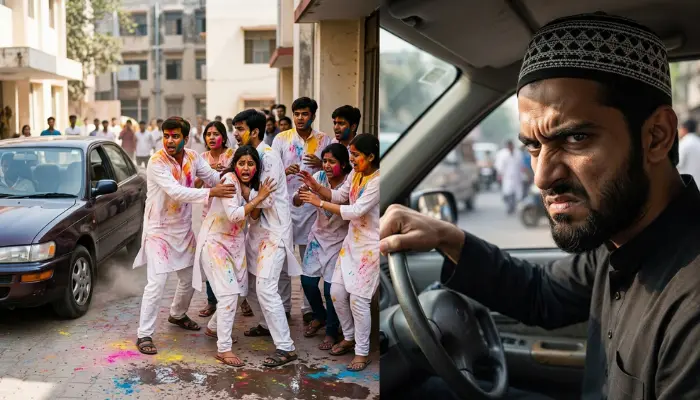
Case Summary
In Ratlam, Madhya Pradesh, Hindu students at Dr Laxmi Narayan Pandey Medical College faced attempted violence from a Muslim man while they played Holi. The accused tried to run a car over Hindu students while playing Holi. This occurred at 4 pm on the day of the incident. Hindu students were playing Holi in the medical college. Meanwhile, the Muslim accused, Dr Rajat Ali Khan from Jaipur, Rajasthan, arrived in a car with his friends. The Hindu students playing Holi asked the accused to take another route. After stopping the car, an argument broke out between Rajat Ali Khan and the Hindu students. During this, Dr Rajat Ali Khan sat in his car and started moving forward. The students playing Holi tried to stop the car, but Rajat Ali Khan did not stop. He accelerated the car at high speed, trying to run over the students. Hindu students again tried to stop the car. When the car did not stop, some students tried to stop it by throwing stones. Following this, the accused fled quickly. After this, some Hindu students chased the Muslim accused, which led to a scuffle between Dr Rajat Ali and other students who came with him. This further led to a clash and fight between the Muslim accused and the Hindus. Dr Ashish Merawandia, a Hindu victim, said that Dr Rajat Ali Khan came with the intention of disrupting the Hindu festival. He deliberately tried to attack Hindu students playing Holi. Dr Bhagwat said that when the accused tried to run them over with his car, three other companions were also present with them. Dr Pankaj Chauhan said that their three companions of the accused sustained injuries. One suffered a fractured hand. Others received scratches. Last year, too, a fight occurred during Holi. Dr Rajat Ali faced suspension from college due to his actions. Dr Rajat Ali claimed he had gone to play Holi at the college and, upon returning, waited in his car outside the emergency room for a fellow doctor. He stated: “A Creta car approached from behind with Dr Pankaj and Dr Ashish inside. They took tools from my car and struck me on the head. I fell unconscious and do not know what happened next. My colleagues arrived later, took me for treatment, and I received four or five stitches.” Dr Rajat Ali offered no comment on his attempt to run Hindu students over with the car. He raised old grudges from the WhatsApp group. Regarding this incident, the police stated that both parties filed complaints against each other at the police station. Dr Ashish Merawandia from Sanwer in Indore, Dr Prashant Gaurav from Gwalior, Dr Priyanshi, and Dr Bhanavat Mude sustained injuries. Driver Dr Rajat Ali Khan also sustained injuries. He received four to five stitches on his head. Meanwhile, Dr Laxmi Narayan Pandey Medical College Superintendent Dr Pradeep Mishra said that a fight occurred on campus. After this, the police received information about the fight, and they took action to resolve it and maintain the law and order situation.
Why it is Hate Crime ?
This case is being added to the tracker under the primary category- Attack not resulting in death. The subcategory selected is- Attacked for Hindu identity. In several cases, Hindus are attacked merely for their Hindu identity without any perceived provocation. A classic example of this category of religiously motivated hate crime is a murder in 2016. 7 ISIS terrorists were convicted for shooting a school principal in Kanpur because they got ‘triggered’ seeing the Kalava on his wrist and tilak that he had put. In this, the Hindu victim had offered no provocation except for his Hindu religious identity. The motivation for the murder was purely religious, driven by religious supremacy. Such cases where Hindus are targeted merely for their religious identity would be documented as a hate crime under this category. The other subcategory selected is- Communal Clash/Attack. Communal clash is a form of collective violence that involves clashes between groups belonging to different religious identities. For a communal clash between Hindus and non-Hindus to qualify as a religiously motivated hate crime, the trigger of the violence itself would have to be anti-Hindu in essence. For example, if there is a Hindu religious procession that comes under attack from a non-Hindu mob and after the initial attack, Hindus retaliate in self-defence, leading to a communal clash between the two religious communities. While at a later stage, both communities are involved in the clash/violence, the initial trigger of the violence was by the non-Hindu mob against the Hindus and therefore, it could safely be termed as an anti-Hindu violence. Further, the trigger would also have to be religiously motivated. In the cited example, the attack by the non-Hindu mob was against religious processions and therefore, can be concluded to be religiously motivated. In some cases, the trigger may be non-religious, however, it develops into religious violence against Hindus at a later stage. In such cases too, the foundational animosity towards Hindus becomes the motivating factor of the crime and therefore, it would be classified as a religiously motivated hate crime against Hindus under this category. The incident at Dr Laxmi Narayan Pandey Medical College serves as a clear instance of a religiously motivated hate crime, as Hindu students were specifically targeted with a life-threatening act of violence while observing a sacred religious festival, Holi. The attempt to run over the Hindu students with a vehicle transforms a navigational disagreement into a targeted assault on a religious group. The victims’ account suggests that the perpetrator did not merely happen upon the scene but arrived with the specific intent of disrupting the celebration. By weaponising a vehicle against Hindus based on their participation in a religious activity, the act transcends a simple dispute and enters the realm of a hate crime, where the identity and faith of the victims are the primary drivers of the aggression. Holi, known as the Festival of Colours, holds profound spiritual and cultural significance in Hinduism, marking the arrival of spring and the triumph of good over evil. It is a time of communal harmony, joy, and the renewal of social bonds, traditionally celebrated with the throwing of coloured powders and water. For the Hindu students at the medical college, playing Holi was an expression of their faith and heritage. An attack during such a significant period is not only a physical assault but a desecration of a holy occasion, striking at the heart of the community’s right to practice their religion safely and openly. The nature of the attack showcases deep-seated religious animosity, particularly given the disproportionate scale of the violence relative to the initial interaction. The Hindu students made a polite and reasonable request for the Muslim man to take an alternative route to ensure the safety of those celebrating in the street. Rather than following this simple request or choosing a legal alternative, the perpetrator responded with lethal intent. This extreme reaction to a minor, respectful suggestion reveals a profound underlying hostility toward the Hindu faith. The decision to accelerate a car into a crowd of Hindus over a mere request to change routes demonstrates that the perpetrator’s actions were fuelled by religious intolerance, where the presence of a Hindu celebration was viewed as a provocation justifying deadly force. Despite the Muslim man’s claims that he was the initial victim of an assault and his attempts to frame the incident as a result of prior rivalries, the evidence from the scene tells a different story. News reports detailing his attempt to run over the Hindu students with a vehicle suggest that these counterclaims were a calculated effort to hide his crime. This attempt to manipulate the narrative and cover up a life-threatening assault further showcases the depth of his hatred. By shifting the blame onto those Hindus he tried to kill, the perpetrator demonstrates a profound lack of remorse and a persistent religious animosity, confirming that the attack was a premeditated act of violence disguised as a personal dispute. Overall, this instance of attempting to kill Hindu students by running them over with a car provides a clear illustration of the depth of hatred held by the perpetrator. Such a violent response to a minuscule request highlights a refusal to acknowledge the basic rights and safety of the Hindu community and altogether amounts to a communal attack on Hindus. By choosing to use a vehicle as a weapon against those celebrating their faith, the incident stands as a stark example of how religious prejudice can manifest in extreme, premeditated violence, marking it as an undeniable hate crime rooted in religious animosity. Given that this case meets the criterion of a religiously motivated offence, it is being added to the hate crime database of the tracker. Disclaimer: The Hinduphobia Tracker records incident dates based on when the crime occurs, not media reporting dates. In this case, as media reports do not specify the exact date of the crime, the media reporting date of 4 March 2026 serves as the indicative incident date. This date is recorded for documentation purposes only. The Hinduphobia Tracker records the victim count as six in this case: five Hindu men and one Hindu woman who sustained injuries. The victims are identified as Dr Ashish Merawandia, Dr Bhagwat, Dr Pankaj Chauhan, Dr Prashant Gaurav, Dr Priyanshi, and Dr Bhanavat Mude. Although reports state that Dr Rajat Ali Khan sat in his car with three other people, they nowhere indicate that these individuals supported or participated in his attempt to run over Hindu students playing Holi. Therefore, Hinduphobia Tracker records Dr Rajat Ali Khan alone as the perpetrator, with a perpetrator count of one.
Victim Details
Total Victim
6
Deceased
0
Gender
- Male 5
- Female 1
- Third Gender 0
- Unknown 0
Caste
- SC/ST 0
- OBC 0
- General 0
- Unknown 6
Age Group
- Minor 0
- Adult 6
- Senior Citizen 0
- Unknown 0


Case Status
Complaint filed


Perpetrators Details
Perpetrators
Muslim Extremists
Perpetrators Range
One Person
Perpetrators Gender
male
 Sources




