Holi festival falsely vilified and portrayed as misogynistic by leftist-Muslim news outlet
 Doha, Doha, Qatar
  3 March, 2026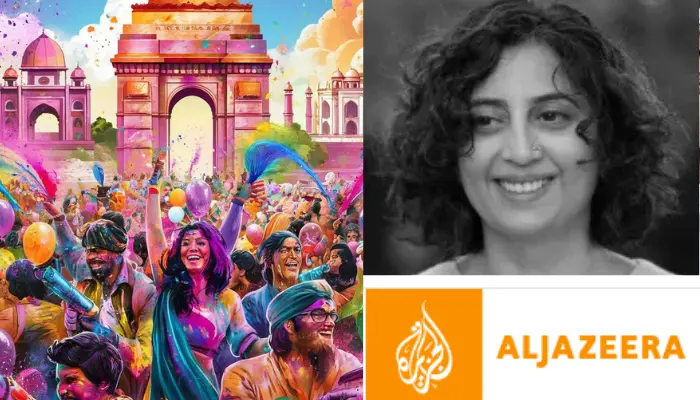
Case Summary
Holi, a revered Hindu festival, was denigrated by a Leftist Muslim news outlet named Al Jazeera, a Qatari-funded outlet infamous for its anti-Hindu and anti-India positions. On the day of Holi, 4 March 2026, the outlet published an article titled ‘The Dark Side of Holi’, written by journalist Vidya Krishnan, known for her past instances of anti-Hindu social media posts. The article portrays Holi as a regressive and misogynistic festival. It begins by stating, “India’s festival of colour has become a day when women brace for harassment.” It then talks about the story of Hiranyakashipu, recounting how Hiranyakashipu used a boon granted to his sister Holika to kill his enemy, his own son Prahlad. It states that Holika was wrapped in a magical, invisible blanket by her brother and set on fire when Prahlad sat in his aunt's lap. The prince prayed to Lord Vishnu, who burned away the evil and saved the young devotee Prahlad. Vidya wrote in this article that the story of Holika is a prime example of how Hindu women are viewed and punished as enforcers of patriarchy. Vidya wrote that Holika's brother set her on a pyre, and we (Hindus) celebrate her by symbolically burning her every year. She then stated, "It's easy to portray Holika as a fiery villain, but she's closer to a modern feminist hero than a child-burning demon, especially in Modi's India." And then, to further defame Holi, Vidya wrote about mass rapes taking place in India and also wrote that women are targeted during this festival and that girls live in constant fear of the festival. Vidya also wrote about the completely debunked lie that balloons filled with semen were thrown on Holi. She also wrote that girls are harassed and raped at Holi parties on this day. Notably, as stated earlier, Vidya is infamous for making anti-Hindu remarks in the past. For example, in 2022, she tweeted, selectively targeting Hindu men and calling them toxic. She is also well known for mocking and denigrating Diwali in tweets from 2019. In 2023, she attacked “every Hindu festival” as arriving “like the first punch that starts a bar brawl.”
Why it is Hate Crime ?
This case is added to the tracker under the primary category- Hate speech against Hindus. The subcategory selected is- Anti-Hindu slurs, mocking faith. Anti-Hindu slurs and the deliberate mocking of the Hindu faith owing to religious animosity involve the usage of derogatory terms, stereotypes, or offensive references to religious practices, symbols, or figures. One of the common anti-Hindu slurs used against Hindus is “cow-worshipper” and “cow piss drinker”. The intention of using this term is to demean and mock Hindus as a group and their religious beliefs since Hindus consider the cow holy. Additionally, some symbols and the slurs attached to them have a historical context that exacerbates the insult, hate, stereotyping, dehumanisation and oppression against Hindus. Cow worship has been used for centuries to denigrate Hindus, insult their faith and oppress Hindus specifically as a religious group. There has been overwhelming documentation about how cow slaughter has been used to persecute Hindus with cow meat being thrown in temples and places of worship. There has also been overwhelming documentation where cow meat (beef) has been force-fed to Hindus to either forcefully convert them to Islam or denigrate their faith. Apart from cow worship, the Swastika – which holds deep religious significance for the Hindus – has also been misinterpreted and distorted to use as a slur against Hindus. Similarly, the worship of the Shivling has been used by supremacist ideologies and religions to denigrate Hindus owing to religious animosity. Such slurs and denigration stem out of inherent animosity and hate towards Hindus and their faith, therefore, it is categorised as hate speech targeted at Hindus specifically owing to their religious identity. The other subcategory selected is- Subversion of scriptures. Subverting the religious scriptures of Hindus has particularly devastating consequences. Subversion of the scriptures of Hindus is often done to justify or promote hatred, discrimination, or violence against specific individuals or groups of Hindus. Religious scriptures are often nuanced and those who harbour religious animosity towards Hindus often misquote or misrepresent the scripture to legitimise their animosity and hate towards the faith and its adherents. Any such misquoting of scriptures or subversion to justify hate, violence and discrimination against Hindus owing to religious animosity is hate speech and is categorised as such. The other subcategory selected is- Anti-Hindu subversion and prejudice. Hate speech is defined as any speech, gesture, conduct, writing, or display that is prejudicial against a specific individual and/or group of people, which is leading to or may lead to violence, prejudicial action or hate against that individual and/or group. Media plays a specific and overarching reach in perpetuating prejudicial attitudes towards a community owing to unfair, untrue coverage and/or misrepresentation/misinterpretation, selective coverage and/or omission of facts of/pertaining to issues affecting a specific religious group. This type of bias can dehumanise the victim group, making it easier for others to justify harmful actions against them, which aligns with the objectives of hate speech laws aimed at preventing such harm. It is often observed that the media takes a prejudicial stand against the Hindu community driven by their need to shield the aggressor community which happens to be a numeric minority, however, is the one perpetrating violence against Hindus. For example, the media is often quick to contextualise religiously motivated crimes against Hindus, omit or misrepresent facts that point towards religiously motivated hate crimes, justify and/or downplay religiously motivated hate crimes or simply present fake news to stereotype Hindus. Such media bias leads to the denial of persecution and is often used to dehumanise Hindus, leading to justification for violence against them. For example, the media covered several fake allegations of Hindus targeting Muslims and forcing them to chant Jai Shree Ram. Most of these cases were proved false and fabricated after police investigation. These fake news reports were subsequently never retracted or clarified. Such fake news led to the justification of violence and dehumanisation of Hindus based on the argument that since Hindus targeted Muslims and forced them to chant Jai Shree Ram, the dehumanisation of Hindus and violence against them was par for the course and merely a retaliation. Such media bias leads to prejudicial portrayal of Hindus and offers a justification for violence against them and therefore, is considered hate speech under this category. This case is a clear instance of anti-Hindu hate speech motivated by deep-seated religious animosity towards Hinduism and the Hindu community. Al Jazeera published an article titled ‘The Dark Side of Holi’ on 4 March 2026, written by Vidya Krishnan, which denigrated the revered Hindu festival by portraying it as regressive and misogynistic, beginning with the claim that “India’s festival of colour has become a day when women brace for harassment.” The article then subverted Hindu scriptures by distorting the story of Holika Dahan, a central ritual of Holi that symbolises the triumph of good over evil: Holika, the demoness sister of the tyrant Hiranyakashipu, attempted to kill his son Prahlad, a devout follower of Lord Vishnu, by luring him onto a pyre, protected by a boon that made her fireproof. Lord Vishnu's blessings intervened, burning Holika while saving Prahlad, a narrative Hindus celebrate annually to honour devotion, righteousness, and the destruction of adharma (evil). Yet the article falsely portrayed this as Hiranyakashipu forcing Holika onto the pyre to burn alive alongside Prahlad, framing Hindus as annually celebrating the “burning of women” and recasting Holika as a “modern feminist hero” rather than the child-killing demoness she is in scripture. This deliberate perversion of sacred Hindu texts subverts their reality, popularises anti-Hindu prejudice, mocks Hindu beliefs and fuels hatred by painting Hindu traditions as inherently patriarchal and punitive towards women, constituting hate speech that incites contempt for the Hindu community’s faith and identity. The accused further escalated this hate by claiming the entire festival revolves around mass harassment, sexual assault, molestation, and rape of women, alleging girls live in “constant fear” of Holi and citing debunked fabrications like semen-filled balloons, while linking it to broader “mass rapes” in India. While isolated, unfortunate incidents of molestation occur during Holi, as they do at events worldwide, from New Year’s Eve celebrations to music festivals, these do not define the festival’s essence of joy, renewal, and communal unity through colours and devotion. By selectively amplifying such aberrations into an all-encompassing narrative that tar Holi alone as a misogynistic orgy of violence, while ignoring similar issues in non-Hindu contexts, the article reveals a targeted agenda to demonise Hindu practices. This calculated distortion, fixating on one Hindu festival to propagate lies and stereotypes, exemplifies hate speech: it dehumanises Hindu participants, erodes cultural pride, and perpetuates religious animosity by portraying Hinduism as uniquely predatory, directly inciting prejudice and hostility against the global Hindu community. Vidya Krishnan’s history of anti-Hindu rhetoric, when combined with this Holi article, reveals a clear pattern of targeting and denigrating Hindu festivals, showcasing her deep-seated animosity towards Hinduism and the Hindu community. As noted earlier, she tweeted in 2022, selectively targeting Hindu men as “toxic”; mocked and denigrated Diwali in 2019; and in 2023 attacked “every Hindu festival” as arriving “like the first punch that starts a bar brawl.” These repeated assaults on Hindu celebrations, Diwali, Holi, and festivals in general, form a consistent campaign to portray Hindu traditions as violent, regressive, and patriarchal. By fixating on Hindu religious events while ignoring equivalent issues in other faiths, her body of work incites contempt for Hindu identity, subverts sacred narratives, and amplifies stereotypes that fuel discrimination. This serial denigration constitutes hate speech motivated by religious hostility, as it systematically erodes respect for Hinduism and vilifies its adherents. Given that this case meets the parameters of a religiously motivated hate speech, it is being added to the Hate Crime database of the Hinduphobia Tracker.


Case Status
Unknown


Perpetrators Details
Perpetrators
Others
Perpetrators Range
One Person
Perpetrators Gender
female
 Sources




