Sacred temple wealth exploited: Hindu Religious and Charitable Endowments Department misuses temple funds on party promotion in Tamil Nadu
 Tamil Nadu, India
  4 March, 2026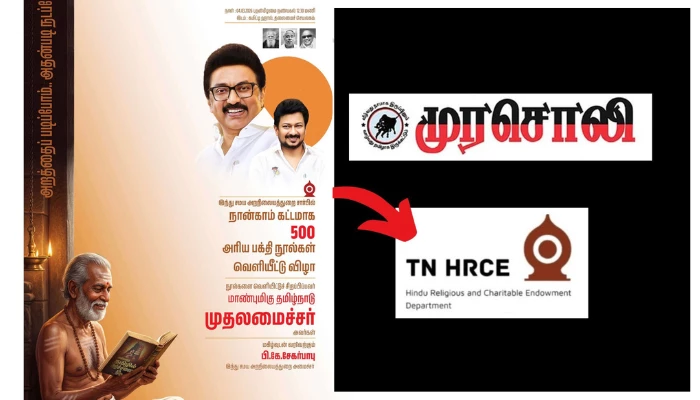
Case Summary
In Tamil Nadu, funds belonging to Hindu temples, collected from Hindu devotees, managed by the Hindu Religious and Charitable Endowments Department, were misused for political publicity by the Dravida Munnetra Kazhagam party. They floated an advertisement in a newspaper, displaying Bhakti Book Project and using Chief Minister M.K. Stalin's image, calling it an initiative of the Government. According to reports, the advertisement was issued on 5 March 2026 under the authority of Minister P.K. Sekarbabu. It stated that the release was being carried out “on behalf of the Hindu Religious and Charitable Endowments Department” and highlighted the Chief Minister’s role in presiding over the event. The wording was criticised for presenting the project as a government initiative rather than one funded by temple resources. As per media accounts, devotees and Hindu organisations expressed anger that temple wealth, meant for the upkeep of temples and religious purposes, was instead being channelled into advertisements in a party newspaper. They pointed out that this amounted to misuse of sacred funds and undermined the rights of devotees. The controversy gained further weight because the Madras High Court had earlier ruled that temple funds cannot be diverted for non‑temple projects, emphasising that such resources belong to the devotees. The incident led to demands for accountability and transparency. Various Hindu groups called for an enquiry into the financial management of the Hindu Religious and Charitable Endowments Department and action against officials responsible for the diversion. According to reports, critics noted that while temple funds were being spent on political advertisements, many temples across Tamil Nadu continued to suffer from poor maintenance and a lack of resources. At the time of reporting, no police case had been registered, but the matter remained under public and media scrutiny. The advertisement in Murasoli became a fresh example of temple wealth being used in ways that devotees considered inappropriate and politically motivated.
Why it is Hate Crime ?
The primary category selected in this case is- Restriction/ban on Hindu practices. The subcategory selected is- Administration restricting religious practice. In several cases, it is seen that the administration/state disallows a religious practice owing to prejudicial orders and concerns, targeted specifically against the Hindu community. Such restriction/prohibition would be considered documented as a hate crime because the orders are often a result of pressure by groups that harbour animosity towards Hinduism and Hindus. Often, the restriction by the authorities is driven by bias, hostility, or prejudice against the specific community being stopped from holding a religious practice, by pressure groups that harbour animosity towards Hindus, intrinsic to their faith. Since practices are intrinsic to the faith of the Hindus, such prejudicial restriction is considered a curtailing of the fundamental rights of the Hindu community. In several cases, for example, the authorities ban a Hindu religious practice due to pressure from groups opposed to the religion. In other instances the prohibition is selectively enforced against one religious group (Hindus) while others are allowed to proceed. There are still other cases where the authorities preemptively restrict a religious practice by Hindus because those who hold animosity towards Hindus may get “provoked” leading to them being violent, thereby assuaging the sentiments of those who hold animosity towards Hindus by curtailing the religious rights of Hindus. Such acts and orders are prejudiced, indicating discriminatory motives owing to the capitulation to groups that harbour animosity towards Hindus and therefore, would be categorized as a religiously motivated hate crime since the original pressure leading to the order itself is a result of hatred/bias/prejudice/religious hate against Hindus. In this case, the incident involving the use of temple funds by the Tamil Nadu HR&CE Department for the Bhakti book project and related publicity reflects a deeper pattern in which financial resources donated by Hindu devotees for temple upkeep were diverted to purposes beyond the maintenance and functioning of temples. Temple funds consist of offerings made by devotees with the clear belief that these contributions will be used for religious rituals, preservation of temple structures, and the continuation of temple traditions. Diverting such funds into promotional activities connected with political platforms undermines the religious purpose for which these donations were made and weakens the institutional foundations of Hindu worship. Temple administration relies heavily on these offerings to sustain daily rituals, conduct festivals, maintain temple premises, support priests, and preserve the cultural heritage associated with temples. When funds are redirected towards activities unrelated to temple upkeep, the immediate consequence is the neglect and weakening of temple institutions themselves. This concern is not merely theoretical; courts in India have repeatedly emphasised that temple funds belong to the deity and must be used strictly for religious purposes connected to temple maintenance and worship. The misuse of temple funds also restricts the broader expression of Hindu identity. Temples are not only places of worship but also centres of cultural life where festivals, rituals, and community gatherings reinforce the continuity of Hindu traditions. When the financial resources meant to sustain these institutions are diverted, the ability of temples to organise religious activities, maintain infrastructure, and serve devotees is gradually eroded. Over time, this financial weakening directly affects the visibility and vitality of Hindu religious practices in public life. The issue becomes even more serious when funds originating from temple donations are used in ways that benefit political actors or party-aligned platforms. Devotees donate to temples out of faith and spiritual devotion, not to finance political messaging or publicity. When political parties or state authorities use temple resources in such a manner, it represents a breach of trust placed by Hindu devotees, and signals disregard for the sanctity of temple institutions and the religious sentiments attached to them. In effect, diverting temple funds from their intended religious purpose undermines temple maintenance and restricts the institutional structures that sustain Hindu religious life. If resources collected for temple upkeep are repeatedly redirected towards political or administrative projects, the long-term result will be the weakening of temple infrastructure and the erosion of spaces where Hindus practise and express their faith. For these reasons, the case was included in the Hinduphobia Tracker as an instance where the institutional and financial foundations of Hindu religious practice were undermined.


Case Status
Unknown


Perpetrators Details
Perpetrators
State and Establishment
Perpetrators Range
Unknown
Perpetrators Gender
unknown
 Sources




