Elderly Hindu woman slapped; 'Pakistan Zindabad' slogans raised by mob of Muslim men armed with swords on Holi in Dehradun, Uttarakhand
 Dehradun, Uttarakhand, India
  3 March, 2026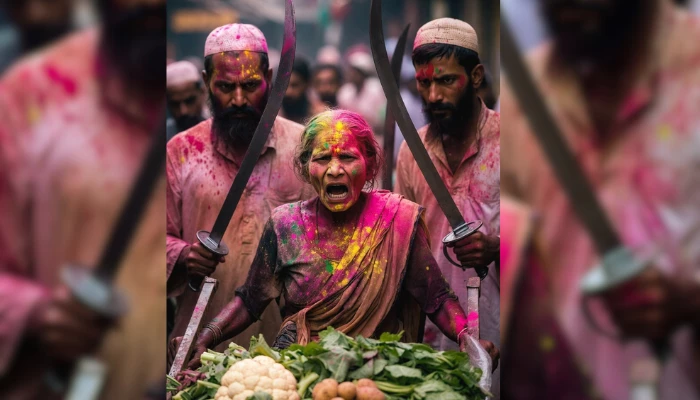
Case Summary
In Dehradun, Uttarakhand, an elderly Hindu woman, a vegetable vendor, was slapped for opposing the unruly behaviour of Muslim men. Hindu men who came to resolve the issue had to face a mob of Muslim men armed with swords. The incident took place in the Kotwali Nagar area near Laxman Chowk, Dehradun, Uttarakhand. The victim was Lakshmi Devi Sonkar, a 65-year-old Hindu woman who ran a vegetable stall. The primary accused was a Muslim man named Salim, aged 16–17 years, residing in Shiv Nagar Colony on Kanwali Road. Additional individuals from the Muslim community became involved later, forming a mob. The event occurred on 4 March 2026, during evening Holi celebrations. It began when a Muslim man approached Lakshmi Devi Sonkar's vegetable stall and took some fruits. They left but returned shortly afterwards. At that point, the men verbally abused the woman, threw the fruits at her, slapped her on the face, and threatened to kill her. When she resisted, they pushed her onto the road and then fled from the scene. Family members of the victim and residents learned of the assault and gathered at the location to protest. A dispute arose between the two groups. From the opposing side, stones were pelted at the protesters. A mob of 150–200 people assembled, some of whom carried swords. During the confrontation, individuals in the mob raised slogans of "Pakistan Zindabad". The situation became chaotic and tense. A video of the incident, capturing the assault and subsequent clashes, became viral on social media, attracting widespread attention and sparking an outburst from several Hindu organisations, who expressed fury and demanded strict action against the accused and what they described as radical elements. The police received information about the incident and arrived promptly at the spot. They deployed additional forces to control the crowd and restore order in the area. A case was registered against the three primary accused based on the victim's complaint. The police continued their investigation to identify other individuals involved in the stone-pelting and mob actions. No serious injuries occurred beyond the initial assault, and the area saw increased security measures during the festival period to prevent any further disturbances.
Why it is Hate Crime ?
This case is being added to the tracker under the primary category "Attack not resulting in death". The subcategory selected is- “Attacked for Hindu identity.” In several cases, Hindus are attacked merely for their Hindu identity without any perceived provocation. A classic example of this category of religiously motivated hate crime is a murder in 2016. 7 ISIS terrorists were convicted for shooting a school principal in Kanpur because they got ‘triggered’ seeing the Kalava on his wrist and the tilak that he had put. In this, the Hindu victim had offered no provocation except for his Hindu religious identity. The motivation for the murder was purely religious, driven by religious supremacy. Such cases where Hindus are targeted merely for their religious identity would be documented as a hate crime under this category. The second sub-category is " Attacked for opposing radicals or trying to save a victim". In several cases, Hindus are attacked for opposing religiously motivated crimes being committed against a fellow Hindu or simply for voicing an opinion opposing radical elements, who either have in the past or continue to persecute Hindus. In such cases, the initial attack against the victim, against which the Hindu was trying to defend the victim, would also need to be classified as a religiously motivated hate crime. Since the initial crime itself was religiously motivated and the subsequent crime of attempting to save the victim or speaking against the radical elements ends up inviting a violent attack, it would also be classified as a religiously motivated hate crime under this category. Another subcategory selected is "Communal Clash/Attack". Communal clash is a form of collective violence that involves clashes between groups belonging to different religious identities. For a communal clash between Hindus and non-Hindus to qualify as a religiously motivated hate crime, the trigger of the violence itself would have to be anti-Hindu in essence. For example, if there is a Hindu religious procession that comes under attack from a non-Hindu mob and after the initial attack, Hindus retaliate in self-defence, leading to a communal clash between the two religious communities. While at a later stage, both communities are involved in the clash/violence, the initial trigger of the violence was by the non-Hindu mob against the Hindus, and therefore, it could safely be termed as an anti-Hindu violence. Further, the trigger would also have to be religiously motivated. In the cited example, the attack by the non-Hindu mob was against religious processions and therefore can be concluded to be religiously motivated. In some cases, the trigger may be non-religious; however, it develops into religious violence against Hindus at a later stage. In such cases, too, the foundational animosity towards Hindus becomes the motivating factor of the crime, and therefore, it would be classified as a religiously motivated hate crime against Hindus under this category. This case carried clear religious markers because the violence did not remain confined to a dispute involving an elderly vegetable vendor. What began as an assault on a Hindu woman rapidly escalated into a large-scale communal mobilisation involving a Muslim mob, stone pelting, sword-wielding individuals, and slogans expressing allegiance to Pakistan. The scale and nature of the response transformed the incident from a personal altercation into an act of collective intimidation directed at Hindus. One of the most significant aspects of the case is the victim herself. Lakshmi Devi was a 65 year old Hindu woman earning her livelihood through a small vegetable stall. The fact that she was slapped, abused, pushed onto the road, and threatened with death for objecting to misconduct demonstrates the complete disproportion between the trigger and the response. The perpetrators were not responding to any serious provocation. They chose to violently target an elderly Hindu woman because they believed they could do so with impunity. The religious dimension became even clearer when Hindus from the locality gathered in support of the victim. Instead of the matter remaining limited to the individuals involved, a large Muslim mob assembled and confronted those demanding accountability. This escalation is important because it transformed an assault on one Hindu woman into a show of collective strength directed against the wider Hindu community. The message was clear: anyone who stood with the victim would face organised retaliation. The presence of a mob armed with swords further reinforced this message. Weapons were not brought to resolve a disagreement. They were brought to intimidate. Such displays of force are intended to create fear not only among those present but also among other Hindus who may consider resisting similar acts in the future. The objective extends beyond the immediate victim and seeks to establish dominance through fear. Further, the raising of "Pakistan Zindabad" slogans is perhaps the clearest religious marker in the entire incident. These slogans had nothing to do with the original dispute involving the elderly Hindu woman. They were raised only after Hindus gathered to support her. At that point, the incident stopped being a simple altercation and took on an openly communal character. Some may argue that "Pakistan Zindabad" is merely a pro-Pakistan slogan and not an anti-Hindu one. However, raising slogans such as Pakistan Zindabad does not only show pro-Pakistan sentiments, but also anti-Hindu sentiments. It is pertinent to note that Muslim extremists harbour specific animosity towards Hindus and their faith and also view India as a Hindu collectivity. The very basis of the partition of India was that the Muslims believed that Islam was a nation unto itself, which could not survive with a Hindu collectivity like India. Further, this would also mean that the slogan Pakistan Zindabad is about hailing a Muslim collectivity and an expression of transnational loyalty and anti-Hindu sentiments. For that reason, any slogan which expresses transnational loyalty, faith in the Ummah, is automatically a slogan against Hindus and the Hindu collectivity. When such slogans are raised during a confrontation with Hindus, they become an assertion of a religious identity in opposition to the Hindu community standing before them. In that sense, the slogan is not just about Pakistan. It is about identifying with a Muslim collectivity while expressing hostility towards the Hindu collectivity. The slogan also reflects a form of transnational religious loyalty, in which religious identity takes precedence over local community ties or national identity. When raised by a mob confronting Hindus, it sends a message that the perpetrators see themselves as part of a larger religious bloc and view Hindus as the opposing group. This creates an "us versus them" atmosphere and deepens communal divisions. The speed with which a trivial dispute escalated into mob mobilisation, sword-wielding intimidation, stone pelting, and communal sloganeering is also telling. Such reactions do not arise from the immediate incident alone. They reflect an underlying hostility where even minor objections by Hindus can trigger an aggressive collective response. The violence was not aimed merely at punishing the victim. It was intended to send a wider message that Hindus who challenge misconduct, seek accountability, or stand together in support of one another can be met with organised force. Since the assault on the Hindu woman, the mobilisation of a large Muslim mob, the use of weapons, the communal slogans, and the intimidation of Hindus who came to support the victim establish the religiously aggravating nature of the offence and the conduct reflects hostility towards Hindus and sought to create fear within the wider Hindu community through collective intimidation and displays of communal dominance, this case qualifies as a religiously motivated hate crime. Disclaimer: The reports confirm the targeting of the elderly Hindu woman. Although her family members were also affected during the mob violence, the exact number of victims could not be ascertained from the available information. Accordingly, the victim count has been recorded as one.
Victim Details
Total Victim
1
Deceased
0
Gender
- Male 0
- Female 1
- Third Gender 0
- Unknown 0
Caste
- SC/ST 0
- OBC 0
- General 0
- Unknown 1
Age Group
- Minor 0
- Adult 1
- Senior Citizen 0
- Unknown 0


Case Status
Arrested


Perpetrators Details
Perpetrators
Muslim Extremists
Perpetrators Range
From 10 to 100
Perpetrators Gender
male
 Sources




