Hindu youth brutally assaulted and abused with casteist slurs for accidentally spilling Holi colours on Muslim men
 Etah, Uttar Pradesh, India
  3 March, 2026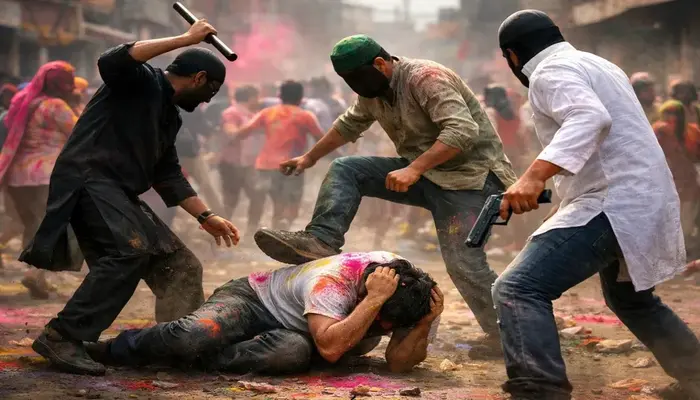
Case Summary
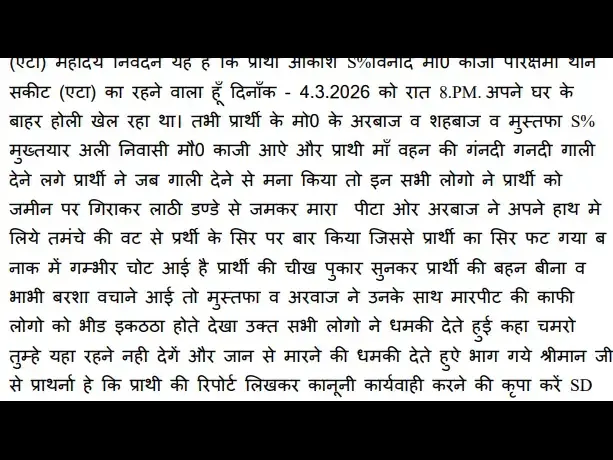
In Mohalla Qazi of Etah district, Uttar Pradesh, a Dalit Hindu youth named Akash was brutally assaulted by three Muslim brothers, Arbaaz, Shahbaz, and Mustafa, after colour accidentally fell on their clothes while playing Holi. According to the FIR, the incident occurred on the evening of 4 March 2026, when Akash, the 22-year-old son of Vinod, was celebrating the Holi festival with other youths in the locality. During this time, the three Muslim brothers, Arbaaz, Shahbaz, and Mustafa, sons of Multyar Ali and residents of the same locality, passed by and colour was inadvertently splashed onto them. Instead of accepting the accidental nature of the incident, the accused began hurling filthy abuses and casteist slurs at Akash and directed offensive remarks towards his mother and sister. When Akash objected to the abuse and asked them to stop, the situation escalated rapidly as the three brothers threw him to the ground and began assaulting him with sticks. During the assault, Arbaaz struck Akash on the head with the butt of a pistol he was carrying, causing a fracture and severe injuries to his head and nose. Hearing his cries and seeing him bleeding, Akash’s sister Bina and sister-in-law Varsha rushed to rescue him, but Mustafa and Arbaaz also assaulted them when they attempted to intervene. As a crowd began gathering at the scene, the accused threatened the victim and his family, stating, “Chamaron tumhe rehne nahi denge” (“We will not allow Chamars to live here”). They also threatened to kill them before fleeing from the spot. Following the attack, Akash filed a written complaint at the Sakit police station on 6 March 2026. Based on his complaint, police registered an FIR invoking sections 115(2), 351(3), and 352 of the Indian Penal Code for voluntarily causing grievous hurt and assault, along with Section 3(2)(va) of the Scheduled Castes and Scheduled Tribes (Prevention of Atrocities) Act, 1989, since the victim belonged to a Scheduled Caste community. The FIR recorded that the accused abused Akash’s family members, beat him with sticks, and struck his head with the butt of a pistol before threatening to kill him and drive his family out of the locality. Station House Officer Videsh Rathi confirmed that Akash sustained serious injuries in the attack and underwent a medical examination, after which a case was registered, and an investigation was initiated against the three accused brothers.
Case Images
Why it is Hate Crime ?
This case is being added to the tracker under the primary category- Attack not resulting in death. The subcategory selected is - Attacked for opposing radicals or trying to save victim. In several cases, Hindus are attacked for opposing religiously motivated crimes being committed against a fellow Hindu or simply for voicing an opinion opposing radical elements, who either have in the past or continue to persecute Hindus. In such cases, the initial attack against the victim, against which the Hindu was trying to defend the victim, would also need to be classified as a religiously motivated hate crime. Since the initial crime itself was religiously motivated and the subsequent crime of attempting to save the victim or speaking against the radical elements ends up inviting a violent attack, it would also be classified as a religiously motivated hate crime under this category. The other sub-category selected here is - Attacked for Hindu identity. In several cases, Hindus are attacked merely for their Hindu identity without any perceived provocation. A classic example of this category of religiously motivated hate crime is a murder in 2016. 7 ISIS terrorists were convicted for shooting a school principal in Kanpur because they got ‘triggered’ seeing the Kalava on his wrist and tilak that he had put. In this, the Hindu victim had offered no provocation except for his Hindu religious identity. The motivation for the murder was purely religious, driven by religious supremacy. Such cases where Hindus are targeted merely for their religious identity would be documented as a hate crime under this category. The second primary category selected here is - Hate speech against Hindus. Within it, the sub-category selected here is - Anti-Hindu slurs, mocking faith. Anti-Hindu slurs and the deliberate mocking of the Hindu faith owing to religious animosity involve the usage of derogatory terms, stereotypes, or offensive references to religious practices, symbols, or figures. One of the common anti-Hindu slurs used against Hindus is “cow-worshipper” and “cow piss drinker”. The intention of using this term is to demean and mock Hindus as a group and their religious beliefs since Hindus consider the cow holy. Additionally, some symbols and the slurs attached to them have a historical context that exacerbates the insult, hate, stereotyping, dehumanisation and oppression against Hindus. Cow worship has been used for centuries to denigrate Hindus, insult their faith and oppress Hindus specifically as a religious group. There has been overwhelming documentation about how cow slaughter has been used to persecute Hindus with cow meat being thrown in temples and places of worship. There has also been overwhelming documentation where cow meat (beef) has been force-fed to Hindus to either forcefully convert them to Islam or denigrate their faith. Apart from cow worship, the Swastika – which holds deep religious significance for the Hindus – has also been misinterpreted and distorted to use as a slur against Hindus. Similarly, the worship of the Shivling has been used by supremacist ideologies and religions to denigrate Hindus owing to religious animosity. Such slurs and denigration stem out of inherent animosity and hate towards Hindus and their faith, therefore, it is categorised as hate speech targeted at Hindus specifically owing to their religious identity. This case has been added to the tracker as it represents targeted violence against a Dalit Hindu individual that arose in the context of the celebration of a Hindu religious festival. The incident occurred during the festival of Holi, when the victim, Akash, was playing Holi and colours accidently spilled on the Muslim youths, after which they brutally assaulted him. The victim was celebrating Holi in a customary manner by playing with colours among his friends. Holi is one of the most widely celebrated festivals in Hinduism, which is traditionally marked by the public exchange of colours, water, and festive interaction among community members. Practices such as applying coloured powder and throwing coloured water form an integral part of the cultural and religious expression associated with Holi. In this instance, the dispute began when colour accidentally fell on three Muslim men, Arbaaz, Shahbaz, and Mustafa, who were passing through the area. What began as an unintended and routine occurrence associated with Holi celebrations rapidly escalated into a violent assault. In plural and densely populated localities, such incidents during festivals are typically resolved through dialogue, clarification, or a simple apology, as the playful exchange of colours is an expected feature of Holi celebrations. However, instead of resolving the matter peacefully, the Muslim accused responded with verbal abuse and casteist slurs. The situation then escalated into a violent attack, where the accused brutally assaulted him, causing serious injuries. The severity of violence inflicted on the victim demonstrates that the response went far beyond a routine misunderstanding arising during festival celebrations. The violence stemmed from a benign and culturally rooted act, playing Holi with colours, but this simple expression of faith and celebration provoked hostility. When a routine and culturally recognised aspect of a Hindu religious celebration becomes the catalyst for violence, it demonstrates intolerance toward the public expression of that religious practice. The attack, therefore, reflected religious profiling and direct targeting of a Hindu man for his faith and customs. Such assaults on Hindus based on their religious identity constitute clear instances of religiously motivated hate crimes. In this case, the victim was abused with casteist slurs by the Muslim accused, which demonstrates religious animosity. It can be argued that a caste-specific slur was aimed at his micro identity of belonging to the Dalit section of the Hindu community and not his Hindu identity itself. However, as far as Abrahamic religions are concerned, the micro identities of caste, region, and language are secondary. It is the religious identity that drives the animosity of the perpetrator against the Hindu victim. In this case, while the accused hurled caste abuses at the victim, the animosity was driven by his animosity towards Hinduism and Hindus. The fact that caste slurs were hurled at the victim by the perpetrator makes it a religiously motivated hate crime against the victim. The assault also extended to other members of the victim’s family. When Akash’s sister and sister-in-law attempted to intervene and rescue him, they were also physically assaulted by the attackers. The accused threatened the victim and his family and warned that they would not be allowed to live in the locality. Such threats, combined with the physical violence and the caste-based slurs, indicate an attempt not only to harm the victim but also to intimidate and terrorise his family because of their Hindu identity and public expressions of their faith. Acts of violence that include threats of expulsion from a locality and humiliation through caste abuse demonstrate a broader intent to assert dominance and create fear within the Hindu community. The intent was not only to inflict physical harm but also to provoke, humiliate and terrorise Hindus during their sacred celebration. This pattern reflects a wider issue where expressions of Hindu religious and cultural practices in shared spaces become flashpoints for confrontation. Festivals such as Holi involve public celebration and communal participation, and hostility toward these expressions can manifest through attempts to restrict, punish, or violently retaliate against participants. When such violence is triggered by activities connected to a Hindu festival, it sends a message that participation in religious celebrations will provoke retaliation. This can lead to the gradual erasure of Hindu cultural practices from public spaces, as individuals refrain from openly celebrating their traditions out of fear of retaliation and violence. Taken together, the circumstances of this incident demonstrate clear elements of religious hostility linked to the celebration of a Hindu religious festival and the religious and caste identity of the victim, and for these reasons, the case has been included in the hate crime database.
Victim Details
Total Victim
3
Deceased
0
Gender
- Male 1
- Female 2
- Third Gender 0
- Unknown 0
Caste
- SC/ST 3
- OBC 0
- General 0
- Unknown 0
Age Group
- Minor 0
- Adult 3
- Senior Citizen 0
- Unknown 0


Case Status
Complaint registered


Perpetrators Details
Perpetrators
Muslim Extremists
Perpetrators Range
From 2 To 5
Perpetrators Gender
male
 Sources




