Hindu youth brutally assaulted by Muslims over social media post about Muslim religious leader
 Koppal, Karnataka, India
  2 March, 2026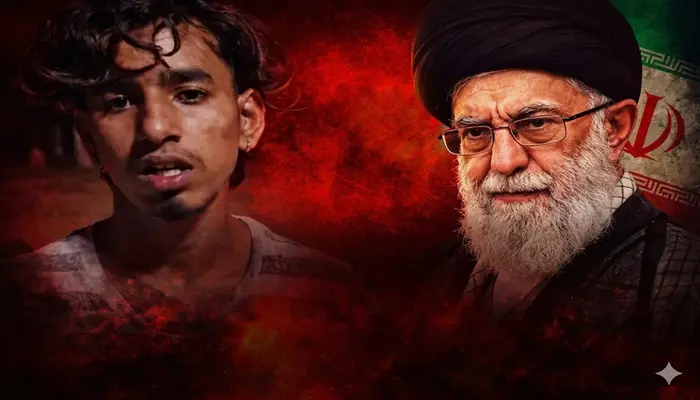
Case Summary
In Gangavathi town of Koppal district in Karnataka, a Hindu youth named Chandrashekhar was brutally assaulted by a group of Muslim men after he shared an Instagram story about Iranian Supreme Leader Ali Khamenei. According to reports, the victim, Chandrashekhar, who runs a dry fruit business in the town, had posted a news update on his Instagram story stating that Khamenei had been killed in missile strikes carried out by the United States and Israel. The post angered a group of local Muslim youths who developed hostility towards him over the social media update. The dispute began on the night of 3 March 2026, when Chandrashekhar was working inside his dry fruit shop in Gangavathi, when another group of around five to six Muslim youths entered the premises. The group surrounded him and began verbally abusing him over the Instagram post. They accused him of hurting religious sentiments and soon escalated the confrontation into a violent attack. The Muslim youths brutally assaulted Chandrashekhar inside his shop and issued death threats during the assault. They warned him that they would enter his house and eliminate him and his family if he continued to post such content on social media. Terrified by the threats and violence, Chandrashekhar rushed to the Gangavathi Town Police Station late at night and filed a complaint seeking protection. Following his complaint, the police registered a case and initiated an investigation into the incident. Authorities began examining CCTV footage from around the shop and nearby areas in order to identify the attackers and proceed with legal action. The incident created tension in the locality, prompting the administration to deploy additional police personnel in the area to prevent any escalation of the situation. Hindu organisations also demanded the immediate arrest of those involved in the assault, stating that attacking an individual for sharing an international news update on social media amounted to an attack on freedom of expression.
Why it is Hate Crime ?
This case has been added to the tracker under the primary category of - Attack not resulting in death. Within it, the sub-category selected is - Attacked for opposing radicals or trying to save victim. In several cases, Hindus are attacked for opposing religiously motivated crimes being committed against a fellow Hindu or simply for voicing an opinion opposing radical elements, who either have in the past or continue to persecute Hindus. In such cases, the initial attack against the victim, against which the Hindu was trying to defend the victim, would also need to be classified as a religiously motivated hate crime. Since the initial crime itself was religiously motivated and the subsequent crime of attempting to save the victim or speaking against the radical elements ends up inviting a violent attack, it would also be classified as a religiously motivated hate crime under this category. The other sub-category selected is - Attacked over 'Blasphemy'. Blasphemy essentially refers to the desecration of anything which is held sacred/holy to a group of people. However, for religious supremacist groups, the elements of ‘blasphemy’ are ever-changing, shifting and expanding – leading to infringement on the rights of other religious groups, freedom of speech and expression, threats and even physical violence. There are instances where blasphemy is also used as a dog whistle to target Hindus owing to intrinsic animosity towards Hinduism. There are several instances where stating truths as mentioned in the non-Hindu doctrine itself has led to unmitigated violence against Hindus. There have also been instances where non-Hindus have themselves created a ‘blasphemous’ situation, like placing a Quran in a temple, to use it as an excuse to attack Hindus. Essentially, Blasphemy charges are often made up and/or are used to shut down any form of criticism of non-Hindu faiths and as a tool to target Hindus. Any physical violence over Blasphemy charges against Hindus are foundationally based on animosity for Hindus and their faith owing to religious supremacist ideologies, therefore, such attacks would be documented as religious motivated hate crimes under this category. The case has been added to the tracker because of the assault of a Hindu youth, Chandrashekhar, by a group of Muslim youths after he shared an Instagram story about the killing of Iran’s Supreme Leader Ali Khamenei. The post triggered hostility among some local Muslim youths who took offence at the content. On the evening of 3 March 2026, a Muslim youth named Shaheen, along with his associates, confronted Chandrashekhar near Jamia Masjid, leading to a heated argument. Later that night, a group of around five to six Muslim youths entered Chandrashekhar’s shop, verbally abused him over the Instagram post, physically assaulted him, and issued death threats. Ali Khamenei was not merely a political authority but also a central religious figure within Iran’s theocratic system of governance. As the Supreme Leader, he held the highest political office in the country while simultaneously serving as a senior Shiite Islamic cleric whose authority derived from religious doctrine. His position merges political leadership with religious influence, making him a significant religious figure for many Muslims in India and around the world. Over the years, Khamenei has also been criticised for remarks and positions perceived as hostile towards non-Islamic faith traditions, including Hindu practices in India. His commentary on issues such as communal tensions in India has often framed the situation through a religious lens, drawing criticism for amplifying narratives that portray Hindus in a negative light, while simultaneously portraying Muslims as victims. It is pertinent to note that Muslim extremists harbour specific animosity towards Hindus and their faith and also view India as a Hindu collectivity. The very basis of the partition of India was that the Muslims believed that Islam was a nation unto itself, which could not survive with a Hindu collectivity like India. Thus, by attacking Chandrashekhar over a social media post concerning Ali Khamenei, the Muslim youths were effectively expressing a form of transnational religious loyalty that prioritised allegiance to a global Islamic figure. Their reaction demonstrated that the issue was not merely disagreement with a post but a perceived obligation to defend a religious authority associated with the broader Muslim world. In doing so, they attempted to enforce religious sensitivities through intimidation and violence against a Hindu individual. This behaviour reflects the ideological framework in which loyalty to the global Muslim community or religious leadership is treated as paramount, even when it results in hostility towards members of other religious groups within one’s own country. By targeting Chandrashekhar for discussing an international political and religious figure, the attackers sought to silence him through force, reinforcing a narrative where criticism or discussion of Islamic figures by non-Muslims is treated as unacceptable, punishable or even blasphemous. In many instances involving religiously motivated violence, accusations of blasphemy play a central role in triggering attacks. While such allegations are often associated with perceived insults against the Prophet Muhammad/Allah/Quran, they are not limited to remarks about the Prophet alone. Hindu Individuals have also been targeted for statements relating to Islamic religious leaders, political figures, or historical personalities associated with Islam. In such contexts, any perceived criticism, discussion, or negative reference to figures revered within the Muslim community can be framed as an act of blasphemy. The threshold for what constitutes blasphemy, therefore, becomes highly subjective and fluid, allowing accusations to extend beyond strictly religious matters and encompass political or historical commentary as well. In many such cases, Muslim mobs require only a perceived insult as a trigger to attack non-Muslims, particularly Hindus. The allegation of blasphemy often becomes a convenient pretext that can be exaggerated or even fabricated to justify aggression. Because the criteria for what constitutes blasphemy are vague and constantly shifting, Muslims are able to weaponise the accusation at will, making Hindus easy targets of intimidation and violence. Even a mere allegation can be enough to provoke outrage, mob mobilisation, and assaults on Hindu victims. Historically, such accusations have also been used to settle personal disputes, silence criticism, or intimidate individuals into submission. The repeated targeting of Hindus under the guise of defending religious sentiments illustrates how blasphemy allegations can function as a tool to incite hostility and unleash violence against members of another faith community. A similar pattern has been observed in other incidents where perceived insults towards Islamic figures have triggered violence against Hindus. For example, in 2022, a Hindu youth named Prakash Lonare in Bagalkote, Karnataka, was attacked by a mob of around 15–20 people after he posted a smiley emoji on a social media post related to Tipu Sultan, which some individuals considered disrespectful. In another case, political commentator and journalist Nupur J. Sharma received widespread threats and calls for violence after remarks referencing Khwaja Moinuddin Chishti were circulated online and portrayed as insulting the revered Sufi figure. These incidents demonstrate how even minor expressions, social media reactions, or discussions about religious personalities can be framed as blasphemous and used to justify threats, mob mobilisation, or violence against Hindus. The assault, therefore, cannot be seen as a mere interpersonal dispute over a social media post. Chandrashekhar was targeted specifically because he was a Hindu who had shared content relating to a prominent Islamic religious figure. The violent reaction of the Muslim youths was rooted in religious animosity and a desire to punish a Hindu individual for engaging with or commenting on a figure they associated with their faith. The attack was thus motivated by religion-based hostility, making it a clear instance where violence was directed at the victim because of his religious identity.
Victim Details
Total Victim
1
Deceased
0
Gender
- Male 1
- Female 0
- Third Gender 0
- Unknown 0
Caste
- SC/ST 0
- OBC 0
- General 0
- Unknown 1
Age Group
- Minor 0
- Adult 1
- Senior Citizen 0
- Unknown 0


Case Status
Complaint registered


Perpetrators Details
Perpetrators
Muslim Extremists
Perpetrators Range
From 5 to 10
Perpetrators Gender
male
 Sources




