Hindu families brutally attacked over playing Holi by Muslims in Barabanki, Uttar Pradesh
 Bara Banki, Uttar Pradesh, India
  3 March, 2026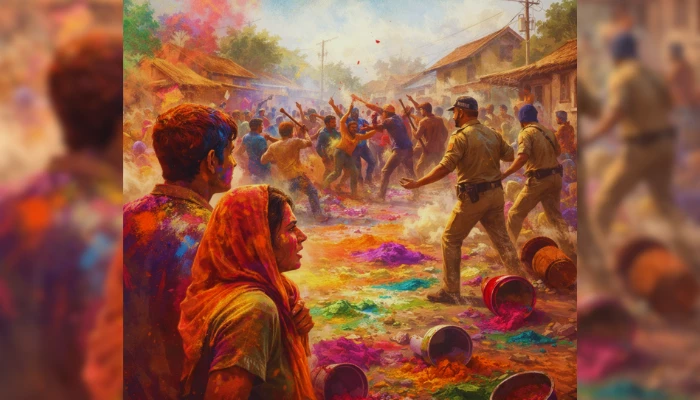
Case Summary
In Tikaria village, Barabanki, Hindu residents celebrating Holi were attacked by a group of Muslim men after a minor dispute occurred over Holi colours. Eleven Hindus were injured as sticks, rods, and knives were used to attack them. This incident occurred on 4 March 2026. The incident took place during Holi celebrations in Tikaria village under Deva police station. Hindu families and youths were playing with gulal (colours) near the village lanes when a dispute arose with Muslim residents. Within minutes, this escalated as the Muslim side launched an attack. This further led to a communal clash between Hindus and Muslims. Sticks, batons, and iron rods were used in the fight by the Muslim group, and eleven Hindus sustained injuries. In this clash, 8 people from the Muslim side were injured. One of the Hindu victims, Awadesh, stated, “When no male members were at home, the Muslim men entered and assaulted my family. When others and I came to defend, we were beaten mercilessly. Four Muslim men held me and attacked me with a knife.” Locals described the scene as chaotic, with Hindu families rushing indoors to avoid the confrontation. Police reached the spot promptly and brought the situation under control. Officers confirmed that First Information Reports (FIRs) were being registered and complaints had been received from both sides. Patrolling was intensified in the area to prevent further escalation.
Why it is Hate Crime ?
This case is being added to the tracker under the primary category- Attack not resulting in death. The selected subcategory is- Attacked for Hindu identity. In several cases, Hindus are attacked merely for their Hindu identity without any perceived provocation. A classic example of this category of religiously motivated hate crime is a murder in 2016. 7 ISIS terrorists were convicted for shooting a school principal in Kanpur because they got ‘triggered’ seeing the Kalava on his wrist and the tilak that he had put. In this, the Hindu victim had offered no provocation except for his Hindu religious identity. The motivation for the murder was purely religious, driven by religious supremacy. Such cases where Hindus are targeted merely for their religious identity would be documented as a hate crime under this category. The other sub-category is- Attacked for opposing radicals or trying to save a victim. In several cases, Hindus are attacked for opposing religiously motivated crimes being committed against a fellow Hindu or simply for voicing an opinion opposing radical elements, who either have in the past or continue to persecute Hindus. In such cases, the initial attack against the victim, against which the Hindu was trying to defend the victim, would also need to be classified as a religiously motivated hate crime. Since the initial crime itself was religiously motivated and the subsequent crime of attempting to save the victim or speaking against the radical elements ends up inviting a violent attack, it would also be classified as a religiously motivated hate crime under this category. The other subcategory selected is- Communal clash/attack. Communal clash is a form of collective violence that involves clashes between groups belonging to different religious identities. For a communal clash between Hindus and non-Hindus to qualify as a religiously motivated hate crime, the trigger of the violence itself would have to be anti-Hindu in essence. For example, if there is a Hindu religious procession that comes under attack from a non-Hindu mob and after the initial attack, Hindus retaliate in self-defence, leading to a communal clash between the two religious communities. While at a later stage, both communities are involved in the clash/violence, the initial trigger of the violence was by the non-Hindu mob against the Hindus, and therefore, it could safely be termed as an anti-Hindu violence. Further, the trigger would also have to be religiously motivated. In the cited example, the attack by the non-Hindu mob was against religious processions and therefore can be concluded to be religiously motivated. In some cases, the trigger may be non-religious; however, it develops into religious violence against Hindus at a later stage. In such cases, too, the foundational animosity towards Hindus becomes the motivating factor of the crime, and therefore, it would be classified as a religiously motivated hate crime against Hindus under this category. This case was added to the tracker because it demonstrated how a routine act associated with a Hindu religious festival became the trigger for violence directed at those participating in it, ultimately developing into a broader communal confrontation. The sequence of events illustrated how Hindus celebrating their Holi festival were attacked by Muslims in circumstances where the only identifiable factor was their participation in a Hindu religious celebration. Holi is one of the most vibrant Hindu festivals, traditionally marked by colours, laughter, and playful interaction among neighbours and friends. Playing with colours is not merely a casual activity but an intrinsic part of the festival itself. In this context, the Hindus involved were participating in a customary festive practice that forms the core of Holi celebrations. Their actions reflected nothing beyond the normal expression of their religious and cultural traditions. Attacking Hindus immersed in these celebrations desecrated their faith at its heart, transforming a moment of celebration into terror. Such violence during Holi directly insulted the Hindu faith and traditions, confirming the religious nature of the crime. By targeting Hindu families and youths playing with gulal in Tikaria village, Barabanki, the Muslim group aimed to humiliate and suppress Hindu practices, making this unequivocally a hate crime fuelled by animosity towards Hinduism. Overall, the brutality of the violence clearly showcased communal motivations. The assault was brutal and deliberate, showcasing a clear example of communal violence. When Hindus are attacked solely for their religious identity during Holi festivities, it reveals an underlying hostility rooted in contempt for their faith, symbols of worship, and cultural practices such as Holi. The fact that the assault occurred during active Holi celebrations underscored that the intent was not only to inflict physical harm but also to provoke, humiliate, and terrorise Hindus during their sacred festival. The timing exposed a calculated effort to undermine and desecrate the spirit of Holi. This was therefore not an isolated dispute over colours but a targeted act of intimidation against Hindus, making it a clear and deliberate case of a religiously motivated hate crime. The situation subsequently developed into a broader clash involving members of both communities. Yet the sequence of events made it clear that the violence began when Hindus celebrating Holi were attacked, after which the confrontation widened. In such situations, even though violence may later involve individuals from both sides, the initial aggression directed at those celebrating a Hindu festival formed the defining trigger of the incident. An even more alarming aspect of the incident was that the Muslim attackers did not stop at confronting the Hindu victims outside. The Muslim perpetrators entered Awadesh's house and continued the assault inside the private space of the family. Awadesh was brutally attacked when he tried to protect his relatives from the Muslim attackers who had barged into their home. His only act was to shield his family, yet he became a primary target of the violence and was beaten with sticks and rods. The intrusion into the house transformed the episode from a street altercation into a direct invasion of a Hindu family’s safety and dignity within their own home. The Muslim group stormed a residence and assaulted a Hindu man simply for defending his loved ones; it revealed that the aggression was not about colours or a fleeting dispute but about intimidating and overpowering the Hindu family itself during a Hindu festival. Such episodes left a lasting impression on local communities, reinforcing the perception that deep-seated religious animosity could turn even a simple act of familial protection into a reason for brutal retaliation. These actions deepened the climate of fear, signalling to the wider Hindu community that even their homes might not remain safe when hostility around their religious celebrations escalated. At the same time, the case reflected a troubling pattern that had appeared repeatedly in several parts of the country where routine Hindu festivals became flashpoints for communal confrontations. When the normal cultural expression of a festival such as Holi became the cause of hostility and violent retaliation, it showcases deep-seated underlying religious hostility towards Hinduism and the Hindu community, making it a religiously motivated crime. Given that this case meets the parameters of a hate crime, it is being added to the Hate Crime database of the Hinduphobia tracker. Disclaimer: Media reports stated that 11 Hindu villagers were injured in Manethu village under Gajner police station, Kanpur Dehat, but no gender-wise breakdown was provided. For documentation clarity, the Hinduphobia Tracker has applied a proportional demographic estimate based on India’s Census 2011 and NFHS 5 (2019–21) rural population data. Accordingly, the 11 victims are estimated as 6 men (55%) and 5 women (45%), reflecting a balanced gender distribution consistent with typical rural family demographics. Media reports in this case did not specify the total number of Muslim perpetrators. They stated only that 8 Muslims were also injured as a result of the communal clash, which they had started. Hence, the perpetrator count has been recorded as 8. This is a conservative estimate.
Victim Details
Total Victim
11
Deceased
0
Gender
- Male 6
- Female 5
- Third Gender 0
- Unknown 0
Caste
- SC/ST 0
- OBC 0
- General 0
- Unknown 11
Age Group
- Minor 0
- Adult 0
- Senior Citizen 0
- Unknown 11


Case Status
Complaint registered


Perpetrators Details
Perpetrators
Muslim Extremists
Perpetrators Range
From 5 to 10
Perpetrators Gender
male
 Sources




