Hindu youths brutally attacked for celebrating Holi by group of Muslim men in Chandauli, Uttar Pradesh
 Chandauli, Uttar Pradesh, India
  4 March, 2026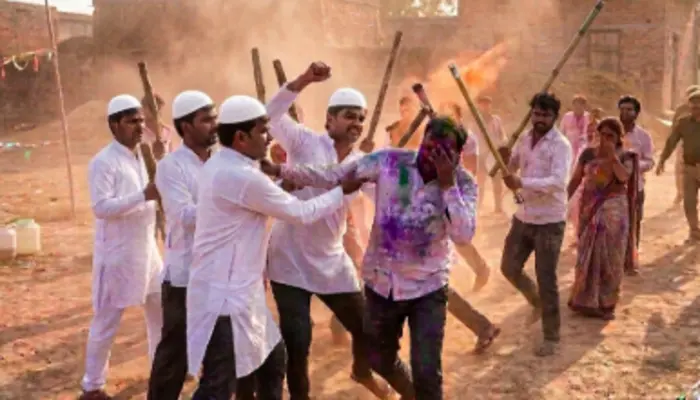
Case Summary
In the Dudhari-Tenduhan village of Chandauli district, Uttar Pradesh, Hindu youths were brutally attacked for celebrating Holi by a group of Muslim men. The incident occurred on 5 March 2026, when a group of Hindu youths were dancing to Holi songs and playing with colours/abir. During the celebrations, colours were splashed on a Muslim man named Khurshid, a resident of Dudhari village, while he was travelling in an e-rickshaw. This triggered a dispute between the two sides, which quickly escalated into a physical fight after Khurshid called more people from his village. The clash turned violent as the group of Muslim men used sticks, hockey sticks, and sharp weapons during the assault, resulting in multiple injuries. During this time, members of the Muslim community also entered the house of one of the Hindu villagers, brutally assaulting him. Around half a dozen people were injured in the incident, including two Hindu men named Shashi Prakash and Chandan suffering serious injuries. They were later admitted to the district hospital for treatment. Other injured individuals were also taken to the District Joint Hospital. News of the clash spread quickly, drawing residents from surrounding areas to the spot and creating a tense atmosphere in the village. Police from Syedaraja police station reached the location after receiving information about the incident and worked to bring the situation under control. Based on the complaint filed by the injured individuals, a case was registered against four Muslim men, and several individuals were detained for questioning. Three accused were arrested and taken to the police station. Given the tension in the area, police forces were deployed in the village as a precautionary measure while authorities continued their investigation.
Why it is Hate Crime ?
This case is being added to the tracker under the primary category- Attack not resulting in death. The subcategory selected is - Communal clash/attack. Communal clash is a form of collective violence that involves clashes between groups belonging to different religious identities. For a communal clash between Hindus and non-Hindus to qualify as a religiously motivated hate crime, the trigger of the violence itself would have to be anti-Hindu in essence. For example, if there is a Hindu religious procession that comes under attack from a non-Hindu mob and after the initial attack, Hindus retaliate in self-defence, leading to a communal clash between the two religious communities. While at a later stage, both communities are involved in the clash/violence, the initial trigger of the violence was by the non-Hindu mob against the Hindus and therefore, it could safely be termed as an anti-Hindu violence. Further, the trigger would also have to be religiously motivated. In the cited example, the attack by the non-Hindu mob was against religious processions and therefore, can be concluded to be religiously motivated. In some cases, the trigger may be non-religious, however, it develops into religious violence against Hindus at a later stage. In such cases too, the foundational animosity towards Hindus becomes the motivating factor of the crime and therefore, it would be classified as a religiously motivated hate crime against Hindus under this category. The other sub-category selected is - Attacked for Hindu identity. In several cases, Hindus are attacked merely for their Hindu identity without any perceived provocation. A classic example of this category of religiously motivated hate crime is a murder in 2016. 7 ISIS terrorists were convicted for shooting a school principal in Kanpur because they got ‘triggered’ seeing the Kalava on his wrist and tilak that he had put. In this, the Hindu victim had offered no provocation except for his Hindu religious identity. The motivation for the murder was purely religious, driven by religious supremacy. Such cases where Hindus are targeted merely for their religious identity would be documented as a hate crime under this category. This case has been added to the tracker as it represents violence against Hindus by members of the Muslim community that arose directly from the hostility surrounding the celebration of a Hindu religious festival. The incident took place during the festival of Holi, where Hindu youths were celebrating in a customary manner by dancing to Holi songs and playing with colours/abir. Holi is one of the most widely celebrated festivals in Hinduism, which is traditionally marked by the public exchange of colours, water, and festive interaction among community members. Practices such as applying coloured powder and throwing coloured water form an integral part of the cultural and religious expression associated with Holi. In this instance, the dispute began when colour was splashed on a Muslim man named Khurshid while he was travelling through the area. What began as a minor disagreement connected to a routine aspect of Holi festivities rapidly escalated into a violent confrontation. In plural and densely populated localities, such incidents during festivals are typically resolved through dialogue, clarification, or a simple apology, as the playful exchange of colours is an expected feature of Holi celebrations. However, instead of resolving the matter peacefully, the situation escalated when the accused, Khurshid, called additional Muslim men from his village for the attack, transforming a minor disagreement into a broader confrontation. The mobilisation of Muslim men and the subsequent escalation into a violent clash demonstrate that the response went far beyond a routine misunderstanding arising during festival celebrations. The violence stemmed from a benign and culturally rooted act, playing Holi with colours, but this simple expression of faith and celebration provoked hostility. The attack, therefore, reflected religious profiling and direct targeting of Hindu villagers for their faith and customs. Such assaults on Hindus based on their religious identity constitute clear instances of religiously motivated hate crimes. The nature of the violence further highlights the disproportionate reaction to a trivial trigger connected to a Hindu religious celebration. The Muslim men used sticks, hockey sticks and sharp weapons during the assault, resulting in injuries to several Hindu villagers. The confrontation also extended beyond the immediate location as members of the Muslim group entered the house of a Hindu villager and carried out an assault there. When a routine and culturally recognised aspect of a Hindu religious celebration becomes the catalyst for violence, it demonstrates intolerance toward the public expression of that religious practice. The fact that several individuals were injured in the attack, including Shashi Prakash and Chandan, who sustained serious injuries, underscores the severity of the violence. It is evident that the real motive was religious hatred directed at the Hindu youths for publicly expressing their faith and cultural traditions. The brutality of the attack displays deep-seated religious animosity and intolerance towards Hindus and their customs, turning what should have been a peaceful festival into a violent episode of hate and aggression, clearly constituting a religiously motivated hate crime. The intent was not only to inflict physical harm but also to provoke, humiliate and terrorise Hindus during their sacred celebration. This pattern reflects a wider issue where expressions of Hindu religious and cultural practices in shared spaces become flashpoints for confrontation. Festivals such as Holi involve public celebration and communal participation, and hostility toward these expressions can manifest through attempts to restrict, punish, or violently retaliate against participants. When such violence is triggered by activities connected to a Hindu festival, it sends a message that participation in religious celebrations will provoke retaliation. This can lead to the gradual erasure of Hindu cultural practices from public spaces, as individuals refrain from openly celebrating their traditions out of fear of retaliation and violence. Taken together, the circumstances of the incident demonstrate clear indicators of religion-based hostility. This shows that the incident unfolded in a context where the expression of a Hindu religious practice became the focal point of confrontation and retaliation. For these reasons, the case has been added to the hate crime database. Disclaimer: The Hinduphobia Tracker acknowledges that multiple individuals were injured during the attack carried out by the Muslim group. However, only two victims, Shashi Prakash and Chandan, were explicitly identified in the available reports. Therefore, the victim count in this case has been recorded as two, based on the individuals whose identities were clearly mentioned in the sources.
Victim Details
Total Victim
2
Deceased
0
Gender
- Male 2
- Female 0
- Third Gender 0
- Unknown 0
Caste
- SC/ST 0
- OBC 0
- General 0
- Unknown 2
Age Group
- Minor 0
- Adult 0
- Senior Citizen 0
- Unknown 2


Case Status
Case sub-judice


Perpetrators Details
Perpetrators
Muslim Extremists
Perpetrators Range
From 2 To 5
Perpetrators Gender
male
 Sources




