Hindu men celebrating Holi brutally attacked by unidentified assailants in Rudrapur, Uttarakhand
 Udham Singh Nagar, Uttarakhand, India
  3 March, 2026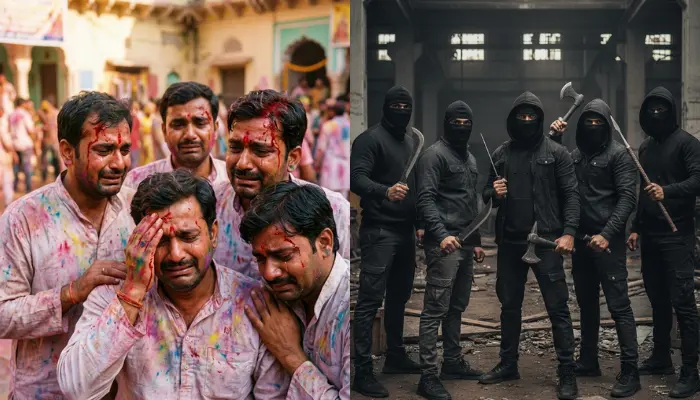
Case Summary
In Transit Camp at the Awas Nagar area of Rudrapur, located in the Udham Singh Nagar district of Uttarakhand, a group of Hindu men celebrating Holi were brutally assaulted by a few unidentified assailants. The accused severely injured the Hindu victims, causing fear in the entire area. According to reports, this incident occurred on 4 March 2026 at the Transit Camp. The Hindu victims were playing Holi with colours when some young unidentified men on bikes suddenly attacked the victims. According to eyewitnesses, the victims were celebrating Holi in a friendly manner outside their office in Awas Vikas. Suddenly, some unidentified men arrived on bikes. They began attacking them without any discussion or verbal argument. The attackers hit a young Hindu man named Himanshu Arora on the head with a liquor bottle, seriously injuring him. Following the incident, other Hindu victims present at the scene were also brutally assaulted. Himanshu was immediately taken to the district hospital, where doctors treated him. At the time of writing this report, his condition was stable. Eyewitness Asan Arora stated that the attackers attacked Himanshu without a word. When other people tried to intervene, they were also assaulted. Asan Arora also stated that one of the attackers pointed a pistol at him, which frightened those present at the scene. However, somehow mustering courage, the people chased the attackers away, after which they fled the scene.
Why it is Hate Crime ?
This case is being added to the tracker under the primary category- Attack not resulting in death. The subcategory selected is- Attacked for Hindu identity. In several cases, Hindus are attacked merely for their Hindu identity without any perceived provocation. A classic example of this category of religiously motivated hate crime is a murder in 2016. 7 ISIS terrorists were convicted for shooting a school principal in Kanpur because they got ‘triggered’ seeing the Kalava on his wrist and tilak that he had put. In this, the Hindu victim had offered no provocation except for his Hindu religious identity. The motivation for the murder was purely religious, driven by religious supremacy. Such cases where Hindus are targeted merely for their religious identity would be documented as a hate crime under this category. The other subcategory selected- Communal Clash/Attack. Communal clash is a form of collective violence that involves clashes between groups belonging to different religious identities. For a communal clash between Hindus and non-Hindus to qualify as a religiously motivated hate crime, the trigger of the violence itself would have to be anti-Hindu in essence. For example, if there is a Hindu religious procession that comes under attack from a non-Hindu mob and after the initial attack, Hindus retaliate in self-defence, leading to a communal clash between the two religious communities. While at a later stage, both communities are involved in the clash/violence, the initial trigger of the violence was by the non-Hindu mob against the Hindus and therefore, it could safely be termed as an anti-Hindu violence. Further, the trigger would also have to be religiously motivated. In the cited example, the attack by the non-Hindu mob was against religious processions and therefore, can be concluded to be religiously motivated. In some cases, the trigger may be non-religious, however, it develops into religious violence against Hindus at a later stage. In such cases too, the foundational animosity towards Hindus becomes the motivating factor of the crime and therefore, it would be classified as a religiously motivated hate crime against Hindus under this category. The other subcategory selected is- Attacked for opposing radicals or trying to save victim. In several cases, Hindus are attacked for opposing religiously motivated crimes being committed against a fellow Hindu or simply for voicing an opinion opposing radical elements, who either have in the past or continue to persecute Hindus. In such cases, the initial attack against the victim, against which the Hindu was trying to defend the victim, would also need to be classified as a religiously motivated hate crime. Since the initial crime itself was religiously motivated and the subsequent crime of attempting to save the victim or speaking against the radical elements ends up inviting a violent attack, it would also be classified as a religiously motivated hate crime under this category. This case stood as a clear instance of a religiously motivated hate crime, as the perpetrators targeted and assaulted Hindu youths while they were celebrating Holi. When other Hindus tried to intervene to save them, the perpetrators brutally assaulted those protectors as well. The overall attack on Hindus during their Holi celebrations amounted to a deliberate assault driven by religious hatred, singling out the victims purely for their faith and festive joy. Holi holds profound religious significance for Hindus, marking the triumph of good over evil through the story of Prahlad's devotion to Lord Vishnu and the demoness Holika's fiery demise. Families and communities gather to light bonfires for Holika Dahan and play with colours, symbolising forgiveness, renewal, and the arrival of spring. This sacred festival embodies Hindu identity, fostering unity and devotion. Attacking Hindu men immersed in these rituals desecrated their faith at its heart, transforming a moment of celebration into terror. Such violence during Holi directly insulted Hindu scriptures and traditions, confirming the religious nature of the crime. By targeting youths playing Holi, the perpetrators aimed to humiliate and suppress Hindu practices, making this unequivocally a hate crime fuelled by animosity towards Hinduism. Overall, the brutality of the violence clearly showcased communal motivations. The assault was brutal and deliberate, showcasing a clear example of communal violence. When Hindu youths are attacked solely for their religious identity, it revealed an underlying hostility rooted in contempt for their faith, symbols of worship and cultural practices such as Holi and the custom of playing with water balloons. The fact that the assault occurred during Holi, one of the most significant Hindu festivals, underscored that the intent was not only to inflict physical harm but also to provoke, humiliate and terrorise Hindus during their sacred celebration. The timing of the attack, coinciding with an important religious festival, exposed a calculated effort to undermine and desecrate the spirit of Holi. This was therefore not an isolated dispute but a targeted act of intimidation against Hindus, making it a clear and deliberate case of a religiously motivated hate crime. The fact that the perpetrators arrived armed with weapons such as liquor bottles and pistols showcased a premeditated nature rather than a momentary burst of anger. They did not stumble upon the scene by chance; instead, they sought out the Hindu youths revelling in Holi, launching a coordinated attack with tools designed to cause severe injury. This level of preparation, combined with the specific targeting of Hindus during their festival, pointed directly to religious animosity as the driving force. Ordinary disputes do not involve such weaponry or timing; this violence stemmed from deep-seated hatred towards Hindu celebrations, intended to send a chilling message of religious dominance and fear. The Hindu locals who tried to intervene and protect the victims were also brutally assaulted. This showcased that Hindus who attempted to shield fellow Hindus from religiously motivated violent attacks became targets themselves. The perpetrators aimed to terrorise the entire community, ensuring no one dared help victims of hate crimes. By assaulting bystanders without hesitation, they created an atmosphere of impunity and dread, discouraging solidarity among Hindus. Such tactics amplified the religious hatred, turning a local incident into a broader campaign to isolate and intimidate the Hindu population during their most joyous festival. Given that this case meets the parameters of a religiously motivated hate crime, it is being recorded in the hate crime database of the Hinduphobia Tracker. Disclaimer: In this case, the victim count was recorded as 2, referring to Himanshu Arora and Asan Arora. The Hinduphobia Tracker acknowledged that many more victims suffered in this incident, but since only two were specifically named, the number of victims was recorded as 2. This represented a conservative count for documentation purposes only.
Victim Details
Total Victim
2
Deceased
0
Gender
- Male 2
- Female 0
- Third Gender 0
- Unknown 0
Caste
- SC/ST 0
- OBC 0
- General 2
- Unknown 0
Age Group
- Minor 0
- Adult 2
- Senior Citizen 0
- Unknown 0


Case Status
Unknown


Perpetrators Details
Perpetrators
Unknown
Perpetrators Range
Unknown
Perpetrators Gender
male
 Sources




