Hindu Dalit couple brutally beaten for defending Hindu migrants attacked during Holi in Mohali, Punjab
 Mohali, Punjab, India
  3 March, 2026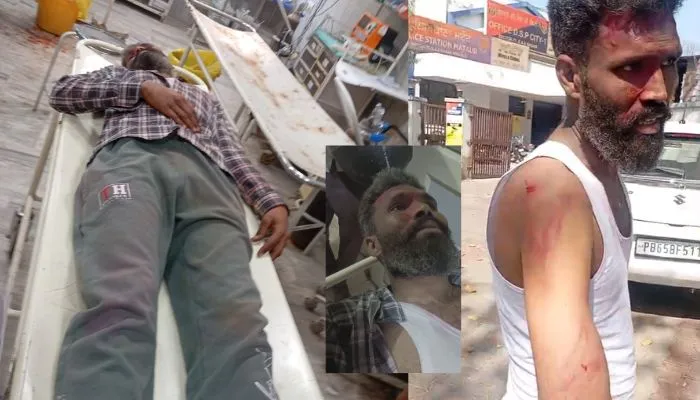
Case Summary
In Mohali, Punjab, Hindu Valmiki activist Rajesh Valmiki Chouhan was assaulted by a group of around 15–16 men while defending other Hindu migrants who were attacked while celebrating Holi. Rajesh's wife was also attacked when she tried to intervene, and the attackers robbed him of ₹5,000 and his mobile phone. On 4 March 2026, Chouhan witnessed Hindu migrants from Uttar Pradesh and Bihar celebrating Holi being beaten in Matour village market near a mosque by 15–16 unknown men, one identified as a Sikh. When he objected to the assault, the group turned on him and launched a violent attack. He was beaten severely, robbed of his belongings, and his wife was manhandled when she attempted to protect him. Chouhan shared videos of his ordeal on social media, showing his injuries and explaining that he had been attacked after opposing the beating of Hindu migrants. In his statement, he said, "Some thugs came and began beating and abusing people, calling them 'UP Bihar wale bhaiye'. Rajesh opposed this, and in retaliation, those thugs launched a murderous attack on him, snatched ₹5,000 and his mobile phone. He added, 'We would not allow Punjab to become Khalistan.'" Locals stated that the clash created panic in the area, with one witness stating, "The Holi celebration turned violent suddenly. Families were frightened to step in." The police confirmed that a complaint had been filed and an enquiry was initiated. Statements were recorded, and authorities assured that strict action would be taken against those responsible. The incident raised concerns about communal tensions during festival gatherings and highlighted the vulnerability of migrant workers. Community representatives noted that such violence undermined the spirit of Holi, which was meant to foster unity and joy.
Why it is Hate Crime ?
This incident has been added to the tracker under the category- Attack not resulting in death. Within this, the sub-category selected is- Attacked for opposing radicals or trying to save a victim. In several cases, Hindus are attacked for opposing religiously motivated crimes being committed against a fellow Hindu or simply for voicing an opinion opposing radical elements, who either have in the past or continue to persecute Hindus. In such cases, the initial attack against the victim, against which the Hindu was trying to defend the victim, would also need to be classified as a religiously motivated hate crime. Since the initial crime itself was religiously motivated and the subsequent crime of attempting to save the victim or speaking against the radical elements ends up inviting a violent attack, it would also be classified as a religiously motivated hate crime under this category. The other sub-category is- Attacked for Hindu identity. In several cases, Hindus are attacked merely for their Hindu identity without any perceived provocation. A classic example of this category of religiously motivated hate crime is a murder in 2016. 7 ISIS terrorists were convicted for shooting a school principal in Kanpur because they got ‘triggered’ seeing the Kalava on his wrist and the tilak that he had put. In this, the Hindu victim had offered no provocation except for his Hindu religious identity. The motivation for the murder was purely religious, driven by religious supremacy. Such cases where Hindus are targeted merely for their religious identity would be documented as a hate crime under this category. This incident reflected a disturbing instance in which a peaceful Hindu religious celebration of the Holi festival became the trigger for targeted violence against Hindu individuals participating in it. Holi is one of the most widely celebrated Hindu festivals and involves the religious application of colours, music and joyous gatherings in public spaces. During the festivities, Hindu men, including migrant workers from Uttar Pradesh and Bihar, were playing with colours as part of the traditional celebrations. These workers had gathered simply to celebrate Holi away from their homes, as migrant communities often do during major festivals to preserve cultural ties and maintain a sense of belonging. However, this celebration resulted in physical violence directed at the Hindu participants. The reaction appeared grossly disproportionate to the circumstances, particularly as the trigger was merely the celebration of a widely observed Hindu festival in a public marketplace. The Dalit Valmiki activist, Chouhan, became a victim when he intervened after witnessing the assault on the migrant workers. The shift in aggression from the migrant celebrants to the activist who attempted to defend them demonstrated that the attackers were willing to target anyone who opposed the violence or stood in support of the Hindu participants. Another notable aspect of the incident was the location and scale of the attack. The assault took place near a mosque in the Matour village market area during the Holi celebrations. The involvement of a large group of approximately 15–16 men significantly intensified the severity of the incident, as a collective group confronting and assaulting a few Hindu individuals celebrating a festival created a clear imbalance of power and increased the sense of intimidation. The presence of a coordinated group engaging in violence suggested that the incident was not merely a spontaneous altercation but a collective act of aggression during a Hindu festival. By targeting Hindu migrants celebrating Holi in Matour village market, Mohali, Punjab, the perpetrators aimed to humiliate and suppress Hindu practices, making this unequivocally a hate crime fuelled by animosity towards Hinduism. Furthermore, assaulting Hindu Valmiki activist Rajesh Valmiki Chouhan, along with manhandling his wife, for opposing the brutal attack on those vulnerable migrants from Uttar Pradesh and Bihar showed that he was targeted for a religiously motivated assault simply because he tried to protect fellow Hindu victims from ongoing hate violence, making it a clear case of religiously motivated violence fuelled by hatred towards Hinduism and the broader Hindu community. The fact that the activist himself was attacked after speaking up against the assault further underscored the atmosphere of intimidation surrounding the incident. Taken together, the assault on migrant Hindu workers celebrating Holi, the subsequent attack on the Dalit Valmiki activist who intervened to defend them, and the involvement of a group of around 15–16 men acting together demonstrated that the incident could not be viewed as an ordinary altercation. The violence emerged in direct connection with the celebration of a Hindu religious festival and was directed at those participating in or defending that celebration. When a peaceful cultural and religious observance became the basis for intimidation and assault, the incident took on the character of hostility towards the religious identity and traditions of those involved. For these reasons, the case was included in the Hinduphobia Tracker's hate crime database as an instance where violence erupted in response to the public celebration of a Hindu festival. Disclaimer: While this tracker acknowledged that around 15–16 men attacked in the Mohali case, for documentation purposes, the religion of the perpetrators was recorded as Sikh since one attacker was identified as Sikh. The religious identities of the remaining perpetrators have not been independently verified at the time of documentation. However, given that they were complicit in the brutal assault, robbery, and manhandling directed toward the Hindu Valmiki activist Rajesh Valmiki Chouhan and Holi-celebrating migrants, the case was recorded under a single perpetrator religion for consistency in categorisation. This approach ensured clarity in data representation without overlooking the involvement of other accused individuals. Since the total number of Hindu migrant victims was not specified and only the Hindu activist Rajesh Valmiki Chouhan and his wife were named, the victim count is recorded as 2. This conservative estimate is recorded for documentation purposes only.
Victim Details
Total Victim
2
Deceased
0
Gender
- Male 1
- Female 1
- Third Gender 0
- Unknown 0
Caste
- SC/ST 2
- OBC 0
- General 0
- Unknown 0
Age Group
- Minor 0
- Adult 2
- Senior Citizen 0
- Unknown 0


Case Status
Complaint filed


Perpetrators Details
Perpetrators
Sikh Extremists
Perpetrators Range
From 10 to 100
Perpetrators Gender
male
 Sources




