Hindu youths attacked by Muslims for accidentally throwing colours during Holi celebrations in Lucknow
 Lucknow, Uttar Pradesh, India
  3 March, 2026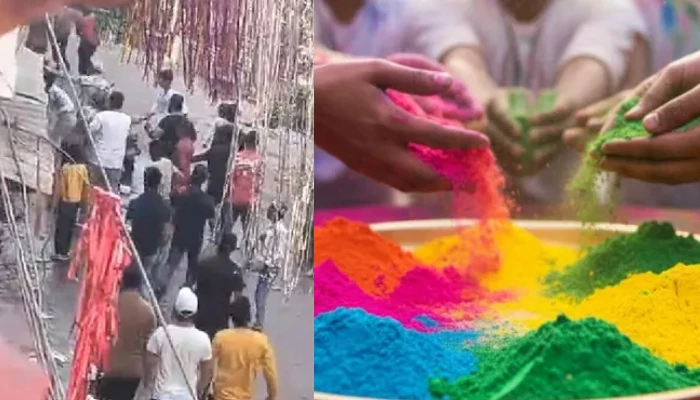
Case Summary
In Lucknow, Uttar Pradesh, Hindu youths playing Holi near Prabha Devi temple were attacked by a group of Muslim men during Holi celebrations over a dispute over gulal (Holi colours). It escalated into stone pelting between the Hindu and Muslim groups. The incident was captured on video and quickly went viral. According to media reports, the dispute began on 4th March 2026 when the Hindu youths were celebrating Holi, and gulal was thrown during the festivities. The gulal accidentally fell on a Muslim passerby, which led to an argument between the Hindu and Muslim groups. The quarrel soon turned violent as Muslims launched an attack. After this, people were seen hitting each other and later resorting to stone pelting. Videos circulating online showed men engaged in a heated scuffle outside the temple premises, alarming devotees and bystanders. Locals expressed concern over the violence at a religious site during a festival meant for joy and community bonding. One resident commented, “People had come to celebrate Holi, not to fight. It was disturbing to see such behaviour near the temple.” Police officials confirmed that they had launched an investigation into the incident. Senior officers stated that they were reviewing the viral footage to identify those involved. Patrolling was intensified in the area to prevent further escalation, and authorities assured strict action against the perpetrators. Reports confirmed that in this case, no fatalities were reported on either the Hindu or the Muslim side.
Why it is Hate Crime ?
This case is being added to the tracker under the primary category- Attack not resulting in death. The subcategory selected is- Attacked for Hindu identity. In several cases, Hindus are attacked merely for their Hindu identity without any perceived provocation. A classic example of this category of religiously motivated hate crime is a murder in 2016. 7 ISIS terrorists were convicted for shooting a school principal in Kanpur because they got ‘triggered’ seeing the Kalava on his wrist and the tilak that he had put. In this, the Hindu victim had offered no provocation except for his Hindu religious identity. The motivation for the murder was purely religious, driven by religious supremacy. Such cases where Hindus are targeted merely for their religious identity would be documented as a hate crime under this category. The other subcategory selected is- Communal clash/attack. Communal clash is a form of collective violence that involves clashes between groups belonging to different religious identities. For a communal clash between Hindus and non-Hindus to qualify as a religiously motivated hate crime, the trigger of the violence itself would have to be anti-Hindu in essence. For example, if there is a Hindu religious procession that comes under attack from a non-Hindu mob and after the initial attack, Hindus retaliate in self-defence, leading to a communal clash between the two religious communities. While at a later stage, both communities are involved in the clash/violence, the initial trigger of the violence was by the non-Hindu mob against the Hindus, and therefore, it could safely be termed as an anti-Hindu violence. Further, the trigger would also have to be religiously motivated. In the cited example, the attack by the non-Hindu mob was against religious processions and therefore can be concluded to be religiously motivated. In some cases, the trigger may be non-religious; however, it develops into religious violence against Hindus at a later stage. In such cases, too, the foundational animosity towards Hindus becomes the motivating factor of the crime, and therefore, it would be classified as a religiously motivated hate crime against Hindus under this category. This case was added to the tracker because it demonstrated how a routine and joyous Hindu religious celebration of Holi became the trigger for targeted hostility and violence against Hindus. The incident occurred during Holi, one of the most vibrant and widely celebrated Hindu festivals, when people traditionally apply colours to one another as a gesture of goodwill and festivity. During these celebrations near the Prabha Devi temple in Lucknow, a small amount of colour accidentally fell on a Muslim individual. Such minor and incidental contact is a common and harmless aspect of Holi festivities, and in a society guided by mutual respect, the matter could easily have been resolved through a brief exchange or apology. Instead, the situation escalated dramatically when the Muslim individual reacted with anger and hostility, transforming a festive moment into a confrontation rooted in resentment towards a Hindu religious celebration. The escalation that followed revealed a pattern of intolerance rather than a spontaneous disagreement. The members of the Muslim community gathered and began pelting bricks and stones at the Hindu participants who were celebrating Holi near the temple. This violence quickly spiralled into clashes, with physical fights breaking out in the area. The response was grossly disproportionate to the trivial trigger, indicating that the objection was not merely about colour falling on someone but about resentment towards Hindus celebrating their festival in public. Holi is deeply embedded in Hindu culture and social life, symbolising joy, renewal and community harmony. However, the violent reaction to such a harmless expression of faith exposed an underlying hostility towards Hindu festivals and the public expression of Hindu traditions. Attacking Hindus immersed in Holi celebrations desecrated their faith at its heart, transforming a moment of celebration into terror. Such violence during Holi directly insulted the Hindu faith and traditions, confirming the religious nature of the crime. By targeting Hindu youths playing with colours, the Muslim group aimed to humiliate and suppress Hindu practices, making this unequivocally a hate crime fuelled by animosity towards Hinduism. Overall, the brutality of the violence clearly showcased communal motivations. The assault was brutal and deliberate, showcasing a clear example of communal violence. When Hindus are attacked solely for their religious identity during Holi festivities, it reveals an underlying hostility rooted in contempt for their faith, symbols of worship, and cultural practices such as Holi. The fact that the assault occurred during active Holi celebrations underscored that the intent was not only to inflict physical harm but also to provoke, humiliate, and terrorise Hindus during their sacred festival. The timing exposed a calculated effort to undermine and desecrate the spirit of Holi. This was therefore not an isolated dispute over colours but a targeted act of intimidation against Hindus, making it a clear and deliberate case of a religiously motivated hate crime. The fact that the Holi celebrations were taking place near a Hindu temple further underscores the religious dimension of the hostility. Temples are natural focal points for Hindu festivities, particularly during major festivals like Holi. The violent disruption of a religious celebration taking place near a temple suggested an attempt to intimidate Hindus and discourage them from freely celebrating their cultural and religious traditions. Instead of accommodating a centuries-old festival that temporarily colours public spaces with joy and celebration, the Muslim attackers chose confrontation and aggression. This behaviour reflected an unwillingness to coexist peacefully with Hindu cultural practices, revealing a deeply troubling lack of secular accommodation and tolerance for the traditions of the Hindu community. Such a reaction over an accidental splash of colour showed how minor incidents are used as pretexts to unleash religious hostility against Hindu festivals. In a pluralistic society, religious celebrations inevitably spill into shared spaces, and mutual adjustment is essential for communal harmony. However, the Muslim attackers in this case chose the opposite path, responding to a trivial and accidental occurrence with organised aggression rooted in anti-Hindu animosity. The disproportionate nature of the reaction strongly indicated that the real issue was not the colour itself but resentment towards Hindus openly celebrating Holi. This incident also highlighted the double standards that often shape narratives around religious tolerance in India. If a similar situation had occurred during a Muslim religious festival and Hindus had reacted with violence to a minor accidental incident, it would likely have been widely portrayed as evidence of Hindu intolerance. However, when Hindu festivals are disrupted or attacked in such a manner, the hostility often goes under-acknowledged. The violent reaction to a harmless Holi celebration exposed a deeper pattern of intolerance towards Hindu religious practices and a refusal to accommodate them in shared public spaces. Given that the violence arose directly from the act of celebrating Holi, involved a coordinated aggressive response against Hindu participants, and displayed clear intolerance towards a Hindu religious festival, this case met the criteria of a religiously motivated hate crime. Therefore, the case was recorded as a hate crime in the hate crime database of the Hinduphobia tracker. Disclaimer: The Hinduphobia Tracker recorded the perpetrator count as one, even though several Muslim perpetrators attacked the Hindu youths. Reports did not specify the total number and mentioned only one perpetrator on whom Holi colours accidentally fell. This conservative estimate of one perpetrator is recorded for documentation purposes only, as the actual number could be higher.


Case Status
Unknown


Perpetrators Details
Perpetrators
Muslim Extremists
Perpetrators Range
One Person
Perpetrators Gender
male
 Sources




