Hindu festival targeted; administration bans Holi celebrations with colours inside revered Hindu temple in Dewas, Madhya Pradesh
 Dewas, Madhya Pradesh, India
  2 March, 2026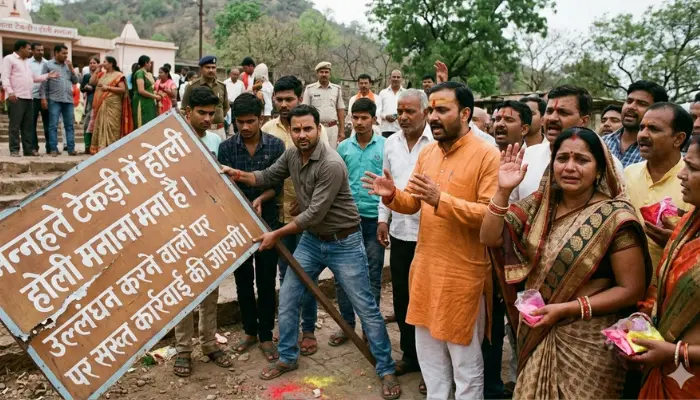
Case Summary
In Dewas, Madhya Pradesh, Holi celebrations with colours were banned by the administration inside the premises of Tekri Mata temple, a revered Hindu temple of Goddess Tulja Bhavani and Goddess Chamunda in the area. According to reports, the temple had always had a history of Holi celebrations with colours inside its premises, but this year, in 2026, the administration banned the celebrations of Holi with colours inside the temple premises. Notably, the temple is on Tekri Hill in Dewas and is managed by a government‑controlled body. It is administered by the Dewas Tekri Temple Trust, which operates under the oversight of the district administration. Following the administration's ban on Holi, several activists from Hindu organisations reached the hill to protest this ban. The workers said that the festival of Holi had been celebrated traditionally there for years and that playing with colours is part of the Hindu faith and tradition. They removed the banning sign, saying that if a sacred festival like Holi is not celebrated in the temple, then there would be no appropriate place to celebrate it. The activists also demanded that the administration take action against the officials who imposed the ban. Pandit Rajendra Pujari of Mata Tekri Temple stated that the administration had posted a sign warning of action against those playing Holi. He argued that the tradition of Holi had originated with the gods and goddesses, so it was not appropriate to ban Holi celebrations in the temple. Following the protests, devotees expressed their faith by playing Holi inside the temple premises. They reiterated their demand for action against the officials who had imposed the ban. Bajrang Dal’s cow protection chief, Ramesh Kaushal, called the administration’s order inappropriate. He said that when Holi is organised in other major temples, it is not appropriate to ban it in Mata Tekri temple. Giving an example, he said that Holi is played in temples at religious places like Mathura and Vrindavan too, so in such a situation, the ban on Mata Tekri in Dewas was beyond comprehension.
Why it is Hate Crime ?
This case is being added to the tracker under the primary category- Restriction/ban on Hindu practices. The subcategory selected is- Administration restricting religious practice. In several cases, it is seen that the administration/state disallows a religious practice owing to prejudicial orders and concerns, targeted specifically against the Hindu community. Such restriction/prohibition would be considered documented as a hate crime because the orders are often a result of pressure by groups that harbour animosity towards Hinduism and Hindus. Often, the restriction by the authorities is driven by bias, hostility, or prejudice against the specific community being stopped from holding a religious practice, by pressure groups that harbour animosity towards Hindus, intrinsic to their faith. Since practices are intrinsic to the faith of the Hindus, such prejudicial restriction is considered a curtailing of the fundamental rights of the Hindu community. In several cases, for example, the authorities ban a Hindu religious practice due to pressure from groups opposed to the religion. In other instances the prohibition is selectively enforced against one religious group (Hindus) while others are allowed to proceed. There are still other cases where the authorities preemptively restrict a religious practice by Hindus because those who hold animosity towards Hindus may get “provoked” leading to them being violent, thereby assuaging the sentiments of those who hold animosity towards Hindus by curtailing the religious rights of Hindus. Such acts and orders are prejudiced, indicating discriminatory motives owing to the capitulation to groups that harbour animosity towards Hindus and therefore, would be categorized as a religiously motivated hate crime since the original pressure leading to the order itself is a result of hatred/bias/prejudice/religious hate against Hindus. This case is a clear instance of a religiously motivated hate crime because the administration banned the celebrations of Holi with colours inside the Tekri Mata Temple, a revered Hindu place of worship. By singling out a core religious practice tied to a specific Hindu festival and prohibiting it inside a Hindu temple, the administration effectively targeted Hindu religious expression on its own sacred ground. Holi, in particular, is not merely a social festival but a deeply rooted religious observance associated with deities and collective devotion. Banning the use of colours during Holi inside the temple directly interferes with a form of worship that devotees see as integral to their faith. This restriction, applied specifically to a Hindu festival within a Hindu temple, goes beyond routine regulation and crosses into the realm of religious targeting, making it a clear case of a religiously motivated hate crime. The practice of playing with colours during Holi holds profound religious significance for Hindus. Colours symbolise divine joy, the victory of good over evil, and the presence of the divine in everyday life. In many Hindu traditions, the entire festival is framed as an offering to the gods, with aarti, bhajans and rituals intertwined with the playful throwing of colours. For devotees, celebrating Holi inside the temple is not a casual social act but a continuation of piety, where the sanctity of the deity and the sanctity of the festival merge. Any act of banning or restricting this religious practice by the administration, therefore, amounts to a direct attack on Hindu religious life. It shows that the administration is going out of its way to selectively target and restrict Hindu festivals, even within Hindu temples, instead of treating them with neutrality or equal respect. This pattern reveals deep‑seated institutionalised bias and prejudice towards Hindu religious festivals, where the state utilises its authority to suppress a core Hindu tradition under the guise of administrative control. It is important to note that the Tekri Mata Temple is a government‑controlled temple and is administered by the Dewas Tekri Temple Trust, which operates under the oversight of the district administration. This transforms the incident from a private or local decision into a clear case of state‑sanctioned restriction and banning of a sacred Hindu religious practice inside the premises of a Hindu temple. When the state, through its own appointed bodies, targets a long‑standing Hindu festival and prohibits devotees from using colours inside the temple, it demonstrates institutionalised discrimination against Hindus. For several years, the temple used to conduct Holi celebrations with colours inside its precincts, making it an established tradition rather than a disruptive novelty. The fact that the practice was suddenly banned only in 2026, without any similar restrictions on comparable practices in other religious spaces, shows that the decision was not based on law and order or safety concerns but on religious bias and prejudice against Hindu religious places. In fact, many Hindu temples across India allow Holi celebrations inside the temple premises, as the playing of colours is widely regarded as an intrinsic part of the Hindu faith and the celebration of Holi. Stopping a sacred, religious and cultural act inside a Hindu temple showcases the extent to which the administration selectively targets Hindu festivals and Hindu religious practices, revealing a clear orientation of bias and hostility towards Hinduism and making this a clear case of a religiously motivated hate crime. When the state begins to ban such practices, it slowly crosses the line from regulation to suppression, and in doing so opens the door to the gradual erasure of Hindu religious practices from the public sphere. Holi colours inside a Hindu temple are not an exceptional or marginal act; they represent a mainstream, widely accepted form of devotion and celebration. By choosing to ban this specific expression of Hindu faith, the administration sets a dangerous precedent whereby every Hindu religious practice can be picked apart and removed under administrative orders. Over time, this incremental banning can lead to Hindu rituals, festivals and symbols being pushed out of public spaces and even from within state‑managed religious institutions. This pattern, where the state uses its power not to protect pluralism but to shrink the space available to Hindu religious life, demonstrates its institutional prejudice and hostility towards the Hindu community. Since this case meets several key parameters of a crime driven by anti‑Hindu prejudice, it is being added to the hate crime database of the Hinduphobia Tracker. Disclaimer: The Hinduphobia Tracker records the dates of incidents based on when the crime occurs rather than when it is reported by the media. However, in this case, media reports have not stated the exact date when the administration restricted or banned the Holi celebrations. Henceforth, the date when the media first reported this incident, 3 March 2026, is being selected as the indicative incident date. This is recorded for documentation purposes only.


Case Status
Unknown


Perpetrators Details
Perpetrators
State and Establishment
Perpetrators Range
Unknown
Perpetrators Gender
unknown
 Sources




