Hindu deities reduced to political metaphors by Indian politician during party event
 Telangana, India
  1 March, 2026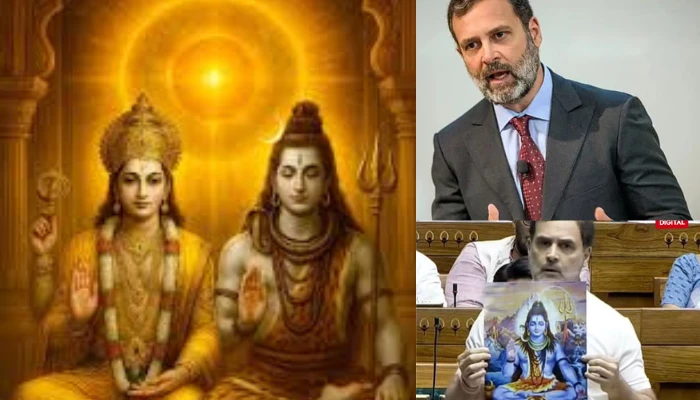
Case Summary
In Anantagiri, Telangana, Congress leader Rahul Gandhi compared his party to Lord Shiva and the BJP to Lord Vishnu during a training event. The remarks were made in front of District Congress Committee presidents and immediately drew criticism for invoking Hindu deities in partisan messaging. The incident took place on 2nd March 2026 at the conclusion of a 10-day training programme for District Congress Committee presidents. Rahul Gandhi, serving as Leader of the Opposition, addressed the gathering and described Lord Shiva as embodying humility, balance, and restraint. He suggested that Congress should reflect these values. In contrast, he likened the BJP to Lord Vishnu, alleging that the party represented power, grandeur, authority, and dominance. As per the reports, the remarks were reported and circulated across media platforms. Critics argued that Gandhi’s comparison was divisive and disrespectful, as it politicised sacred Hindu symbols. BJP leaders, including Union Minister G. Kishan Reddy, condemned the statement publicly, accusing Gandhi of attempting to create a wedge among Hindu devotees. This was not the first time Gandhi had invoked Hindu symbolism in political discourse. In July 2024, during his debut speech as Leader of the Opposition in Parliament, he displayed an image of Lord Shiva and claimed that those “who call themselves Hindus only talk about violence, hatred and lies.” The act was opposed by the Speaker of the Lok Sabha, who reminded him that rules did not allow placards in the House. Prime Minister Narendra Modi and Home Minister Amit Shah had demanded an apology at that time. According to reports, Gandhi’s remarks were intended to politicise the sacred balance by assigning partisan attributes to the deities. No formal police or administrative action was reported in connection with the incident, as the remarks were made in a political setting. However, the controversy sparked widespread debate in the media and among community representatives, with many expressing concern that such statements could undermine communal harmony. The episode reinforced criticism that Gandhi’s political messaging often relied on religious symbolism, raising questions about the appropriateness of invoking deities in partisan contexts. It also highlighted the sensitivity of religious references in Indian politics, where public figures are expected to maintain respect for traditions while engaging in debate.
Why it is Hate Crime ?
The primary category for this case is "Hate speech against Hindus". The sub-category here is "Anti-Hindu slurs, mocking faith". Anti-Hindu slurs and the deliberate mocking of the Hindu faith owing to religious animosity involve the usage of derogatory terms, stereotypes, or offensive references to religious practices, symbols, or figures. One of the common anti-Hindu slurs used against Hindus is “cow-worshipper” and “cow piss drinker”. The intention of using this term is to demean and mock Hindus as a group and their religious beliefs since Hindus consider the cow holy. Additionally, some symbols and the slurs attached to them have a historical context that exacerbates the insult, hate, stereotyping, dehumanisation and oppression against Hindus. Cow worship has been used for centuries to denigrate Hindus, insult their faith and oppress Hindus specifically as a religious group. There has been overwhelming documentation about how cow slaughter has been used to persecute Hindus, with cow meat being thrown in temples and places of worship. There has also been overwhelming documentation where cow meat (beef) has been force-fed to Hindus to either forcefully convert them to Islam or denigrate their faith. Apart from cow worship, the Swastika, which holds deep religious significance for the Hindus, has also been misinterpreted and distorted to use as a slur against Hindus. Similarly, the worship of the Shivling has been used by supremacist ideologies and religions to denigrate Hindus owing to religious animosity. Such slurs and denigration stem from inherent animosity and hate towards Hindus and their faith; therefore, it is categorised as hate speech targeted at Hindus specifically owing to their religious identity. This case qualifies as a clear instance of religiously motivated hate speech because the accused, Rahul Gandhi, deliberately compared the revered Hindu deities Lord Shiva and Lord Vishnu to political parties in a mocking and derogatory manner through a widely circulated social media post. Such a comparison reduces deeply revered deities to instruments of political commentary, thereby trivialising their spiritual and theological significance. In Hindu theology, Lord Brahma, Lord Vishnu, and Lord Mahesh (Shiva) together form the Trimurti, representing the cosmic functions of creation, preservation, and transformation. These deities occupy a central place in Hindu cosmology and are revered across Shaivite and Vaishnavite traditions as complementary manifestations that maintain universal balance. They are not treated as competing entities or ideological camps. Framing these sacred figures within a narrative of political opposition distorts their theological meaning and undermines the philosophical harmony that the Trimurti represents in Hindu belief. For millions of Hindus, these deities are objects of deep reverence expressed through daily worship, religious rituals, festivals, pilgrimages, and lifelong devotion. When such sacred figures are invoked in partisan political comparisons, they are shifted from the realm of spiritual reverence into the arena of political contestation. This transformation trivialises their sacred status and risks normalising the use of Hindu religious symbols as tools of political messaging. The remarks were delivered in a public political setting and were widely reported and circulated across media platforms, amplifying their impact. Because the comparison involved sacred Hindu deities and framed them within partisan political narratives, it constituted a public act that diminished the sanctity associated with those figures in Hindu belief. A similar controversy had also arisen earlier in July 2024 during the same leader’s debut speech as Leader of the Opposition in the Lok Sabha. During that address, he held up an image of Lord Shiva while criticising political opponents and stated that those “who call themselves Hindus only talk about violence, hatred and lies.” The remarks drew immediate objections from several Members of Parliament, with the Prime Minister describing the statement as a serious allegation against the Hindu community and the Home Minister demanding an apology in the House. The Speaker of the Lok Sabha also reminded members that displaying placards or images was not permitted under parliamentary rules. The episode triggered widespread criticism, with many observers arguing that invoking a sacred Hindu deity while simultaneously associating Hindus with violence and hatred constituted a derogatory and inappropriate use of religious symbolism in political discourse. Taken together, the repeated invocation of sacred Hindu deities within contentious political messaging demonstrates a pattern in which revered figures of the Hindu faith are drawn into partisan narratives. The use of such sacred symbols in a manner that trivialises or distorts their spiritual significance constitutes an act that disrespects the religious sentiments of Hindus. For these reasons, the incident meets the threshold of religiously motivated hate speech and has been documented in the tracker under speech that mocks or undermines Hindu faith. Disclaimer: The Hinduphobia Tracker records incidents based on when the act occurred, not when the media reported it. In this case, the media report surfaced on 4 March 2026, whereas the incident occurred on 2nd March 2026; therefore, the latter is recorded as the indicative date for documentation purposes.


Case Status
Unknown


Perpetrators Details
Perpetrators
State and Establishment
Perpetrators Range
One Person
Perpetrators Gender
male
 Sources




