Hindu traditional Holika Dahan sabotaged as Muslim youth premeditatedly sets sacred pyre ablaze in Rampur, Uttar Pradesh
 Rampur, Uttar Pradesh, India
  1 March, 2026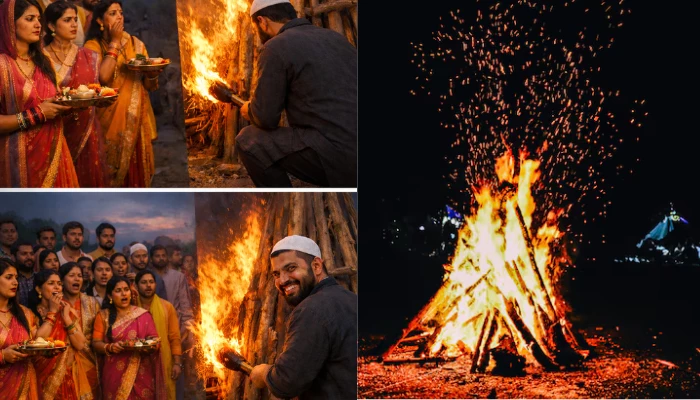
Case Summary
On 2nd March 2026 in Bajidpur village, Rampur, Hindu devotees preparing for Holika Dahan were disrupted when a Muslim youth deliberately set fire to the Holika prematurely. This created a ruckus within the village. As per media reports, hundreds of Hindu families, including women and children, had assembled for the annual fire ceremony and pradakshina. The scheduled time for the ritual had been set after the passing of a lunar eclipse, which was considered inauspicious, and the pyre was meant to be lit only afterwards. The Muslim youth deliberately burnt the Holika during this inauspicious period, which alarmed the villagers and was seen as a violation of the sanctity of the festival. The situation escalated as Hindu men confronted the Muslim man for his action, and tensions rose in the area. The ritual was disrupted, and the atmosphere became hostile, forcing devotees to halt the ceremony. Police forces, led by senior officers, reached the spot promptly. The man was taken into custody, and officials assured villagers of strict action. Patrolling was intensified to prevent further escalation, and authorities later confirmed that peace had been restored. Reports and videos circulated locally, showing the disruption during the puja preparations. As per reports, the deliberate timing and manner of the act suggested that the gathering had been targeted.
Why it is Hate Crime ?
This incident has been added to the tracker under the category- "Attack on Hindu religious representations". Under this, the first subcategory selected is "Defiling religious customs". Sanatan Dharma is not a religion of one book, which is to say that while it has religious scriptures that form the central tenets of the faith, there are several traditions followed through thousands of years, mostly passed from generation to generation orally. Several such customs and traditions are followed by various Hindus and Hindu sects. Defiling of these traditions and customs is a breach of an individual or group’s religious practices. Such practices can range from dietary restrictions like not eating non-vegetarian food for a certain period of the year, not eating non-vegetarian food at all, not eating beef since the cow is considered holy in Hinduism, the sanctity of religious customs followed in the house (like many ISCKON devotees), etc. Any malicious action leading to the breach of such traditions or defilement of these traditions owing to animosity towards the faith or for the sake of activism stems not only from the lack of faith in the religion itself but also from disregard for the faith of the devotees who follow the customs/traditions and implicit bias against the faith, the tradition itself. Since these specific traditions are central to the faith of the devotees of that specific sect of Hindus, any non-compliance with these traditional rules would be considered a religiously motivated hate crime. The other sub-category selected for this case is "Breaking rules of place of worship". Sanatan Dharma is not a religion of one book, which is to say that while it has religious scriptures that form the central tenets of the faith, there are several traditions followed through thousands of years, mostly passed from generation to generation orally. One of these oral traditions or written traditions is the rules of specific temples. Certain temples have rules that are traditional, dependent on the worship of the presiding deities. These rules and traditions have been followed for thousands of years, whether they find scriptural mention or not. Such traditions are based on the nature and rules of worship of the presiding deity of that temple. Any non-compliance of these traditions owing to animosity towards the faith or for the sake of activism stems not only from the lack of faith in the presiding deity but also disregard for the faith of the devotees of that deity/temple and implicit bias against the faith, the tradition and the deity itself. Since these specific traditions are central to the faith of the devotees of that specific temple and presiding deity, any non-compliance with these traditional rules would be considered a religiously motivated hate crime. This case was included in the Hinduphobia Tracker because it represented a direct and deliberate act of religious targeting against Hindus during one of their most sacred festivals, Holika Dahan. The Muslim man intentionally ignited the Holika fire before the auspicious timing, sabotaging the ritual and creating disruption within the village. Holika Dahan is a ritual that holds deep religious and cultural significance for Hindus. It is not a mere bonfire. It is a ritual anchored in ancient Hindu scriptures, symbolising the triumph of good over evil and the spiritual cleansing of negativity. Its timing, the muhurat, was meticulously calculated according to Hindu religious tradition to ensure auspiciousness. Performing it at the correct muhurat is central to its spiritual efficacy and communal meaning. The malicious act, by the Muslim man, was not carried out in respect of the ritual but as a deliberate insult aimed at Hindu devotees, their faith, and their dharma. It was blasphemous in nature, as it was performed without any participation in the festival or acknowledgement of its traditions. The question naturally arose as to why someone would ignite a ritual fire that held no meaning for them, if not to intentionally provoke and hurt another community. By interfering with this ritual, the perpetrator directly targeted not only a religious practice but the very heart of Hindu devotional life, undermining the sanctity of a moment deeply significant to the community. The intention behind the act, combined with its timing during the inauspicious lunar eclipse period, highlighted a calculated disrespect for Hindu customs and beliefs. Hindus across India lit Holika fires in strict adherence to muhurats and traditional practices. Therefore, igniting the fire before the scheduled time and at precisely this moment showed deliberate animosity and a clear understanding of the ritual’s significance. It was, therefore, more than a casual act; it was symbolic religious aggression and a deliberate act aimed at dishonouring Hindu devotees and their faith. When Hindu festivals were disrupted or mocked in this manner, it sent a broader message of intolerance and undermined the visibility of Hindu religious expression. Holi, and particularly Holika Dahan, was a communal anchor, a moment where devotion, cultural memory, and identity were publicly celebrated. Attacks on it threatened the transmission of these cultural and spiritual values, weakening the community’s ability to assert its identity openly. Given the deliberate targeting, the religious knowledge displayed in the timing, and the intent to dishonour Hindu devotees and their faith, this incident qualified as a hate crime motivated by religious animosity. It was therefore added to the Hinduphobia Tracker database as a clear instance of religiously motivated aggression against Hindu practices.


Case Status
Arrested


Perpetrators Details
Perpetrators
Muslim Extremists
Perpetrators Range
One Person
Perpetrators Gender
male
 Sources




