Hindu youths playing Holi brutally assaulted by Muslim mob near a mazaar in Dehradun; attackers also target victim’s mother
 Dehradun, Uttarakhand, India
  1 March, 2026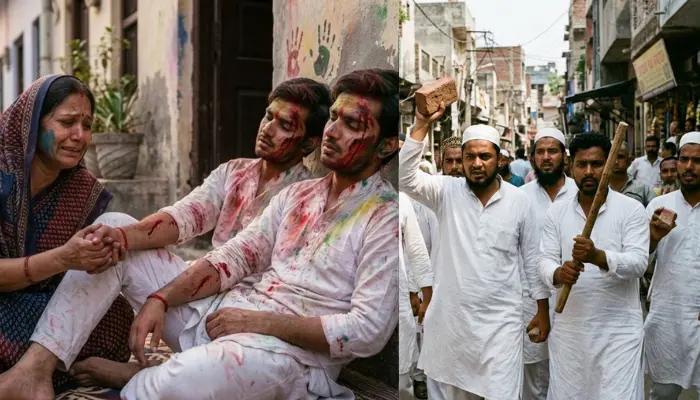
Case Summary
In Dehradun, Uttarakhand, two Hindu youths named Chirag Anand and Anand were brutally assaulted and abused by a Muslim mob of 24 men over playing Holi with water balloons near a mazaar (Islamic shrine). The attackers also manhandled and abused one of the victim’s mothers. According to media reports, this occurred on Monday (2 March 2026), when Anand was playing Holi with his friend Chirag Anand near RGM Plaza on Chakrata Road. During this, a water‑filled balloon accidentally caught on a wire. The balloon burst, splashing water onto a Muslim youth, Sahil Dhiman’s clothes. This enraged Sahil Dhiman, who then summoned his Muslim accomplices, Mohammad Salman, Deepak and Intaqab, and others. Following this, a Muslim mob arrived armed with sticks and began assaulting Chirag Anand. They brutally struck him on the head and back with the sticks. When Chirag Anand tried to escape, the attackers pelted him with bricks and stones. Chirag Anand saved his life by hiding in the alleyway of a Mazaar (Islamic shrine). According to Anand, following this initial assault, the Muslim mob arrived at his home in Mazar Wali Gali, Luniya Mohalla, and began pushing and abusing his mother, Rajni Anand. In this matter, Anand lodged a formal police complaint. City Kotwal Hariom Chauhan said that on the basis of the complaint, a case had been registered against the Muslim perpetrators, Sahil Dhiman, Mohammad Salman, Deepak, Intaqab and 20 other Muslim men.
Why it is Hate Crime ?
This case is being added to the tracker under the primary category- Attack not resulting in death. The subcategory selected is- Attacked for Hindu identity. In several cases, Hindus are attacked merely for their Hindu identity without any perceived provocation. A classic example of this category of religiously motivated hate crime is a murder in 2016. 7 ISIS terrorists were convicted for shooting a school principal in Kanpur because they got ‘triggered’ seeing the Kalava on his wrist and tilak that he had put. In this, the Hindu victim had offered no provocation except for his Hindu religious identity. The motivation for the murder was purely religious, driven by religious supremacy. Such cases where Hindus are targeted merely for their religious identity would be documented as a hate crime under this category. The other subcategory selected is- Communal clash/attack. Communal clash is a form of collective violence that involves clashes between groups belonging to different religious identities. For a communal clash between Hindus and non-Hindus to qualify as a religiously motivated hate crime, the trigger of the violence itself would have to be anti-Hindu in essence. For example, if there is a Hindu religious procession that comes under attack from a non-Hindu mob and after the initial attack, Hindus retaliate in self-defence, leading to a communal clash between the two religious communities. While at a later stage, both communities are involved in the clash/violence, the initial trigger of the violence was by the non-Hindu mob against the Hindus and therefore, it could safely be termed as an anti-Hindu violence. Further, the trigger would also have to be religiously motivated. In the cited example, the attack by the non-Hindu mob was against religious processions and therefore, can be concluded to be religiously motivated. In some cases, the trigger may be non-religious, however, it develops into religious violence against Hindus at a later stage. In such cases too, the foundational animosity towards Hindus becomes the motivating factor of the crime and therefore, it would be classified as a religiously motivated hate crime against Hindus under this category. The other subcategory selected is- Attacked for crossing 'Muslim area'. One of the reasons that Hindus get attacked unprovoked specifically by Islamists is for crossing ‘Muslim areas’. Essentially, Muslim mobs often attack Hindus crossing or present in certain areas which have a majority Muslim population. It has often been cited as one of the reasons to blame Hindus for attacks against themselves, signalling that Hindus displaying religious symbols, taking our religious processions or crossing any area which is dominated by Muslim residents is a provocation in and of itself. These areas are mostly ghettoized areas where mobs mobilize quickly to attack Hindus for a variety of reasons like playing music during a religious procession, crossing a mosque, wearing a tilak or any other religious symbol in a Muslim-dominated area, praying at a local temple in that area etc. There have been cases where the few local Hindus of that area have been attacked on their way to the Temple for prayers as well, simply because the area is considered a Muslim-dominated area. Several times, it is entirely possible that the immediate trigger for the violence against Hindus was non-religious in nature, however, the violence became religiously motivated in nature because the area was Muslim dominated and the residents on the whole harboured animosity towards Hindus, evidenced from the actions of the mob, the slogans, and the nature of the attack. Such crimes are motivated by the religious identity of the victims and are therefore classified as hate crimes under this category. This case is being added to the tracker as it represents a clear instance of targeted violence against the two Hindu youths due to their religious identity. The Hindu youth Anand and his friend Chirag Anand were assaulted solely for playing Holi with water balloons, an age-old practice symbolising joy and religious celebration. Some may attempt to argue that the attack was the result of a water-filled balloon that accidentally landed on the wire and splashed water onto the clothes of a Muslim youth. However, if that had been the primary cause, the issue could have ended after the initial argument and dispute. Instead, the Muslim perpetrator chose to escalate the matter by bringing a large Muslim mob to attack the Hindu youths, demonstrating deliberate religious intent. The violence stemmed from a benign and culturally rooted act, playing Holi with water balloons, but this simple expression of faith and celebration provoked hostility. The attack, therefore, reflected religious profiling and direct targeting of Hindu youths for their faith and customs. Such assaults on Hindus based on their religious identity constitute clear instances of religiously motivated hate crimes. The assault was brutal and deliberate, showcasing a clear example of communal violence. When Hindu youths are attacked solely for their religious identity, it reveals an underlying hostility rooted in contempt for their faith, symbols of worship and cultural practices such as Holi and the custom of playing with water balloons. The fact that the assault occurred during Holi, one of the most significant Hindu festivals, underscores that the intent was not only to inflict physical harm but also to provoke, humiliate and terrorise Hindus during their sacred celebration. The timing of the attack, coinciding with an important religious festival, exposes a calculated effort to undermine and desecrate the spirit of Holi. This was therefore not an isolated dispute but a targeted act of intimidation against Hindus, making it a clear and deliberate case of a religiously motivated hate crime. Moreover, the fact that the Muslim group, led by the accused, returned with almost two dozen Muslim individuals armed with weapons such as sticks, stones and bricks, confirms that this assault was neither impulsive nor a momentary outburst of anger. Their preparation with weapons and their coordinated attack demonstrate premeditation and organised violence. The aggression was disproportionate and excessive, launched over a minor incident, an accidental water balloon landing on the wire and splashing water onto the clothes of a Muslim youth. It is evident that the real motive was religious hatred directed at the Hindu youths for publicly expressing their faith and cultural traditions. The brutality of the attack displays deep-seated religious animosity and intolerance towards Hindus and their customs, turning what should have been a peaceful festival into a violent episode of hate and aggression, clearly constituting a religiously motivated crime. The incident occurred near a mazaar, an Islamic shrine, and it is crucial to note that Muslims often consider areas around mosques, dargahs, mazaars and places where their community is in the majority as “Muslim areas.” This reveals a disturbing sense of Islamic supremacy held by the attackers, who viewed the vicinity of the mazaar as an exclusive zone where non‑Muslims, particularly Hindus, were unwelcome. This sense of entitlement and superiority reflects deep‑seated prejudice and an attempt to assert religious dominance over public space. The assault on the Hindu youths was motivated by this supremacist ideology, with the Muslim group in the area looking down upon Hindus and believing they had the right to control who could move freely and celebrate Hindu festivals in “their area.” Such an act illustrates a dangerous mindset rooted in exclusion, intolerance and religious animosity, making this case a clear example of a crime motivated by religious hatred. This violent escalation to Anand’s home clearly showcases deep religious animosity rather than a spontaneous quarrel. After assaulting the Hindu youths at Chakrata Road, the Muslim mob did not disperse or limit itself to the original location; instead, it deliberately moved to Mazar Wali Gali, Luniya Mohalla, to target the Hindu household. There, the group physically manhandled and verbally abused Anand’s mother, Rajni Anand, focusing their aggression on a vulnerable family member associated with the victims. This shift from street violence to a residential attack demonstrates a conscious effort to intimidate the entire Hindu family, not just the youths, and to mark their home as a site of humiliation. By crossing the boundary from public space to private residence and singling out the mother, the mob sent a message that religious identity alone made the family a legitimate target, exposing calculated hostility towards Hindus and their domestic life, rather than a mere dispute over a minor incident. Given that this case meets all criteria of a religiously motivated crime, targeting Hindus for their faith, employing coordinated violence and deliberately timing the attack to coincide with a religious festival such as Holi, this incident has been added to the Hinduphobia Tracker’s hate crime database, reflecting its clear nature as a hate crime without any ambiguity. Disclaimer: In this case, the number of primary victims is being taken as three, referring to Anand, Chirag Anand and Rajni Anand. This is because Rajni Anand was also targeted by the perpetrators, even though the initial focus of the attack was on the two Hindu youths.
Victim Details
Total Victim
3
Deceased
0
Gender
- Male 2
- Female 1
- Third Gender 0
- Unknown 0
Caste
- SC/ST 0
- OBC 0
- General 0
- Unknown 3
Age Group
- Minor 0
- Adult 3
- Senior Citizen 0
- Unknown 0


Case Status
Complaint registered


Perpetrators Details
Perpetrators
Muslim Extremists
Perpetrators Range
From 10 to 100
Perpetrators Gender
male
 Sources




