Hindu religious ritual halted, women abused by armed Muslim mob during Holika Dahan in Rajkot, Gujarat
 Rajkot, Gujarat, India
  1 March, 2026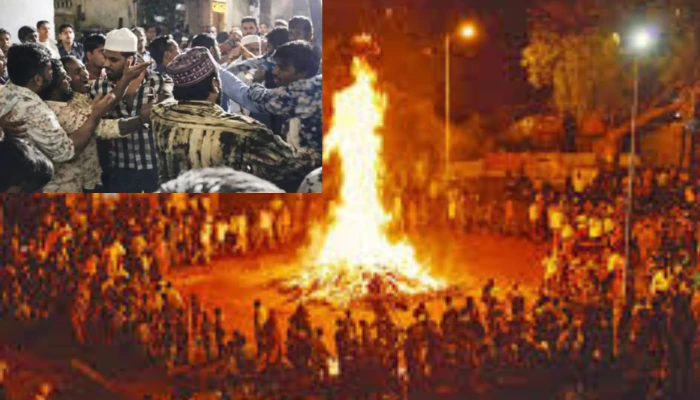
Case Summary
On 2nd March 2026 in Bhagwatipara, Rajkot, Hindu devotees performing Holika Dahan were disrupted when Muslim men on motorcycles carried out stunts near the ritual. After objections, the Muslim mob returned with weapons and abused the women. Hindu families had assembled with women and children to perform the annual fire ceremony and pradakshina. While the pradakshina (circumambulation) and puja were going on, two local Muslim men arrived there on a bike and started doing stunts, which frightened the women and children present. Consequently, the Hindu men scolded the Muslim duo for their inappropriate action. Both the Muslim men fled the spot; however, they returned with a mob carrying weapons, including pipes in their hands, and started fighting with the Hindus involved in the Holika Dahan. They also abused the women. The ritual was disrupted, and clashes broke out between the groups. Devotees tried to continue the ceremony, but the disturbance forced them to stop. Videos of the incident circulated online, showing the disruption during the puja. The deliberate timing and manner of the disturbance suggested that the gathering had been targeted. Police forces, led by senior officers, reached the spot quickly. Three individuals were detained, and patrolling was intensified in the area to prevent further escalation. Authorities later confirmed that peace was restored. The investigation was underway to determine whether more arrests were necessary.
Why it is Hate Crime ?
This case is being added to the tracker under the primary category "Attack not resulting in death". Within it, the sub-category selected is - Attacked on a religious procession. The outward celebration and display of religious symbols is an intrinsic part of Hinduism. Religious processions on various festivals are age-old traditions and a way to manifest faith and form a part of the religious practices of Hindus. On several occasions, such religious processions come under attack by non-Hindu mobs, in a manifestation of their animosity towards Hinduism and its practices. The reasons cited for such violent attacks are many and range from crossing a non-Hindu resident-dominated area to playing loud music, crossing from an area where there is a religious structure of another faith, etc. The violent attacks are triggered by the outward display of religiosity by Hindus. The attacks are mainly a manifestation of religious supremacist doctrine, which believes that idolatry, essentially the Hindu faith, deserves to be annihilated since the very tenets of Hinduism, its practices and traditions are considered a sin in those doctrines. Since these attacks emanate from intrinsic and doctrinal animosity towards Hindus and Hinduism, it is considered a religiously motivated hate crime under this category. The second sub-category is " Attacked for opposing radicals or trying to save a victim". In several cases, Hindus are attacked for opposing religiously motivated crimes being committed against a fellow Hindu or simply for voicing an opinion opposing radical elements, who either have in the past or continue to persecute Hindus. In such cases, the initial attack against the victim, against which the Hindu was trying to defend the victim, would also need to be classified as a religiously motivated hate crime. Since the initial crime itself was religiously motivated and the subsequent crime of attempting to save the victim or speaking against the radical elements ends up inviting a violent attack, it would also be classified as a religiously motivated hate crime under this category. Another subcategory selected is "Communal Clash/Attack". Communal clash is a form of collective violence that involves clashes between groups belonging to different religious identities. For a communal clash between Hindus and non-Hindus to qualify as a religiously motivated hate crime, the trigger of the violence itself would have to be anti-Hindu in essence. For example, if there is a Hindu religious procession that comes under attack from a non-Hindu mob and after the initial attack, Hindus retaliate in self-defence, leading to a communal clash between the two religious communities. While at a later stage, both communities are involved in the clash/violence, the initial trigger of the violence was by the non-Hindu mob against the Hindus, and therefore, it could safely be termed as an anti-Hindu violence. Further, the trigger would also have to be religiously motivated. In the cited example, the attack by the non-Hindu mob was against religious processions and therefore can be concluded to be religiously motivated. In some cases, the trigger may be non-religious; however, it develops into religious violence against Hindus at a later stage. In such cases, too, the foundational animosity towards Hindus becomes the motivating factor of the crime, and therefore, it would be classified as a religiously motivated hate crime against Hindus under this category. The fourth subcategory selected is “Attacked for Hindu identity.” In several cases, Hindus are attacked merely for their Hindu identity without any perceived provocation. A classic example of this category of religiously motivated hate crime is a murder in 2016. 7 ISIS terrorists were convicted for shooting a school principal in Kanpur because they got ‘triggered’ seeing the Kalava on his wrist and the tilak that he had put. In this, the Hindu victim had offered no provocation except for his Hindu religious identity. The motivation for the murder was purely religious, driven by religious supremacy. Such cases where Hindus are targeted merely for their religious identity would be documented as a hate crime under this category. This case was included in the tracker because Hindu devotees engaged in Holika Dahan were attacked while performing a sacred ritual. The decisive trigger was the return of a Muslim mob armed with weapons after objections were raised to their earlier disruptive behaviour. The mob fought with the Hindus and abused the women present, showing hostility towards Hindu culture and festivities and contempt for those practising them. The attack was directed at the outward celebration of the Hindu faith. Holika Dahan is performed publicly, with families gathered around the sacred fire for pradakshina and puja. The deliberate intrusion into this ritual space and the aggression that followed demonstrated animosity towards the visible practice of Hinduism. Holika Dahan traces back to the Puranic tale of Prahlad, whose unwavering devotion let him emerge unscathed from Holika's fire through Vishnu's grace—embodying dharma's eternal victory over adharma. This cornerstone Hindu ritual brings families together, women and children included, to circle the pyre three times in clockwise pradakshina, tossing grains, coconuts, and flowers into the flames while chanting mantras to Agni Devta for purification and protection. Participants later apply vibhuti from the ashes as a sacred mark, fostering deep communal bhakti. The Muslim mob struck exactly then, with bike stunts and armed return, showing utter disregard for this pivotal festive moment central to Hindu traditions and culture. The confrontation also arose because Hindu men opposed the disruptive behaviour near the sacred fire. Their objection was an attempt to protect the dignity of the ritual and the safety of women and children present. The violent retaliation that followed showed that Hindus were attacked for resisting radical actions, turning their defence of the ritual into the reason for targeted violence. The incident developed into a communal clash once the mob returned with weapons, and fighting broke out. While both groups were involved in confrontation at a later stage, the initial aggression was directed at Hindus during their religious observance. The violence, therefore, originated from an anti-Hindu trigger, and the subsequent escalation was rooted in that hostility. Finally, the abuse directed at women during the ritual showed that Hindus were attacked for their identity and practice, without provocation beyond their participation in Holika Dahan. The targeting of women added a dimension of humiliation and intimidation, reinforcing the bias-based nature of the attack. Disclaimer: Media reports stated that multiple Muslims launched the attack, but only three Muslim men were arrested and specified, though a large number of muslim mob later attacked. Therefore, the perpetrator count was recorded as three (3). This is a conservative estimate, as the number of perpetrators could be higher.


Case Status
Arrested


Perpetrators Details
Perpetrators
Muslim Extremists
Perpetrators Range
From 2 To 5
 Sources




