Hindu woman subjected to rape and death threats by Muslim men for sharing Hindu leaders post in Chhindwara, Madhya Pradesh
 Chhindwara, Madhya Pradesh, India
  24 February, 2026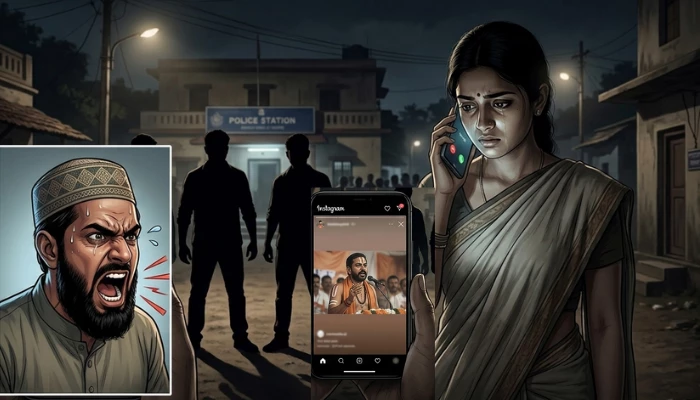
Case Summary
In Chhindwara, Madhya Pradesh, a 22‑year‑old Hindu woman was threatened after posting a Hindu leader’s statement on social media. Muslim men named Bilal, Dilawar, and Salman issued rape and death threats, targeting her and her community. The Hindu woman had shared a post by a Hindu leader, Arvind Rajput, on Instagram on 24 February 2026. Soon after, Bilal, Dilawar, and Salman contacted her and demanded the deletion of the post. They threatened her with rape and death, and one of them said, “मैं पठान हूं, सच में रेप करता हूं” (“I am a Pathan, I really rape”). They also claimed, “तेरे समाज की चार लड़कियां मेरी गर्लफ्रेंड हैं” (“Four girls from your community are my girlfriends”), using intimidation to pressure her. Soon after, she informed her family and approached the police. Locals expressed that such threats were unacceptable and demanded immediate action. An FIR was registered under sections related to rape threat and criminal intimidation. The threats were made through phone calls. Protests erupted outside the police station in Chhindwara, with hundreds demanding swift justice and protection for women. Community representatives stated that such intimidation was a direct attack on freedom of expression. Police arrested Bilal, Dilawar, and Salman, and officials confirmed that an investigation was underway and strict action would follow.
Why it is Hate Crime ?
This case is being added to the tracker under the primary category "Attack not resulting in death". The subcategory selected is- Attacked for supporting/being part of a perceived Hindu party/org or working for the Hindu community. In several cases, Hindus are attacked specifically or tangentially for their association with parties or organisations perceived to be pro-Hindu and/or for working in favour of the Hindu community. One of the classic cases was the attack against a Bharatiya Janata Party Yuva Morcha (BJYM) worker, Praveen Nettaru. Nettaru was attacked and hacked to death for his association with Hindu organisations and his work for the Hindu community. He was murdered by PFI, a terror organisation that aimed to commit a genocide of Hindus, target Hindu leaders specifically and turn India into an Islamic Nation. In such cases, the immediate trigger for the violence may be non-religious, either according to the perpetrator or the police. However, there are surrounding circumstances from which the conclusion can be reached that the victim was attacked for his association with a Hindu organisation. In a similar case, Rinku Sharma was attacked by radicals. He was a member of Bajrang Dal and regularly worked for the Hindu community. While the police cited a different non-religious trigger for the attack, he was indeed associated with a Hindu organisation, and the family of Rinku Sharma specifically attributed his gruesome murder to his working for Bajrang Dal and raising Jai Shree Ram slogans. Such cases are intrinsically driven by religious hate and would therefore be documented as a hate crime under this category. The other category selected is- Hate speech against Hindus. Under this, the subcategory selected is- Violent threats. Violent threats, explicit, implicit or implied, is the most dangerous form of hate speech since it goes beyond discriminatory and prejudicial language to express the intent of causing harm to an individual or a group of people based on their religious identity and faith. There could be several different kinds of threats that are issued to Hindus based on religious animosity. An explicit threat would mean the direct threat of violence towards an individual Hindu, a group of Hindus or Hindus at large. Physical violence, death threats, threats of destruction of property belonging to Hindus and threats of genocide would mean explicit threats against Hindus for their religious identity. Implicit threats may not be a direct threat but implied through the use of symbols of actions – for example – in the Nupur Sharma case, other than explicit threats, there were also implicit threats when Islamists took to the streets to burn and beat her effigies. It implies that they want to do the same to Nupur Sharma – thereby is considered an implicit threat. Violent threats can be delivered in person, through letters, phone calls, graffiti, or increasingly through social media and other online platforms. It would be important to understand that a threat – explicit or implicit, online or offline – to an individual who happens to be a Hindu does not qualify as a religiously motivated threat. Such a threat, while vile and dangerous, could be owing to non-religious reasons and/or personal animosity. To qualify as a religiously motivated threat, it would need to exhibit an indication that the individual is being targeted for religious reasons and/or owing to his/her religious identity as a Hindu. This incident qualified as a hate crime because the threats were directly connected to the woman’s Hindu identity and her act of sharing a post by Hindu organisation leader Arvind Rajput. The perpetrators explicitly invoked religion in their intimidation, making the trigger communal rather than personal. She was targeted not randomly, but solely because she publicly expressed support for a Hindu leader, and her identity as a Hindu woman made her the focus of their threats. The use of rape threats highlighted the severity of the attack. Rape is a heinous crime that inherently violates bodily autonomy and dignity, and in this case, it was weaponised as a tool to terrorise her because of her religion. The perpetrators combined sexual violence threats with death threats and intimidation, aiming to silence her religious expression and undermine the collective dignity of her community. The significance of the trigger lay in her support for a Hindu leader’s post, which represents broader Hindu leadership and community expression. Public expression of religious identity is part of collective identity and civilisational continuity; the threats sought to disrupt that expression and coerce submission. This crossed the threshold from ordinary misconduct into bias-based targeting because the victim was Hindu, the perpetrators identified themselves by religion, and the threats were explicitly tied to her Hindu affiliation. The coercion involved sexual violence threats, humiliation, and intimidation, creating a clear power imbalance and demonstrating religiously motivated animus. Therefore, the case is recorded in the Hindu phobia tracker.
Victim Details
Total Victim
1
Deceased
0
Gender
- Male 0
- Female 1
- Third Gender 0
- Unknown 0
Caste
- SC/ST 0
- OBC 0
- General 0
- Unknown 1
Age Group
- Minor 0
- Adult 1
- Senior Citizen 0
- Unknown 0


Case Status
Arrested


Perpetrators Details
Perpetrators
Muslim Extremists
Perpetrators Range
From 2 To 5
Perpetrators Gender
male
 Sources




