Hindus asked to celebrate Holi in 'restrictive' manner by Pakistan President; no similar curbs issued for Ramadan or Eid
 Pakistan
  28 February, 2026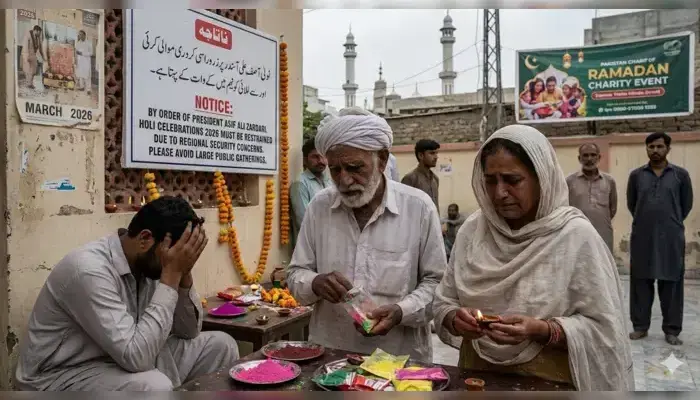
Case Summary
In Pakistan, Hindus were asked not to celebrate Holi in a grand manner by Pakistani President Asif Ali Zardari under the pretext of "regional and security concerns". However, no such restrictions were issued against Ramadan or Eid celebrations for Muslims. According to reports, President Asif Ali Zardari's official X account put out a post on 1st March 2026 stating: "President Asif Ali Zardari has urged the Hindu community to celebrate Holi in a simple and restrained manner this year, keeping in view the situation on Pakistan’s western border and the tensions in the region, and has called for unity and shared responsibility at this time." This demand by the President led to Dr Ramesh Kumar Vankwani, Patron-in-Chief of the Pakistan Hindu Council, stating that the president had appealed to all Hindus to avoid large public gatherings and observe Holi with simplicity. He added that under the current circumstances, national security and the safety of citizens were everyone's responsibility. Dr Vankwani directed the Pakistan Hindu Council to review the preparations for Holi events across the country, avoid large gatherings, and fully cooperate with local authorities. Notably, while the Pakistani President asked Hindus to tone down their Holi celebrations, no such demand was made to Muslims regarding Ramadan or Eid celebrations. The incident is yet another grim example of the ongoing pattern of targeted abductions and coercive conversions of Hindu girls in Pakistan, particularly minors, underscoring the broader reality of relentless persecution faced by the Hindu minority. This community continues to endure systemic discrimination, violence, and forced conversions, with women and young girls being especially vulnerable to abduction, forced conversion to Islam, and marriage to Muslim men, often without any legal protection or recourse. Hindu temples are routinely vandalised or destroyed, and entire communities face deep social and economic marginalisation. Blasphemy laws are disproportionately used against Hindus, leading to false accusations and severe punishments. Many Hindu families are forced to flee their homes due to religious intolerance, living in constant fear of attacks. This sustained persecution highlights the dire conditions for Hindus in Pakistan, where their religious identity makes them targets of oppression.
Why it is Hate Crime ?
The primary category selected in this case is- Restriction/ban on Hindu practices. The subcategory selected is- Restriction on expression of Hindu identity. An example of the state-affected prejudicial and targeted orders against the Hindu community would be a government denying the right of a Hindu or a group of Hindus to hold a religious procession owing to the animosity of non-Hindu groups. Denial of the religious right of the Hindus to assuage the non-Hindu group which harbours animosity to a point where it could lead to violence against Hindus is not only a failure of law and order but is a prejudicial order against Hindus, denying them their fundamental rights to express their religious identity. An example of a hate crime against Hindus by a non-Hindu would be a non-Hindu institution forcing its Hindu employees to abandon religious symbols that a Hindu would wear as an expression of faith owing to inherent prejudice against the faith professed by the victim or a non-Hindu group of people restricting a Hindu group from constructing a place of worship simply because the demography of the area in which the temple is being built is dominated by non-Hindus. Such actions are driven by religious animosity and/or prejudice against Hindus and their faith and would therefore be categorized as a hate crime. The other subcategory selected is- Administration restricting religious practice. In several cases, it is seen that the administration/state disallows a religious practice owing to prejudicial orders and concerns, targeted specifically against the Hindu community. Such restriction/prohibition would be considered documented as a hate crime because the orders are often a result of pressure by groups that harbour animosity towards Hinduism and Hindus. Often, the restriction by the authorities is driven by bias, hostility, or prejudice against the specific community being stopped from holding a religious practice, by pressure groups that harbour animosity towards Hindus, intrinsic to their faith. Since practices are intrinsic to the faith of the Hindus, such prejudicial restriction is considered a curtailing of the fundamental rights of the Hindu community. In several cases, for example, the authorities ban a Hindu religious practice due to pressure from groups opposed to the religion. In other instances the prohibition is selectively enforced against one religious group (Hindus) while others are allowed to proceed. There are still other cases where the authorities preemptively restrict a religious practice by Hindus because those who hold animosity towards Hindus may get “provoked” leading to them being violent, thereby assuaging the sentiments of those who hold animosity towards Hindus by curtailing the religious rights of Hindus. Such acts and orders are prejudiced, indicating discriminatory motives owing to the capitulation to groups that harbour animosity towards Hindus and therefore, would be categorized as a religiously motivated hate crime since the original pressure leading to the order itself is a result of hatred/bias/prejudice/religious hate against Hindus. This case represents a clear instance of religiously motivated discrimination and targeting of Hindu minorities in Pakistan by the Pakistani President. President Asif Ali Zardari specifically asked Hindus not to celebrate Holi in a grand or unrestricted manner, urging them to tone down their festivals under the pretext of security concerns related to the situation on Pakistan’s western border and regional tensions. However, no similar curbs were issued for Ramadan or Eid celebrations among Muslims, showcasing a blatant religious bias and discriminatory approach by state authorities that singles out Hindu practices for restriction. Holi holds deep-seated religious significance for the Hindu community, symbolising the triumph of good over evil, the arrival of spring, and communal joy through rituals like Holika Dahan and colour play, rooted in ancient Hindu scriptures such as the Bhagavata Purana. Curbing Holi celebrations in this context under the pretext of security concerns clearly demonstrates religious prejudice and animosity. If security concerns were the real reason to curb Holi celebrations, then why were such restrictions not imposed or curbs not demanded even for Ramadan or Eid celebrations? The fact that a Hindu festival was selectively targeted for not celebrating it grandly showcases the biased nature of the Pakistani President and the wider Pakistani institutions, making it a clear case of religiously motivated targeting of Hindus and their religious festival. When Hindu festivals are curbed, it creates and showcases intolerance for Hindu religious expression, and when the administration restricts such Hindu festivals under flimsy pretexts, it showcases their bias and intolerance towards the expression of Hindu identity and celebration of Hindu festivals publicly, making it a clear case of religious animosity. Such kinds of restrictions, if normalised over time, can gradually push these festivals out of the public sphere altogether. When celebrations are repeatedly curtailed, they risk fading from collective public memory, eventually leading to a situation where the very practices, symbols, and shared experiences that sustain Hindu identity in the public domain begin to disappear. In the long run, this erosion of visible religious expression can weaken the community’s ability to preserve and transmit what makes them culturally and civilisationally Hindu. Furthermore, Pakistan's history of Hindu persecution heightens the severity of this incident, with the Hindu community routinely targeted for their religious identity through forced conversions to Islam, abductions and forced marriages of Hindu women and minor girls, routine demolition or vandalism of temples, and regular attacks on Hindu religious events by the majority Muslim population. Amidst all this, the Pakistani President imposing such an unfair restriction, even if not legally enforced, but through an appeal to Hindus not to do it, showcases a clear case of religious bias and discrimination, with Hindus being one of the vulnerable minorities. Even if there are no clear legal orders, when such statements are made by higher authorities, it does impose an unwritten restriction on their festivals, making it a clear case of religious animosity. Such targeting of Hindu festivals amidst lame pretexts showcases deep-seated hatred for Hinduism and the Hindu minorities in Pakistan, making it a clear case of religiously motivated hate crime. Since this case meets the parameters of a religiously motivated hate crime, it is being added to the hate crime database of the Hinduphobia Tracker.


Case Status
Unknown


Perpetrators Details
Perpetrators
State and Establishment
Perpetrators Range
One Person
Perpetrators Gender
male
 Sources




