Hindu religious sentiments insulted after idols of Hindu deities stolen by Muslim man in Bangladesh, amidst ongoing persecution of Hindus
 Joypurhat District, Bangladesh
  26 February, 2026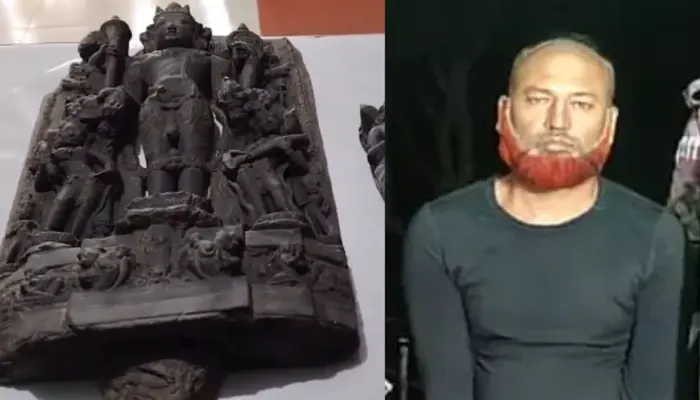
Case Summary
In the Sadar Upazila of Joypurhat, Bangladesh, Hindu religious sentiments were insulted after Hindu idols were stolen by a Muslim man named Shahidul Islam. On 27 February 2026, members of the Joypurhat Battalion (20 BGB) recovered two Vishnu idols made of Kashti stone during a late-night operation. Acting on confidential intelligence, a special patrol team under the leadership of Lt. Col. Mohammad Latiful Bari conducted the operation at approximately 1:30 am in the Kamar village area. During the patrol, the team became suspicious of a man standing in a secluded location carrying a white plastic bag. He was detained and identified as a Muslim man named Shahidul Islam (40), son of the late Moyez Uddin of Rashidnagar Tulat village. Upon questioning, he was unable to provide a satisfactory explanation regarding the contents of the bag and subsequently disclosed that it contained stolen idols of Hindu god Vishnu. A search of the bag resulted in the recovery of one large and one small Vishnu idol carved from Kashti stone. The larger idol weighed 28 kilograms and 500 grams, while the smaller weighed 2 kilograms and 200 grams. The estimated market value of the recovered idols was approximately Tk 30 lakh 70 thousand. The idols and the detained individual were handed over to the concerned police station after completion of the required legal formalities. The operation formed part of ongoing efforts by the border security forces to curb the smuggling and trafficking of archaeological and religious artefacts in border areas. A fresh wave of anti-Hindu violence followed the 13th National Parliamentary Election 2026 in Bangladesh, reinforcing a recurring pattern of post-poll violence targeting Hindu minorities. Within days of the announcement of results, Hindu families in districts such as Noakhali, Rangpur, Nilphamari, Sylhet, Thakurgaon, and Dinajpur reported coordinated attacks involving arson, looting, assault, and vandalism of temples and homes. In several instances, Hindu homes were selectively targeted, looted, and families were threatened with displacement. This escalation of violence against Hindus in Bangladesh unfolded in three distinct phases: first, following the ouster of Sheikh Hasina’s government in August 2024; second, after the death of Sharif Osman Bin Hadi in December 2025; and third, in the immediate aftermath of the 13th National Parliamentary Election 2026. This electoral violence unfolded against the broader backdrop of sustained anti-Hindu hostility that had persisted since the ouster of the Sheikh Hasina government in August 2024. During that period, multiple reports documented attacks on Hindu homes, temples, and religious institutions, alongside intimidation campaigns, arson, and mob assaults targeting minority neighbourhoods. The Hinduphobia tracker has recorded 336 such incidents against the Hindu minority, underscoring the scale and persistence of anti-Hindu violence during this period. A further escalation occurred following the death of Sharif Osman Bin Hadi, a Muslim political activist and student leader known for his anti-Hindu and anti-India rhetoric. Hadi had been involved in political unrest after the fall of the Hasina government and was killed in Dhaka on 18 December 2025 during clashes. In the aftermath of his death, Hindu communities were blamed and subsequently targeted in retaliatory violence. Hindu homes were selectively set ablaze in multiple localities, forcing families to flee and leaving many displaced. The attacks appeared patterned rather than sporadic, with Muslim mobs focusing on Hindu neighbourhoods, properties, and religious symbols. Among the victims was Dipu Chandra Das, who was lynched to death and his body was set ablaze by a Muslim mob over false blasphemy allegations. The Hinduphobia tracker documented 51 incidents of anti-Hindu violence in the period following Hadi’s death alone. Such incidents underscore the vulnerability of the Hindu minority amid rising communal hostility and the weaponisation of religious accusations. Reports further indicated that posters and written materials calling for the extermination of Hindus were displayed in public spaces, signalling an alarming normalisation of genocidal rhetoric. When combined with acts of arson, vandalism, assault, and targeted intimidation, these developments suggest a coordinated environment of hostility aimed at terrorising the Hindu community and reinforcing majoritarian dominance.
Case Images

Why it is Hate Crime ?
This case has been added to the tracker under the prime category of- Attack on Hindu religious representations. Under this, the sub-category selected is- Desecration of Hindu religious symbol. Icons and symbols or a religious representation of a spiritual ideal are widely revered in Hinduism. Iconography is of vital significance in the Hindu milieu. It helps connect people’s spiritual beliefs with the real world. Iconography within the Hindu faith takes several shapes and forms. Murtis are of most significance to Hindus, to which daily rituals, prayers and offerings are done. Besides the murtis, there are several other symbols which have deep significance in the Hindu faith – the Om and Swastika for example. Since these Hindu religious symbols hold paramount importance in Hinduism, any desecration of symbols, icons, murtis, religious representations and manifestations, is driven by animosity towards the faith itself which manifests itself through these murtis, icons and symbols. Therefore, any desecration of these Hindu religious symbols and representations is considered religiously motivated hate crimes under this category. The recovery of two idols of the Hindu deity Vishnu in Sadar Upazila of Joypurhat must be examined within the wider pattern of repeated targeting of Hindu religious symbols and heritage sites in Bangladesh. In Hindu theology, a consecrated idol is not treated as a mere artefact or decorative sculpture; it is regarded as the embodied presence of the deity following ritual invocation. The removal, trafficking, or desecration of such idols therefore constitutes not only a property offence but a profound violation of sacred space and religious identity. Those who engage in the theft and smuggling of consecrated idols are necessarily aware that these objects are integral to Hindu worship and community life, and that their removal causes deep religious hurt and disruption of devotional practice. While idol smuggling is often framed in purely economic or criminal terms, the targeting of specifically Hindu sacred icons in a context where the Hindu minority has faced sustained hostility cannot be viewed as neutral. The attempted trafficking of Vishnu idols demonstrates a conscious selection of religious artefacts central to the Hindu faith. Such acts contribute to the erosion of minority religious heritage and create an atmosphere of vulnerability among Hindu communities. In Islamic theology, idol worship, referred to as shirk, is regarded as the gravest sin, and the Qur’an strictly condemns it while emphasising the complete rejection of any practice associated with idolatry. Muslims are taught from a young age that idolatry is an unforgivable sin. While this belief is central to the Islamic faith, it has also led, historically and in contemporary times, to intolerance and hostility towards idol-worshipping religions, especially Hinduism. Within this doctrinal framework, the theft and attempted smuggling of a Vishnu idol by a Muslim man cannot be viewed purely as an act of economic opportunism; it reflected more than personal disrespect. It represented a manifestation of theological hostility towards Hindu devotional practices, rooted in the Islamic doctrinal position that idol worship is religiously impure and forbidden. Therefore, the act of stealing the Vishnu idol was one imbued with religious contempt against Hinduism. The attempted smuggling of sacred Vishnu idols from Joypurhat, therefore, fits the pattern of religiously aggravated harm against a Hindu minority's sacred institutions. Therefore, this case has been added to the tracker.


Case Status
Arrested


Perpetrators Details
Perpetrators
Muslim Extremists
Perpetrators Range
One Person
Perpetrators Gender
male
 Sources




