Hindu sentiments insulted: Leftist journalist makes objectionable remarks against revered female characters in Mahabharata
 India
India  26 February, 2026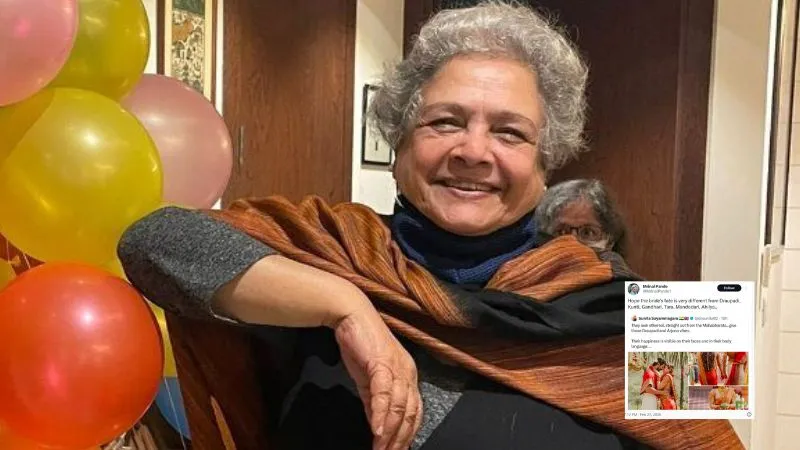
Case Summary
An anti-Hindu remark mocking the revered female characters in the Mahabharata, a revered Hindu epic, was made by leftist journalist Mrinal Pandey of the Congress National Herald. According to reports, all this started with an X (formerly Twitter) user who commented on the wedding photos of South Indian actress Rashmika Mandanna and actor Vijay Deverakonda, saying that the couple was giving off "Draupadi and Arjuna vibes from the Mahabharata." Responding to this post, she, in a mocking veiled attack on all the women of the Mahabharata, said, "Hopefully, the bride's fate will be very different from that of Draupadi, Kunti, Gandhari, Tara, Mandodari, and Ahalya." Responding to the accused's derogatory comment, X user Namita Balyan shared the impressive personalities of all these women from the Mahabharata. Namita said, "Draupadi, Kunti, Gandhari, Tara, Mandodari, and Ahalya were all extremely powerful, courageous, patient, and very important women of their time. Their contributions were not limited to their marriages or marital lives; they also displayed strength and wisdom in difficult situations." Namita further said, "Judging such great women solely on the basis of their 'marriage' not only shows incomplete information but also diminishes their role. This thinking itself was regressive, while the person who posted it was trying to portray herself as progressive." The accused Mrinal Pandey also distorted the Mahabharata and Draupadi's image by creating false assumptions. She described Draupadi as "Chidagnikund Sam Bhoota," meaning, according to her, Draupadi was born from a raging fire within. Responding to Namita's comment, she wrote, "This must have affected her precious and youthful years. Such a huge trauma must have left a deep mark on her mind. For example, Draupadi is described as Chidagnikund Sam Bhuta, meaning she was born from a fierce inner fire. This means that her personality reflects the intense power of inner fire, anger, and self-respect." Following this, Hindu Sanskrit scholar Nityanand Mishra exposed her distorted narratives about the Mahabharata and Draupadi; he was dismayed. He explained in detail that the claims made about Draupadi were not found in either the original text of the Mahabharata or its authentic versions. Mishra clearly stated that nowhere in the Critical Edition of the Mahabharata was Draupadi referred to as "Chidagnikundasambhuta." This term did not originate from the Mahabharata. He explained that the term "Chidagnikundasambhuta" actually referred to the goddess Lalita, who is mentioned in the Lalita Sahasranama and was associated with the Brahmanda Purana. This meant that the term associated with Draupadi had no connection to the Mahabharata. Nityanand Mishra also pointed out that the meaning of this word had been misinterpreted. Chit or Chid meant 'consciousness,' not inner anger. The true meaning of 'Chidagnikundasambhuta' was born from the fire altar of consciousness. To describe it as born from the fire of intense anger within was to distort the original Sanskrit meaning. Citing scholarly translations and traditional interpretations, Mishra said that the meaning of words in Sanskrit texts should be understood based on context and tradition, not arbitrarily. After this truth came to light, the accused's narrative of misrepresenting Hindus and their history failed to collapse. Instead of correcting her comment, apologising, or deleting the post, she blocked Nityanand Mishra. This was not the first time she was embroiled in such anti-Hindu controversies. In the past, when Kangana Ranaut was nominated by the Bharatiya Janata Party for the Mandi Lok Sabha seat, she made an offensive derogatory remark: "Do you get the right rate in Mandi?" On the other hand, when Kafeel Khan, accused in the Gorakhpur BRD Medical College incident, was released from jail, she could not hide her joy. She compared Khan to Lord Krishna. People found it highly objectionable to associate a man accused in a case that resulted in the deaths of innocent children with God. Even then, she did not hesitate. Her hatred for Hindus did not end there. She spewed venom even after the Kolkata Port was named after Shyama Prasad Mukherjee, a Hindu leader. She likened Mukherjee's name to a "monkey." Furthermore, mocking a Sikh leader who had once visited the Mahakal Temple, she asked, "When will you visit the Golden Temple?"
Why it is Hate Crime ?
This case has been added to the tracker under the primary category- Hate Speech against Hindus. The subcategory selected is- Anti-Hindu slurs, mocking faith. Anti-Hindu slurs and the deliberate mocking of the Hindu faith owing to religious animosity involve the usage of derogatory terms, stereotypes, or offensive references to religious practices, symbols, or figures. One of the common anti-Hindu slurs used against Hindus is “cow-worshipper” and “cow piss drinker”. The intention of using this term is to demean and mock Hindus as a group and their religious beliefs since Hindus consider the cow holy. Additionally, some symbols and the slurs attached to them have a historical context that exacerbates the insult, hate, stereotyping, dehumanisation and oppression against Hindus. Cow worship has been used for centuries to denigrate Hindus, insult their faith and oppress Hindus specifically as a religious group. There has been overwhelming documentation about how cow slaughter has been used to persecute Hindus with cow meat being thrown in temples and places of worship. There has also been overwhelming documentation where cow meat (beef) has been force-fed to Hindus to either forcefully convert them to Islam or denigrate their faith. Apart from cow worship, the Swastika – which holds deep religious significance for the Hindus – has also been misinterpreted and distorted to use as a slur against Hindus. Similarly, the worship of the Shivling has been used by supremacist ideologies and religions to denigrate Hindus owing to religious animosity. Such slurs and denigration stem out of inherent animosity and hate towards Hindus and their faith, therefore, it is categorised as hate speech targeted at Hindus specifically owing to their religious identity. The other subcategory selected is- Subversion of scriptures. Subverting the religious scriptures of Hindus has particularly devastating consequences. Subversion of the scriptures of Hindus is often done to justify or promote hatred, discrimination, or violence against specific individuals or groups of Hindus. Religious scriptures are often nuanced and those who harbour religious animosity towards Hindus often misquote or misrepresent the scripture to legitimise their animosity and hate towards the faith and its adherents. Any such misquoting of scriptures or subversion to justify hate, violence and discrimination against Hindus owing to religious animosity is hate speech and is categorised as such. This case is being added to the tracker as a clear instance of religiously motivated hate speech by the accused, as she mockingly wished that actress Rashmika Mandanna's fate would differ from that of Draupadi, Kunti, Gandhari, Tara, Mandodari, and Ahalya, revered female characters from the Mahabharata. These women hold profound significance in Hinduism's most sacred epic, the Mahabharata, which billions of Hindus revere as a timeless guide to dharma, morality, and devotion. Draupadi embodies fiery strength and justice, Kunti exemplifies selfless motherhood and wisdom, Gandhari represents unwavering loyalty and sacrifice, Tara symbolises grace amidst tragedy, Mandodari stands for virtue in adversity, and Ahalya signifies redemption and purity. By denigrating these icons, the accused deliberately insulted core elements of the Hindu faith, stirring pain among devotees who see them as divine exemplars. This act of scorn towards sacred Hindu figures reveals deep-seated religious animosity, marking it as religiously motivated hate speech that wounds the community's spiritual heart. She further distorted the Mahabharata by misinterpreting Draupadi's description as "Chidagnikundasambhuta," falsely claiming it meant she emerged from a "raging inner fire" of anger and trauma, thereby painting this heroic figure as psychologically scarred. Such deliberate twisting of holy scripture aims to demean Draupadi's exalted image, reducing a symbol of resilience to a caricature of bitterness. This targeted perversion of Hindu texts not only spreads misinformation but also fuels contempt for Hindu beliefs, constituting religiously motivated hate speech by attacking the integrity of scriptures central to Hindu identity and worship. When Hindu Sanskrit scholar Nityanand Mishra factually corrected her, explaining that "Chidagnikundasambhuta" refers to Goddess Lalita, not Draupadi, and means "born from the fire altar of consciousness," she refused to acknowledge her error. Instead of apologising, deleting her original post, or engaging constructively, she simply blocked him. This evasion underscores her malicious intent to perpetuate hurtful rhetoric against Hindus, showing no remorse for mocking revered Mahabharata characters. Her deliberate persistence in spreading divisive and anti-Hindu content confirms religiously motivated hate speech, as it prioritises antagonism over truth and reconciliation. The accused's history reveals a pattern: she equated Kafeel Khan, accused in the Gorakhpur BRD Medical College tragedy that killed innocent children, with Lord Krishna, a beloved Hindu deity embodying divine compassion. This sacrilegious comparison trivialises child deaths while elevating the accused, exposing biased reverence that mocks Hindu sentiments and elevates others at their expense, a hallmark of religiously motivated animosity. From insulting Shyama Prasad Mukherjee as a "monkey" to taunting a Sikh leader's temple visit, her repeated barbs form a clear anti-Hindu tirade. Thus, her current mockery of sacred Mahabharata characters stems from religious malice and hatred, warranting a record in the hate crime database of the Hinduphobia Tracker.


Case Status
Unknown


Perpetrators Details
Perpetrators
Others
Perpetrators Range
One Person
Perpetrators Gender
female
 Sources




