Hindu villagers coerced and brainwashed for religious conversion by Christian evangelists; Hindu activists attacked for opposing it
 Raebareli, Uttar Pradesh, India
  28 February, 2026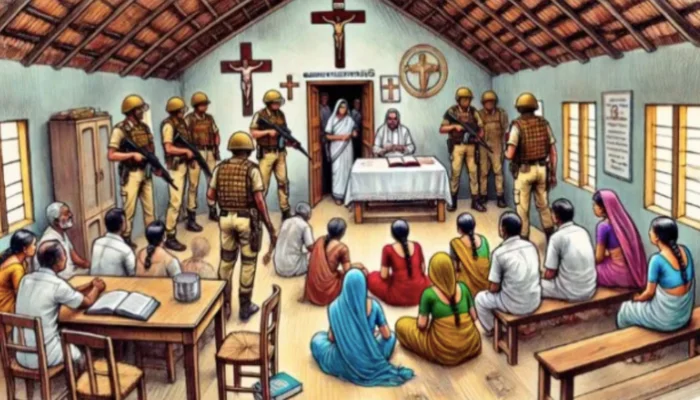
Case Summary
In the Mubarakpur village of Rae Bareli, Uttar Pradesh, Hindu villagers were targeted, brainwashed with religious texts and offered inducements for religious conversion by Christian evangelists. Those who refused to convert were threatened, while Hindu activists were attacked for opposing this illegal conversion. According to reports, a large Christian prayer gathering was organised at a private residence in Mubarakpur on 1 March 2026, where around 200 to 250 men, women, and children had assembled. The gathering was a prayer meeting during which the Hindu villagers, particularly from economically weaker and Scheduled Caste backgrounds, were being induced to convert to Christianity through monetary incentives and material benefits. It was further reported that those unwilling to convert were subjected to intimidation and threats. Literature related to Christianity, including copies of the Bible and other religious materials, was recovered from the premises. A display board containing writings connected to religious conversion was also found at the location. When members of Hindu organisations received information about the illegal conversion activities, they reached the spot and raised objections, revealing that no official permission had been obtained for organising such a large gathering. A confrontation ensued, during which those present at the prayer meeting engaged in a scuffle and issued death threats to the Hindu activists. The situation de-escalated after police officials, including the Circle Officer of Maharajganj area, Pradeep Kumar, and Harchandpur station in-charge Harikesh Singh, arrived with a police team. Vivek Singh, State General Secretary of the Vishwa Hindu Parishad, stated that the landlady of the house had been jailed two years earlier in connection with a religious conversion matter. Bajrang Dal district coordinator Om Prakash Rawat, along with other functionaries of Hindu organisations, reached the house at approximately 2 pm on 1 March 2026. Based on a written complaint submitted at Harchandpur police station, a case was registered against 12 individuals, identified as Ramrati, Kajal Pasi, Savita, Savitri, Santlal Pasi, Ramsamujh, Dhirendra Kumar, Moni Pasi, Ramkishore Pasi, Ankesh Kumar Pasi, Himanshu Pasi, and Ramsumer. All the accused were arrested by the police,, and they confirmed that further investigation was underway. During interrogation, the accused revealed that they attempted to influence people by distributing religious books and organising prayer meetings and bhajan programs. Through these events, Hindus were encouraged to convert to Christianity. They were also lured with promises of financial and other benefits for conversion. Local residents and members of Hindu organisations stated that similar prayer meetings had been conducted in the village multiple times in the past without prior permission, and that poor and illiterate villagers had repeatedly been targeted with inducements to change their religion. Authorities stated that strict action would be taken following the completion of the investigation.
Why it is Hate Crime ?
This case has been added to the tracker under the primary category- Predatory Proselytisation. Within it, the sub-category selected is- Proselytisation by grooming, brainwashing, manipulation or subtle indoctrination, with the tertiary category being - Pattern of targeting Hindus. Religious brainwashing essentially means the often subtle and forcible indoctrination to induce someone to give up their religious beliefs to accept contrasting, regimented ideas. Religious grooming or brainwashing also involves propaganda and manipulation. It involves the systematic effort, driven by religious malice and indoctrination, to persuade “non-believers’ to accept allegiance, command, or doctrine to and of a contrasting faith. Cases of such grooming or brainwashing are far more nuanced than direct threats, coercion, inducement and violence. In such cases, it is often seen that there is repeated, subtle and continual manipulation of the victim to induce disaffection towards their own faith and acceptance of the contrasting faith of the perpetrator. While subtle indoctrination is widely acknowledged as predatory, an element which is often understated in such conversions or the attempts of such conversion is the role of loyalty and trust which might develop between the perpetrator and the victim. Fiduciary relationships are often abused to affect such religious conversion. For example, an educator transmitting religious doctrine of a competing faith to a Hindu student. The Hindu student is likely to accept what the teacher is transmitting owing to the existence of the fiduciary relationship. The exploitation of the fiduciary relationship to religiously indoctrinate victims would also be included in this category. Since the underlying animosity towards the victim’s faith forms the basis of predatory proselytisation, such cases are considered religiously motivated hate crimes. The other sub-category selected is - Conversion/attempts to convert by inducement. Predatory Proselytisation is not just limited to threat, harassment, force and violence, but it also has contours of stealth. In several cases, the Hindu victim is exploited to convert, with non-Hindus taking advantage of their poverty. In such cases, the Hindu victim who is suffering financially is offered monetary benefits, including lucrative offers for jobs, health treatment, education, etc, to induce the victim into changing his/her religion. In such cases, the religious identity of the victim and the aim to disenfranchise him from his faith form the heart of the crime. Also, taking advantage of and exploiting an individual’s economic vulnerabilities is widely acknowledged as exploitation, forms of which are often penalised by law. Such cases therefore are considered religiously motivated hate crimes since the victim’s religious identity forms the very heart of the crime itself. The other sub-category selected is - Harassment, threats, coercion for conversion. Harassment covers a wide range of behaviours of an offensive nature. It is commonly understood as behaviour that demeans, humiliates, and intimidates a person, including threats and coercion. Harassment and threats, in this case, find their root on discriminatory grounds which has the effect of nullifying a person’s rights or infringing upon his freedom to exercise his right specifically owing to the victim’s religious identity. Verbal and physical threats and psychological or physical harassment are often used against Hindu victims because they choose to practice their professed religion. Religious harassment also includes forced and involuntary conversions by harassment, threats or coercion. Coercion includes intimidatory tactics like force-feeding a Hindu victim beef to convert to another religion, forceful circumcision etc. In several cases documented, non-Hindu perpetrators or those who harbour specific animosity towards Hinduism, harass victims simply based on their religious identity. Such cases often also include harassment to ensure the Hindu victim abandons his/her professed religion and adopts the religion of the perpetrator. Such cases where Hindu victims are harassed to convert to the perpetrator’s religion are rooted in animosity towards the victim’s religious identity and are therefore documented as religiously motivated hate crimes. The second primary category selected here is - Attack not resulting in death. Within it, the sub-category selected here is - Attacked for opposing radicals or trying to save victim. In several cases, Hindus are attacked for opposing religiously motivated crimes being committed against a fellow Hindu or simply for voicing an opinion opposing radical elements, who either have in the past or continue to persecute Hindus. In such cases, the initial attack against the victim, against which the Hindu was trying to defend the victim, would also need to be classified as a religiously motivated hate crime. Since the initial crime itself was religiously motivated and the subsequent crime of attempting to save the victim or speaking against the radical elements ends up inviting a violent attack, it would also be classified as a religiously motivated hate crime under this category. The other primary category relevant here is - Hate speech against Hindus. Within it, the sub-category selected is - Violent threats. Violent threats, explicit, implicit or implied, is the most dangerous form of hate speech since it goes beyond discriminatory and prejudicial language to express the intent of causing harm to an individual or a group of people based on their religious identity and faith. There could be several different kinds of threats that are issued to Hindus based on religious animosity. An explicit threat would mean the direct threat of violence towards an individual Hindu, a group of Hindus or Hindus at large. Physical violence, death threats, threats of destruction of property belonging to Hindus and threats of genocide would mean explicit threats against Hindus for their religious identity. Implicit threats may not be a direct threat but implied through the use of symbols of actions – for example – in the Nupur Sharma case, other than explicit threats, there were also implicit threats when Islamists took to the streets to burn and beat her effigies. It implies that they want to do the same to Nupur Sharma – thereby is considered an implicit threat. Violent threats can be delivered in person, through letters, phone calls, graffiti, or increasingly through social media and other online platforms. It would be important to understand that a threat – explicit or implicit, online or offline – to an individual who happens to be a Hindu does not qualify as a religiously motivated threat. Such a threat, while vile and dangerous, could be owing to non-religious reasons and/or personal animosity. To qualify as a religiously motivated threat, it would need to exhibit an indication that the individual is being targeted for religious reasons and/or owing to his/her religious identity as a Hindu. This case has been added to the tracker because Hindu villagers were targeted, brainwashed with religious texts and offered inducements for religious conversion by Christian evangelists. Around 200 to 250 men, women and children, primary belonging to Scheduled caste and economically vulnerable sections were present at the gathering. Firstly, Hindu villagers were lured for conversion under the guise of a prayer meeting. What was presented as a simple prayer gathering inside a house was in reality a covert attempt at religious conversion. These were not genuine community prayers but calculated efforts to exploit the trust of Hindus and manipulate them into abandoning their faith. The organisers deliberately held the meeting in secrecy and without permission from the administration, indicating a deliberate and deceptive strategy designed to avoid public attention and scrutiny. By conducting such gatherings covertly, the Christian missionaries sought to manipulate vulnerable Hindus, taking advantage of their emotional and social circumstances to push them towards conversion. Secondly, Hindus villagers from economically weaker and Scheduled Caste backgrounds, were induced to convert to Christianity through monetary incentives and material benefits. Offering incentives or making false promises, especially when directed at vulnerable individuals in need, shows that these incentives are not acts of kindness or charity. Instead, they are calculated moves to exploit vulnerable Hindus because of religion. By providing inducements in exchange for conversion, the accused were effectively blackmailing those who might have been desperate for assistance or hope. Such instances are seen in many cases where members of Christian missionary groups target socially and economically vulnerable Hindus to further their agenda of religious conversions. This form of coercion strips people of their agency and dignity and results in coerced conversions. These are not random or isolated incidents, but rather cases deeply rooted in religious animosity towards Hindu victims. Thirdly, those who refused to convert were subjected to intimidation and threat. Pressuring or threatening a Hindu individual to discard his religious faith and embrace another was a direct attack on his religious identity and dignity. It was not a matter of personal choice; it was coercion rooted in hostility towards the victim's Hindu identity. Such an attempt reflects religious animosity because the act is not simply about personal differences but about erasing the victim’s Hindu faith, making it a religiously motivated crime. Fourth, Christian religious literature, including copies of the Bible and other religious materials, was also recovered from the premises. The Christian perpetrators were also actively attempting to indoctrinate the Hindu victims by using Christian religious texts and literature. Using the scriptures or literature of one faith to deliberately target and manipulate members of another, with the clear intention of religious conversion, represents a direct attack on the Hindu faith. Such actions are designed to violate and undermine the beliefs of Hindu victims and are clear indicators of religious hostility towards Hindus and their religious identity. Such actions further demonstrate that this was not an isolated incident of evangelism, but rather part of a broader, organised operation to further religious conversions. When Christian religious material is used to exploit trust, sow doubt, and misrepresent the beliefs of Hindus to coerce conversion, particularly in a systematic manner, it constitutes a religiously motivated offence. Fifth, it was further reported that children were also present at the prayer meeting. Thus, some of the victims were minors, which means the element of consent and genuine change of conscience was missing ab initio. Minors, due to their young age and lack of maturity, are particularly vulnerable to manipulation and coercion. They may not have the ability to fully understand the implications of converting to another religion, and the perpetrators purposely targeted and exploited this vulnerability of the victim. Since this case exemplifies the use of coercion and manipulation to achieve religious conversion, it is a blatant act of religious hate. Sixth, when members of Hindu organisations reached the house to oppose the ongoing conversion activities, they were met with hostility by those present at the gathering. Hindu activists were attacked and given death threats by the Christian perpetrator. This was not merely a spontaneous disagreement but a targeted act of intimidation directed at Hindu activists because they sought to resist and expose religious conversion efforts affecting members of their community. The violence and threats were aimed at silencing opposition and deterring scrutiny, thereby reinforcing the communal character of the incident. The fact that the activists were assaulted and threatened for objecting to the conversion of Hindus demonstrated a clear element of religiously motivated hostility. Seventh, furthermore, it was also revealed that the landlady of the house had been jailed two years earlier in connection with a religious conversion matter. Thus, it was not an isolated incident but part of a pattern where Hindus were targeted as a collectivity. When individuals or groups focus their efforts on converting members of a particular religion, in this case, Hindus, then it demonstrates a fundamental disregard for the Hindu faith. Conversion, especially when not based on personal conviction but rather on external persuasion or pressure, is not simply about sharing a different belief system. It is an attempt to undermine the values, traditions, and identity of the Hindu community. In this context, the Christian perpetrators specifically targeted Hindus, which demonstrates a lack of respect for Hinduism and its followers. Such actions are carried out to strip Hindu victims of their faith, making it a religiously motivated crime. The Christian faith, by its very theological foundations, places a strong emphasis on proselytisation. In pursuit of conversion objectives, Christian evangelists often employ unethical means, ranging from psychological pressure and misinformation to inducements such as money or jobs. This systematic attempt to erode the religious foundation of individuals and replace it with allegiance to another faith reflects deep religious malice and animus against the Hindu identity. Because the core motivation of the act stems from hostility toward the victim’s religion, it meets the threshold of a hate crime. Hence, categorised as a hate crime in the database. Disclaimer: Media reports state that around 250 Hindu villagers, including men, women and children, were targeted for conversion, but no gender-wise or age-wise breakdown was provided. For documentation clarity, the Hinduphobia Tracker has applied a proportional demographic estimate based on India’s Census 2011 and NFHS-5 (2019–21) rural population patterns. Accordingly, the 250 participants are estimated as 125 men (50%) and 125 women (50%), reflecting an equal gender distribution consistent with typical rural family demographics. As the age-wise segregation was also not specified in the media report, the Hinduphobia Tracker has used a proportional demographic estimate derived from the same data sources. Accordingly, the 250 participants are estimated as 175 adults (70%) and 75 children (30%).
Victim Details
Total Victim
250
Deceased
0
Gender
- Male 125
- Female 125
- Third Gender 0
- Unknown 0
Caste
- SC/ST 250
- OBC 0
- General 0
- Unknown 0
Age Group
- Minor 75
- Adult 175
- Senior Citizen 0
- Unknown 0


Case Status
Arrested


Perpetrators Details
Perpetrators
Christian Extremists
Perpetrators Range
From 10 to 100
Perpetrators Gender
both
 Sources




