Hindu devotees detained and forced to pray on roads as Tamil Nadu government bars prayer recitations
 Tamil Nadu, India
  22 February, 2026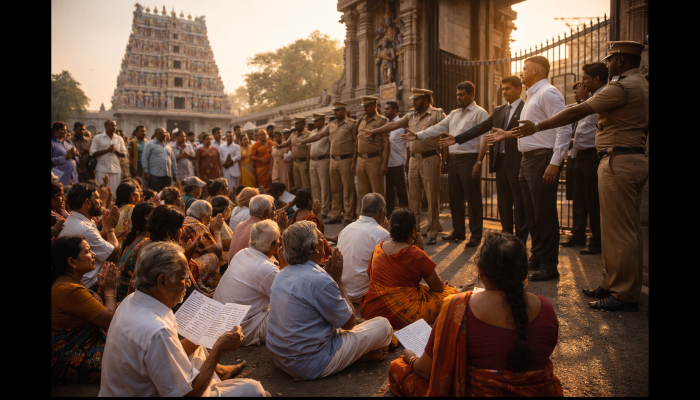
Case Summary
Thousands of Hindu devotees of Lord Murugan across Tamil Nadu were prevented from reciting Kandha Sashti Kavasam, a sacred Hindu hymn dedicated to Lord Murugan, at temples across the state on 23 February 2026, marking the auspicious occasions of Sashti and Krithigai. Several devotees were detained, physically removed from temple premises, and compelled to sit on public roads to conduct their prayers. The Dravida Munnetra Kazhagam state government directed officials of the Hindu Religious and Charitable Endowments (HR&CE) department to prevent the event and to lodge complaints against participants, with oral instructions passed to department officials across multiple temples. Hindu Munnani State President Kadeswara Subramaniam strongly condemned the actions and stated that the state government had violated the constitutional right of Hindu devotees to worship. Thousands of Hindu devotees under the banner of Muruga Bhaktargal Peravai gathered at temples across Tamil Nadu on 23 February 2026 to recite Kandha Sashti Kavasam as part of a peaceful prayer gathering. The devotees assembled to offer prayers for family welfare, the public good, the progress of Tamil Nadu, and national development, and also as a vow seeking the unhindered implementation of a court order concerning the lighting of the lamp at the Thiruparankundram Deepa Thoon. Hindu Munnani State President Kadeswara Subramaniam stated that the Dravida Munnetra Kazhagam (DMK) state government issued oral instructions to Hindu Religious and Charitable Endowments Department officials to prevent the event and to file complaints against participants. Officials at several temples alerted the police, following which the recitations of Kandha Sashti Kavasam were halted across multiple temples in the state. At Kumbakonam Thenupureeswarar Temple and Arulmigu Subramaniya Swamy Temple in Thanjavur, Hindu Murugan devotees who arrived to sing the sacred hymn were detained by the police, preventing them from worshipping at their own temples. At Kurunthamalai Murugan Temple in Karamadai, devotees were physically removed from the temple premises. At Arulmigu Subramaniaswamy Temple in Mettupalayam, devotees were denied permission to recite the hymn inside the temple and were required to sit on the road outside to conduct their recitation instead. Hindu Munnani State President Kadeswara Subramaniam condemned the actions as arbitrary and stated that the Muruga Bhaktargal Peravai had placed no demands before the state government and that devotees had gathered solely to fulfil a peaceful prayer. He affirmed that Lord Murugan was revered as a family deity by many Hindus in Tamil Nadu and that preventing devotees from reciting Kandha Sashti Kavasam within temple premises constituted an injustice against Murugan worshippers. He urged the Government of Tamil Nadu to withdraw from temple administration under the Hindu Religious and Charitable Endowments (HR&CE) department.
Why it is Hate Crime ?
The primary category for this case is "Restriction/ban on Hindu practices". The sub-category in this case is "Restriction on expression of Hindu identity". An example of the state-affected prejudicial and targeted orders against the Hindu community would be a government denying the right of a Hindu or a group of Hindus to hold a religious procession owing to the animosity of non-Hindu groups. Denial of the religious right of the Hindus to assuage the non-Hindu group which harbours animosity to a point where it could lead to violence against Hindus is not only a failure of law and order but is a prejudicial order against Hindus, denying them their fundamental rights to express their religious identity. An example of a hate crime against Hindus by a non-Hindu would be a non-Hindu institution forcing its Hindu employees to abandon religious symbols that a Hindu would wear as an expression of faith owing to inherent prejudice against the faith professed by the victim or a non-Hindu group of people restricting a Hindu group from constructing a place of worship simply because the demography of the area in which the temple is being built is dominated by non-Hindus. Such actions are driven by religious animosity and/or prejudice against Hindus and their faith and would therefore be categorised as a hate crime. Another sub-category for this case is "Administration restricting religious practice". In several cases, it is seen that the administration/state disallows a religious practice owing to prejudicial orders and concerns, targeted specifically against the Hindu community. Such restriction/prohibition would be considered documented as a hate crime because the orders are often a result of pressure by groups that harbour animosity towards Hinduism and Hindus. Often, the restriction by the authorities is driven by bias, hostility, or prejudice against the specific community being stopped from holding a religious practice, by pressure groups that harbour animosity towards Hindus, intrinsic to their faith. Since practices are intrinsic to the faith of the Hindus, such prejudicial restriction is considered a curtailing of the fundamental rights of the Hindu community. In several cases, for example, the authorities ban a Hindu religious practice due to pressure from groups opposed to the religion. In other instances the prohibition is selectively enforced against one religious group (Hindus) while others are allowed to proceed. There are still other cases where the authorities preemptively restrict a religious practice by Hindus because those who hold animosity towards Hindus may get “provoked” leading to them being violent, thereby assuaging the sentiments of those who hold animosity towards Hindus by curtailing the religious rights of Hindus. Such acts and orders are prejudiced, indicating discriminatory motives owing to the capitulation to groups that harbour animosity towards Hindus and therefore, would be categorised as a religiously motivated hate crime since the original pressure leading to the order itself is a result of hatred/bias/prejudice/religious hate against Hindus. This case qualifies as a hate crime because thousands of Hindu Murugan devotees across Tamil Nadu were prevented from reciting the Kandha Sashti Kavasam inside their own temples on 23 February 2026, an auspicious day marked by Sashti and Krithigai. The restrictions were not incidental or localised but followed oral directions issued through the Dravida Munnetra Kazhagam state government via the Hindu Religious and Charitable Endowments Department, indicating a coordinated administrative decision affecting multiple districts. Devotees had assembled peacefully at the temple premises to participate in a lawful and longstanding religious observance. Instead of facilitating worship, authorities detained participants, removed them from temple grounds, and compelled them to conduct recitations on public roads. In several locations, including Kumbakonam, Thanjavur, Karamadai, and Mettupalayam, police intervention directly obstructed temple-based prayer and prevented devotees from accessing their own places of worship for a sacred observance. Kandha Sashti Kavasam is a devotional hymn dedicated to Lord Murugan and forms a deeply embedded element of Tamil Hindu religious life. Its recitation on Sashti and Krithigai carries particular spiritual significance. Preventing its performance across multiple temples on one of its most sacred occasions constituted a targeted restriction on a clearly identifiable Hindu religious practice. The action was not directed at a general public activity but at a specific form of Hindu worship. The involvement of the Hindu Religious and Charitable Endowments Department is a significant religious marker in this case. The department is tasked with administering Hindu temples and safeguarding their functioning. Using this institutional framework to halt a Hindu religious observance within temple premises represents a direct state-mediated restriction on Hindu worship. Rather than ensuring access to temples, the administrative machinery was deployed to deny devotees the right to perform a sacred hymn. The scope of the restrictions further underscores their coordinated nature. The recitations had been organised by Muruga Bhaktargal Peravai as a collective act of devotion across multiple districts. The direction to prevent the event and to register complaints against participants effectively disrupted a peaceful, large-scale Hindu religious congregation before it could proceed. The simultaneous interference at several temples demonstrates that this was not an isolated law and order decision but a broader administrative action. The physical removal of devotees, detention of worshippers, and relocation of prayer to public roads amounted to a visible and tangible suppression of Hindu religious expression. Worshippers were denied the dignity of observing their faith within temple premises and were treated as participants in an unauthorised activity despite engaging in a lawful devotional practice. The denial of access to temple space for a core religious observance represents a direct curtailment of religious freedom. Taken together, the coordinated administrative directions, the targeting of a specific Hindu hymn on a sacred day, the deployment of temple administrative machinery to obstruct worship, and the police enforcement against peaceful devotees establish clear religious targeting. The action restricted a defined Hindu religious practice within Hindu temples on a day of spiritual significance. These elements collectively demonstrate that the incident meets the threshold of a religiously motivated hate crime and warrants its inclusion in the hate crime database of the Hinduphobia Tracker.


Case Status
Unknown


Perpetrators Details
Perpetrators
State and Establishment
Perpetrators Range
Unknown
Perpetrators Gender
unknown
 Sources




