Hindu temple's land encroached upon, devotees threatened, with attempts to sell meat and build mosque by Muslim community
 Sitapur, Uttar Pradesh, India
  14 December, 2025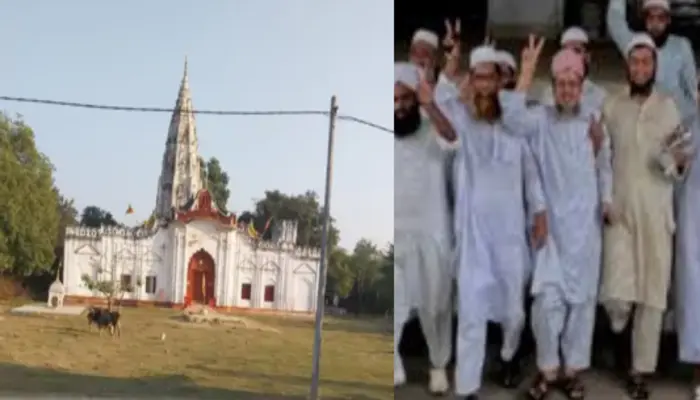
Case Summary
In the Ulra village of Biswan tehsil, Sitapur district, Uttar Pradesh, a Hindu temple's land was encroached upon, devotees were threatened, with attempts to sell meat and build a mosque over it by members of the Muslim community. The Shri Raghunathji Virajman Temple in the Ulra village and the adjoining Shivalaya were established on 4 December 1899 by Thakur Fateh Singh, who had donated approximately 35.3560 hectares of agricultural land and orchards for the maintenance of the temple and its religious functions. According to the temple priest, Dinesh Kumar Mishra, members of the Muslim community had been disposing of animal remains, including bones, skin and meat, within the vicinity of the temple premises, thereby violating the sanctity of the religious site. Meat was being sold openly on parts of the temple land. It was further stated that on multiple occasions, attempts were made to construct a mosque structure within the temple premises and that prayers were offered there, which led to resentment among members of the Hindu community. Portions of the land recorded under Khasra numbers 944 and 945 had been forcibly occupied and utilised for the construction of residential structures, toilets and drainage lines. When objections were raised by the Hindu community, they were subjected to threats, discouraging further resistance. The priest had earlier approached the District Magistrate during Tehsil Day proceedings in Biswan on 15 November 2025, following which directions were issued to the concerned Revenue Inspector to remove the encroachment from the temple land. Subsequently, officials from the local revenue administration submitted a report that resulted in the closure of the matter. The priest stated that the report did not reflect the ground situation and that the issue remained unresolved. He again submitted a formal representation to the District Magistrate seeking removal of encroachment, cessation of meat trade on the premises, and intervention regarding repeated attempts to establish a mosque structure within the temple land. He requested that an impartial inquiry be conducted under the direct supervision of the District Magistrate by an agency other than the Tehsil Biswan office, and that a personal site inspection be carried out to ensure compliance with the earlier order and to determine further action in view of the sensitivity of the matter. Following the renewed representation, the District Magistrate of Sitapur, Raja Ganapati R, issued written instructions to the Sub-Divisional Magistrate of Biswan, Shikha Shukla, directing her to conduct an inquiry into the matter and to take necessary action in accordance with the applicable rules and legal provisions.
Why it is Hate Crime ?
This case has been added to the tracker under the primary category of: Attack on Hindu religious representations. Within it, the secondary category selected is: Encroachment or illicit takeover of temple land/land near the temple. In Hinduism, a temple is the abode of the Deity. The Deity in the Temple is consecrated, thereby, making it a real, breathing entity. Hindus believe that not just the Deity but the temple premises itself are sacred to Hindus since Hindus hold the faith that the entire Temple space is an amalgamation of the divine energy of the deity. Not only the Temple but the Temple premises in its entirety are considered sacred by Hindus. In several cases, the premises of the Temple and/or religious centre are illicitly taken over by institutions belonging to other faiths – like the Waqf board or the Church. Other times, the temple property, land or the property of religious centres are illicitly encroached by non-Hindu groups. Any illicit take over or encroachment is a crime an initio, however, when non-Hindu groups illicitly take over or encroach the sacred land of Hindus, it is an affront to the Hindu community and is therefore classified as a religiously motivated hate crime under this category. The sub-category selected is - Defiling religious customs. Sanatan Dharma is not a religion of one book, which is to say that while it has religious scriptures that form the central tenets of the faith, there are several traditions followed through thousands of years, mostly passed from generation to generation orally. There are several such customs and traditions that are followed by various Hindus and Hindu sects. Defiling of these traditions and customs is a breach of an individual or group’s religious practices. Such practices can range from dietary restrictions like not eating non-vegetarian food for a certain period of the year, not eating non-vegetarian food at all, not eating beef since the cow is considered holy in Hinduism, the sanctity of religious customs followed in the house (like many ISCKON devotees), etc. Any malicious action leading to the breach of such traditions or defilement of these traditions owing to animosity towards the faith or for the sake of activism stems not only from the lack of faith in the religion itself but also from disregard for the faith of the devotees who follow the customs/traditions and implicit bias against the faith, the tradition itself. Since these specific traditions are central to the faith of the devotees of that specific sect of Hindus, any non-compliance with these traditional rules would be considered a religiously motivated hate crime. The other sub-category selected here is - Breaking rules of places of worship. Sanatan Dharma is not a religion of one book, which is to say that while it has religious scriptures that form the central tenets of the faith, there are several traditions followed through thousands of years, mostly passed from generation to generation orally. One of these oral traditions or written traditions is the rules of specific temples. Certain temples have rules which are traditional rules, dependent on the worship of the presiding deities. These rules and traditions have been followed for thousands of years whether they find scriptural mention or not. Such traditions are based on the nature and rules of worship of the presiding deity of that temple. Any non-compliance of these traditions owing to animosity towards the faith or for the sake of activism stems not only from the lack of faith in the presiding deity but also disregard for the faith of the devotees of that deity/temple and implicit bias against the faith, the tradition and the deity itself. Since these specific traditions are central to the faith of the devotees of that specific temple and presiding deity, any non-compliance with these traditional rules would be considered a religiously motivated hate crime. The other sub-category selected here is - Attack on temples. In Hinduism, a temple is the abode of the Deity. The Deity in the Temple is consecrated, thereby, making it a real, breathing entity. Hindus believe that not just the Deity but the temple premises itself are sacred to Hindus since Hindus hold the faith that the entire Temple space is an amalgamation of the divine energy of the deity. Given the central significance of Temples in Hindu Dharma, any attack against a Hindu Temple or its peripheral premises is an attack on the faith itself and is born out of animosity towards the faith, of which, the Temple is a central tenet. Any manner of attack against a Temple and/or its premises would therefore be considered a religiously motivated hate crime. The second primary category selected here is - Attack not resulting in death. Within it, the sub-category selected is - Attacked for opposing radicals or trying to save victim. In several cases, Hindus are attacked for opposing religiously motivated crimes being committed against a fellow Hindu or simply for voicing an opinion opposing radical elements, who either have in the past or continue to persecute Hindus. In such cases, the initial attack against the victim, against which the Hindu was trying to defend the victim, would also need to be classified as a religiously motivated hate crime. Since the initial crime itself was religiously motivated and the subsequent crime of attempting to save the victim or speaking against the radical elements ends up inviting a violent attack, it would also be classified as a religiously motivated hate crime under this category. This case has been added to the tracker because of the illegal encroachment upon the land of the Shri Raghunathji Virajman Temple in Ulra village by the members of the Muslim community. The Hindu temple and the adjoining Shivalaya held deep religious and cultural significance for the local Hindu population. The land surrounding the temple was not merely a piece of property but held deep religious and cultural significance for the local Hindu community. For Hindus, both the temple and its land are considered the abode of the deity, embodying divine energy. Any form of encroachment or seizure of temple land was an attack on the religious rights and sentiments of Hindus, disrupting their ability to worship and maintain their sacred spaces. Any unauthorised occupation of this space, especially one that halts worship and religious observance, is a violation of that sanctity. Such actions are not only an encroachment in legal terms but a direct affront to the religious beliefs and collective identity of Hindus. The priest also stated that the Muslim community also disposed of animal remains, including bones, skin and meat, within the vicinity of the temple premises. This was a deliberate affront to the sanctity of the site. In Hindu religious practice, temple spaces are maintained in accordance with principles of ritual purity. The dumping of animal remains into such a space was a calculated act that undermined the sacred character of the temple and disregarded the deeply held beliefs of devotees. Such conduct went beyond a routine civic dispute and was an act that deliberately humiliated and provoked the religious sentiments of Hindus associated with the temple. There were also attempts to build a mosque and offer prayers within the boundaries of the temple land. Establishing a structure associated with another faith within the premises of a Hindu temple was seen as an encroachment not only upon physical property but upon the symbolic and spiritual domain of the deity. It was a direct challenge to the religious character and sanctity of the site. Building a mosque and offering prayers is a symbolic assertion of Islamic identity over the Hindu places of worship. Because temples occupy a central role in preserving religious continuity, collective memory and community cohesion, any move to implant another religious structure within their premises was an act intended to undermine the Hindu presence within the area. Furthermore, when members of the Hindu community decided to oppose these developments, they were intimidated and harassed by the Muslim community, thus creating an atmosphere in which open resistance became difficult. Such intimidation has a wider social impact beyond the immediate dispute. When Hindus face hostility for defending the sanctity of their temples, it normalises the use of threats and the spectre of violence as tools to silence religious assertion. It sends a message that efforts to protect Hindu places of worship may invite retaliation, thereby eroding the community’s confidence in exercising its religious rights. Taken together, the encroachment upon temple land, the dumping of meat, and the attempts to build a mosque on the premises demonstrate hostility towards Hindu religious spaces and practices. As these actions stemmed from religious animosity directed at a Hindu place of worship, and it interfered with the community’s ability to preserve and practise its faith, the incident has been categorised and included in the tracker as a religiously motivated hate crime. Disclaimer: It is important to clarify that none of the media sources covering this case has specified the exact date when the temple encroachment began. The earliest date mentioned is 15 November 2025, when the priest initially filed a complaint. Since Hinduphobia Tracker records the incident based on when the victim’s ordeal began or when the event occurred and not when it was reported, we have considered the date of the incident as 15 November 2025, though the media reported the incident on 28 February 2026.


Case Status
Complaint filed


Perpetrators Details
Perpetrators
Muslim Extremists
Perpetrators Range
Unknown
Perpetrators Gender
unknown
 Sources




