Minor Hindu girls harassed for wearing Hindu symbols in missionary school; pressured for conversion by Christian principal
 Lucknow, Uttar Pradesh, India
  22 February, 2026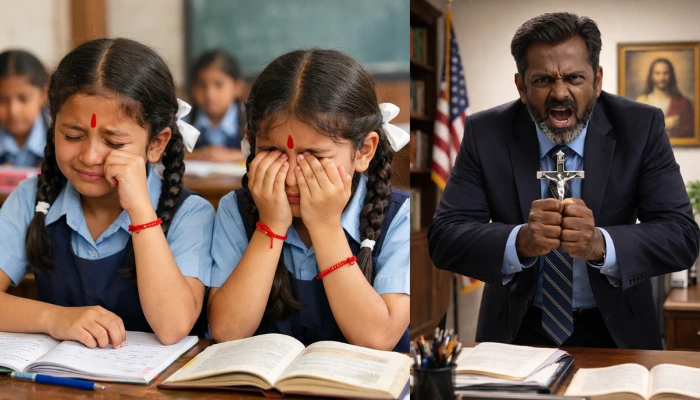
Case Summary
In Lucknow, two minor Hindu female students were subjected to harassment by their Christian principal at school for wearing religious symbols associated with Hinduism. The victims were also targeted for forced religious conversion by the accused. According to reports, this incident came to light when the family of the victims filed a complaint at the Vikas Nagar police station. This incident occurred in St Fidelis School located in Vikas Nagar. Vikas Kumar Verma, the father of the victims, a resident of Shankar Nagar Square, Daliganj, said that he has two daughters who are studying at St Fidelis School in Vikas Nagar. One is a sixth-grader, and the other is a third-grader. They have been facing mental harassment for wearing Hindu religious symbols for several days at school by the principal. The victims' father also said that the principal was trying to convert his Hindu daughters to Christianity. Upon learning of this, an attempt was made to meet with the school administration. The Christian principal then asked the school administration to expel both Hindu girls. Reports also confirmed that the school principal had previously himself converted from Sikhism to Christianity. Regarding this entire matter, Vikas Nagar Station Officer stated that an investigation is underway based on the complaint. Notably, in this case, the Hinduphobia Tracker team tried to contact the Vikas Nagar police, but could not connect with them at the time of writing this report.
Why it is Hate Crime ?
This case is being added to the tracker under the primary category- Attack not resulting in death. The subcategory selected is- Attacked for Hindu identity. In several cases, Hindus are attacked merely for their Hindu identity without any perceived provocation. A classic example of this category of religiously motivated hate crime is a murder in 2016. 7 ISIS terrorists were convicted for shooting a school principal in Kanpur because they got ‘triggered’ seeing the Kalava on his wrist and tilak that he had put. In this, the Hindu victim had offered no provocation except for his Hindu religious identity. The motivation for the murder was purely religious, driven by religious supremacy. Such cases where Hindus are targeted merely for their religious identity would be documented as a hate crime under this category. Another primary category selected is- Restriction/ban on Hindu practices. The subcategory selected is- Restriction on expression of Hindu identity. An example of the state-affected prejudicial and targeted orders against the Hindu community would be a government denying the right of a Hindu or a group of Hindus to hold a religious procession owing to the animosity of non-Hindu groups. Denial of the religious right of the Hindus to assuage the non-Hindu group which harbours animosity to a point where it could lead to violence against Hindus is not only a failure of law and order but is a prejudicial order against Hindus, denying them their fundamental rights to express their religious identity. An example of a hate crime against Hindus by a non-Hindu would be a non-Hindu institution forcing its Hindu employees to abandon religious symbols that a Hindu would wear as an expression of faith owing to inherent prejudice against the faith professed by the victim or a non-Hindu group of people restricting a Hindu group from constructing a place of worship simply because the demography of the area in which the temple is being built is dominated by non-Hindus. Such actions are driven by religious animosity and/or prejudice against Hindus and their faith and would therefore be categorized as a hate crime. Another primary category selected is- Predatory Proselytisation. The subcategory selected is- Proselytisation by grooming, brainwashing, manipulation or subtle indoctrination. The tertiary categories selected are- Conversion of minor, Family claims grooming. Religious brainwashing essentially means the often subtle and forcible indoctrination to induce someone to give up their religious beliefs to accept contrasting regimented ideas. Religious grooming or brainwashing also involves propaganda and manipulation. It involves the systematic effort, driven by religious malice and indoctrination, to persuade “non-believers’ to accept allegiance, command, or doctrine to and of a contrasting faith. Cases of such grooming or brainwashing are far more nuanced than direct threats, coercion, inducement and violence. In such cases, it is often seen that there is repeated, subtle and continual manipulation of the victim to induce disaffection towards their own faith and acceptance of the contrasting faith of the perpetrator. While subtle indoctrination is widely acknowledged as predatory, an element which is often understated in such conversions or the attempts of such conversion is the role of loyalty and trust which might develop between the perpetrator and the victim. Fiduciary relationships are often abused to affect such religious conversion. For example, an educator transmitting religious doctrine of a competing faith to a Hindu student. The Hindu student is likely to accept what the teacher is transmitting owing to existence of the fiduciary relationship. The exploitation of the fiduciary relationship to religiously indoctrinate victims would also be included in this category. Since the underlying animosity towards the victim’s faith forms the basis of predatory proselytization, such cases are considered religiously motivated hate crimes. The other subcategory selected is- Harassment, threats, coercion for conversion. Harassment covers a wide range of behaviours of an offensive nature. It is commonly understood as behaviour that demeans, humiliates, and intimidates a person, including threats and coercion. Harassment and threats, in this case, find their root on discriminatory grounds which has the effect of nullifying a person’s rights or infringing upon his freedom to exercise his right specifically owing to the victim’s religious identity. Verbal and physical threats and psychological or physical harassment are often used against Hindu victims because they choose to practice their professed religion. Religious harassment also includes forced and involuntary conversions by harassment, threats or coercion. Coercion includes intimidatory tactics like force-feeding a Hindu victim beef to convert to another religion, forceful circumcision etc. In several cases documented, non-Hindu perpetrators or those who harbour specific animosity towards Hinduism, harass victims simply based on their religious identity. Such cases often also include harassment to ensure the Hindu victim abandons his/her professed religion and adopts the religion of the perpetrator. Such cases where Hindu victims are harassed to convert to the perpetrator’s religion are rooted in animosity towards the victim’s religious identity and are therefore documented as religiously motivated hate crimes. This case exemplifies a religiously motivated hate crime, as two minor Hindu girls were explicitly targeted for their religious identity. They faced harassment for wearing Hindu religious symbols and pressure for conversion by the Christian principal, demonstrating deliberate bias against their faith that goes beyond mere discipline. The targeting of these victims for wearing religious symbols underscores that they were singled out due to their Hindu identity. Hindu religious symbols hold deep significance as markers of devotion, protection, and cultural heritage, worn to express faith in daily life. Restricting and harassing minor Hindu students in an educational institution for displaying their identity, led by the Christian principal, amounts to suppression of their religious expression, instilling fear and compelling them to conceal their identity to avoid trouble. Overall, this incident crushed the simple religious expression of the children's Hindu identity. They most likely wore these symbols as personal tokens of faith, much like any child might carry a cherished item. Yet the Christian principal suppressed and trampled this innocent display of devotion. Restricting minor Hindu students' rights to express their religious identity, while targeting their faith specifically, epitomises a hate crime. It sends a chilling message of intolerance, dehumanising the victims for simply being Hindu. Such acts are a deliberate effort to erase their religious identity and expression, deeply disrespectful to Hinduism's core values and practices. The message is clear: Hindu symbols and expressions are not welcome in the school and will be forcibly challenged if displayed. This violates a Hindu child’s fundamental right to practise and express their religion, creating an atmosphere of fear and suppression where they feel compelled to hide their faith. Such actions are common tactics to alienate Hindu children from their identity, serving as the first step in grooming through consistent ridicule and punishment, making them susceptible to abandoning their faith under pressure. These deliberate measures erode the children’s confidence in their religion over time, normalising the idea that Hindu identity must be hidden to fit in. Rooted in bias against Hinduism and its adherents, this constitutes a religiously motivated hate crime. Thirdly, it is important to note here that the victims were minors, which means the element of consent and genuine change of conscience was missing ab initio. Minors, due to their young age and lack of maturity, are particularly vulnerable to manipulation and coercion. They may not have the ability to fully understand the implications of religious humiliation or to recognise such deception and brainwashing attempts, and the perpetrator purposely targeted and exploited this vulnerability of the victim, making it a religiously motivated crime. Here, it is also important to mention that in 2022, a massive controversy erupted in Karnataka, which took a national form, after Muslim women insisted that they should be allowed to wear burqas and hijabs in their schools and classrooms. At that time, the argument given by several politicians, social commentators, Hindu activists and even the judiciary was that schools have the right to enforce uniform rules, since wearing uniforms brings harmony and equality in the classroom, and therefore, schools not allowing girls to wear hijab in the classroom is not religious discrimination, but merely an enforcement of widely accepted uniform norms. The argument was also that overt religious symbols like the Hijab can be restricted under the school's policy of uniformity. Pseudo-seculars and leftist groups may argue that a similar line of reasoning should be applied in this case. However, it is important to note that most uniform codes focus on standardising clothing and accessories like shoes, belts, and hair. In the case of Hindus, students are often restricted from wearing even minor religious markers like a tilak, a kalava, or a janeu. These symbols are minute, do not alter the uniform's appearance or disrupt the classroom, and are not overt religious displays. They are benign and harmless, raising serious questions about the motivations behind such enforcement. Therefore, in this case, the religious symbols were most likely minute, like kalava and tilak, and the actions of the Christian principal amount to religious discrimination, fitting the framework of a hate crime where the Hindu children were penalised solely for adhering to their religious practices. Even the Hinduphobia Tracker has previously documented several incidents of similar restrictions on Hindu religious symbols, mostly the kalava and tilak. For example, in December 2025, a mission school in Seoni, Madhya Pradesh, prohibited certain Hindu rituals, such as applying tilak and tying kalava (sacred thread), while involving minor Hindu students in Bible reading and prayer sessions. This raised concerns among the local Hindu community and led to tensions, with many gathering outside the school to protest. In December 2025, Hindu students at St Angela's School in Jatkheda village, Sehore district, Madhya Pradesh, endured severe disciplinary actions from the Muslim administration. Children were compelled to remove kalava (sacred threads) and tilak (forehead marks) and made to stand outside in freezing temperatures. Some were forced into physically punishing positions, including the murga posture. Similarly, in October 2025, in Kulpahar, Mahoba, Uttar Pradesh, Hindu students at a Christian missionary school were denied entry for wearing a tilak and a kalava. They were also brainwashed for religious conversion. The matter came to light after a social media post denigrating Hindu gods and goddesses by the school's Class 12 student, Hemant John, went viral. All this makes it clear that even minor, minuscule religious markers are often used as pretexts to target and harass Hindu minor students in schools, especially by Muslim or Christian teachers, principals, or administrators. This demonstrates that, in this case, the harassment over religious markers constitutes a crime motivated by religious bias rather than maintaining school uniformity. Furthermore, the attempt to convert the victims also showcases that the initial harassment over religious symbols stemmed from religious animosity rather than maintaining school or uniform rules. The manner in which they were harassed and subjugated for religious conversion starkly demonstrated that they were being driven to abandon their Hindu faith identity and convert to Christianity. The victims' father stated unequivocally that the accused sought to convert his minor daughters through these actions, revealing a deliberate plot to dismantle their religious foundations. Using manipulation and religious humiliation techniques, such as mocking sacred symbols like the tilak and kalava, isolating the girls, and exploiting authority to intimidate, amounts to a blatant hate crime that wields power imbalances against defenceless minors to crush one faith and impose another, in direct violation of their right to religious freedom and rooted in overt prejudice against Hinduism. Given that this case meets the parameters of a religiously driven hate crime, it is being added to the hate crime database of the tracker. Disclaimer: The Hinduphobia Tracker records incident dates based on when the hate crime commences, rather than the media reporting date. In this case, since the date of the victims' ordeal has not been specified, the media publication date of 23 February 2026 has been selected as the indicative incident date. This is recorded for documentation purposes only.
Victim Details
Total Victim
2
Deceased
0
Gender
- Male 0
- Female 2
- Third Gender 0
- Unknown 0
Caste
- SC/ST 2
- OBC 0
- General 0
- Unknown 0
Age Group
- Minor 2
- Adult 0
- Senior Citizen 0
- Unknown 0


Case Status
Complaint filed


Perpetrators Details
Perpetrators
Christian Extremists
Perpetrators Range
One Person
Perpetrators Gender
male
 Sources




