Hindu devotees prevented from reciting prayers at temple; Dehradun police claims prayers near mosque could ‘disturb atmosphere’
 Dehradun, Uttarakhand, India
  23 February, 2026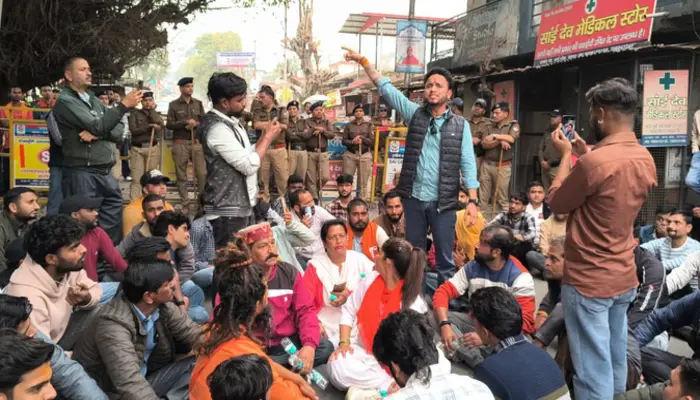
Case Summary
In the Thano area near Jolly Grant, Dehradun, Uttarakhand, communal tensions escalated after members of Hindu community were prohibited from reciting Hanuman Chalisa at a temple situated directly opposite an illegal mosque by Dehradun Police. On 24 February 2026, members of various Hindu organisations gathered with the intention of reciting the Hanuman Chalisa at the Hindu temple, which was located directly opposite an illegal mosque in the Thano area. The Hindu organisation stated that the mosque located at Kandogal Thano area was operating without valid approvals. They revealed that the structure had not received an approved map and that the madrasa functioning within it was neither registered with the Uttarakhand Waqf Board nor recognised by the Uttarakhand Madrasa Education Council. Local residents had previously raised the matter with the administration and the Mussoorie Dehradun Development Authority, after which a portion of the mosque had been sealed in December 2025 in the presence of police personnel. When members of Hindu organisations attempted to march towards the Hindu temple and proceed with the recitation, a heavy police force was deployed to restrict them from doing so. Barricades were erected at Thano Chowk, and Hindu activists were stopped on Dharkot Road near the mosque. The police intervened on the grounds that conducting the recitation in close proximity to the mosque could aggravate the already tense atmosphere. Following the stoppage, the Hindu activists sat on the road, chanted religious slogans and recited the Hanuman Chalisa as a sign of protest. The protest continued for over two hours under tight security arrangements, with personnel from Ranipokhari, Rishikesh and Raiwala police stations deployed under the supervision of the Circle Officer of Rishikesh. The controversy was linked to earlier administrative proceedings. On 17 December 2025, the first floor of the Intezamia Committee Jama Masjid at Kandogal Kudiyal had been sealed. The ground floor was not sealed at that time due to the absence of alternative accommodation for the imams, who were granted a period of 20 to 25 days to make arrangements. Subsequently, the Sub-Divisional Magistrate of Doiwala directed the mosque committee to submit the approved building map, a no-objection certificate from the Uttarakhand Waqf Board, and relevant registration documents from the Madrasa Education Council by 7 January 2026. During a hearing held on 11 February 2026, no such records were produced. Thereafter, on 16 February 2026, the SDM ordered the sealing of the mosque on the grounds that it was being operated without the requisite documentation. However, the sealing action did not take place on that date, which led to further mobilisation by Hindu organisations. During the 24 February 2026 demonstration, leaders associated with groups such as the Vishwa Hindu Parishad, Bajrang Dal and other local Hindu bodies addressed the gathering and warned of intensified agitation if administrative action was not completed by 3 March 2025. They stated that religious observances, including the celebration of Holi and further recitations of the Hanuman Chalisa, would be conducted at the temple even if the sealing order remained unimplemented.
Why it is Hate Crime ?
This case is added to the tracker under the primary category of - Restriction/ban on Hindu practices. Within it, the sub-category selected is : 'Restriction on expression of Hindu identity' An example of the state-affected prejudicial and targeted orders against the Hindu community would be a government denying the right of a Hindu or a group of Hindus to hold a religious procession owing to the animosity of non-Hindu groups. Denial of the religious right of the Hindus to assuage the non-Hindu group, which harbours animosity to a point where it could lead to violence against Hindus, is not only a failure of law and order but is a prejudicial order against Hindus, denying them their fundamental rights to express their religious identity. An example of a hate crime against Hindus by a non-Hindu would be a non-Hindu institution forcing its Hindu employees to abandon religious symbols that a Hindu would wear as an expression of faith owing to inherent prejudice against the faith professed by the victim or a non-Hindu group of people restricting a Hindu group from constructing a place of worship simply because the demography of the area in which the temple is being built is dominated by non-Hindus. Such actions are driven by religious animosity and/or prejudice against Hindus and their faith and would therefore be categorised as a hate crime. The other sub-category selected is - Administration restricting religious practice. In several cases, it is seen that the administration/state disallows a religious practice owing to prejudicial orders and concerns, targeted specifically against the Hindu community. Such restriction/prohibition would be considered documented as a hate crime because the orders are often a result of pressure by groups that harbour animosity towards Hinduism and Hindus. Often, the restriction by the authorities is driven by bias, hostility, or prejudice against the specific community being stopped from holding a religious practice, by pressure groups that harbour animosity towards Hindus, intrinsic to their faith. Since practices are intrinsic to the faith of the Hindus, such prejudicial restriction is considered a curtailing of the fundamental rights of the Hindu community. In several cases, for example, the authorities ban a Hindu religious practice due to pressure from groups opposed to the religion. In other instances the prohibition is selectively enforced against one religious group (Hindus) while others are allowed to proceed. There are still other cases where the authorities preemptively restrict a religious practice by Hindus because those who hold animosity towards Hindus may get “provoked” leading to them being violent, thereby assuaging the sentiments of those who hold animosity towards Hindus by curtailing the religious rights of Hindus. Such acts and orders are prejudiced, indicating discriminatory motives owing to the capitulation to groups that harbour animosity towards Hindus and therefore, would be categorized as a religiously motivated hate crime since the original pressure leading to the order itself is a result of hatred/bias/prejudice/religious hate against Hindus. This case was added to the tracker because members of the Hindu community were prevented by Dehradun Police from reciting the Hanuman Chalisa at the Hindu temple in the Thano area, despite the gathering being for a religious observance. The restriction was imposed in the context of a dispute concerning an illegal mosque situated directly opposite the temple. The police action resulted in the obstruction of a planned Hindu religious recital and triggered public protest. The mosque in question was illegal and was subjected to administrative proceedings, including partial sealing and an order for complete sealing over documentation irregularities. While Hindus intended to recite the Hanuman Chalisa within their own temple premises, Dehradun Police prohibited them from proceeding, claiming it could escalate communal tension. This decision effectively elevated concerns surrounding the illegal mosque, over the functioning and rights of an established Hindu temple. This intervention conveyed the message that the assertion of Islamic presence in the vicinity, through an illegal mosque, carried greater weight than the Hindu community’s right to worship within its own religious space. Even though the temple activity was devotional in nature and confined to Hindu premises, it was curtailed on the claims that it would escalate communal tensions. It demonstrated that worship or religious structures of other faiths, even if illegal, would be given greater preference compared to the Hindu community’s right to practise its faith within a Hindu temple. The restriction imposed on Hindu worship amounted to more than a precautionary administrative step. The action effectively penalised the community for attempting to conduct a public religious ceremony and created a chilling effect on the free and safe expression of the Hindu faith. By erecting barricades, preventing access, and halting the recitation, the authorities disrupted a core devotional practice. The intervention demonstrated a pattern of blocking Hindu religious activity on the premise of maintaining order, thereby placing the burden of restraint on the Hindu side. Such uneven enforcement fosters the perception that Hindu worship is subject to heightened scrutiny and control, even when conducted within a legitimate temple setting. Such actions have a deeper impact than the immediate incident. They cultivate an atmosphere in which Hindus are made to feel that their religious expression is vulnerable to institutional obstruction whenever any objections are anticipated from other faiths. When peaceful worship within a temple is pre-emptively curtailed due to the proximity of another illegal religious structure, it reinforces the belief that Hindu religious practices can be suspended in the name of maintaining order. Therefore, the prevention of the Hanuman Chalisa recital was not a routine law-and-order measure but an act that contributed to a broader pattern of perceived discriminatory interference with Hindu religious expression, warranting its addition to the Hinduphobia Tracker.


Case Status
Case sub-judice


Perpetrators Details
Perpetrators
State and Establishment
Perpetrators Range
Unknown
Perpetrators Gender
unknown
 Sources




