Hindu temple in Uttar Pradesh stripped of land, puja-paath and annual Bhandara suspended due to illegal encroachment by Gram Panchayat member
 Bara Banki, Uttar Pradesh, India
  21 February, 2021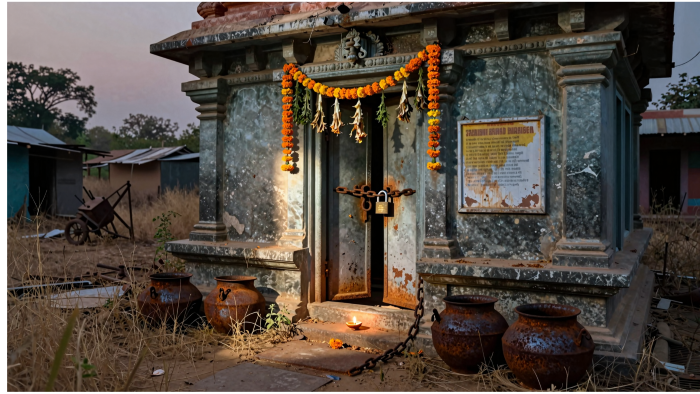
Case Summary
Ramchabutra Mandir, a Hindu temple located in Trilokpur town, Barabanki district, Uttar Pradesh, was subjected to illegal encroachment on approximately eight bigha (a traditional unit of land measurement) of temple land by Gram Panchayat member for five years. The encroachment prevented the temple from carrying out cleaning, puja-paath (Hindu prayer rituals), and the annual Bhandara (a community feast held at Hindu temples) for five consecutive years. The approximately eight bigha of land surrounding Ramchabutra Mandir was donated by devotees specifically for the temple’s use. Lalit Kumar Varma, a Gram Panchayat member, had been occupying this donated temple land for approximately five years. The temple’s caretaker, Mahant Maulhe Das, who had served at the temple for seven years, confirmed that not a single Bhandara had been organised during his tenure as a direct result of the encroachment. The temple’s income, which was generated from this land, funded the temple’s day-to-day operations and the organisation of the annual Bhandara. With the land under occupation, the temple was deprived of both its operational funds and its ability to carry out its religious activities for five consecutive years. The temple’s patron, Rammoorti Nai, stated that whenever Lalit Kumar Varma was asked to vacate the land, he responded with death threats. Rammoorti Nai filed a complaint with the Chief Minister and senior officials demanding that the land be vacated. The temple’s management, the village head, and several villagers levelled encroachment accusations against Lalit Kumar Varma. Locals in the area expressed significant outrage over the encroachment. Lalit Kumar Varma denied the accusations and stated that he had been taking care of the temple for approximately four years and that his uncle had constructed the temple. Ramnagar Naib Tehsildar (Deputy Revenue Officer) Vijay Prakash Tripathi confirmed that he had received information about the matter and that an investigation would be carried out.
Why it is Hate Crime ?
The primary category for this case is "Attack on Hindu religious representations". The sub-category here is "Encroachment or illicit takeover of temple land/land near temple". In Hinduism, a temple is the abode of the Deity. The Deity in the Temple is consecrated, thereby, making it a real, breathing entity. Hindus believe that not just the Deity but the temple premises itself are sacred to Hindus since Hindus hold the faith that the entire Temple space is an amalgamation of the divine energy of the deity. Not only the Temple but the Temple premises in its entirety are considered sacred by Hindus. In several cases, the premises of the Temple and/or religious centre are illicitly taken over by institutions belonging to other faiths – like the Waqf board or the Church. Other times, the temple property, land or the property of religious centres are illicitly encroached by non-Hindu groups. Any illicit take over or encroachment is a crime an initio, however, when non-Hindu groups illicitly take over or encroach the sacred land of Hindus, it is an affront to the Hindu community and is therefore classified as a religiously motivated hate crime under this category. Another sub-category for this case is "Attack on temples". In Hinduism, a temple is the abode of the Deity. The Deity in the Temple is consecrated, thereby, making it a real, breathing entity. Hindus believe that not just the Deity but the temple premises itself are sacred to Hindus since Hindus hold the faith that the entire Temple space is an amalgamation of the divine energy of the deity. Given the central significance of Temples in Hindu Dharma, any attack against a Hindu Temple or its peripheral premises is an attack on the faith itself and is born out of animosity towards the faith, of which, the Temple is a central tenet. Any manner of attack against a Temple and/or its premises would therefore be considered a religiously motivated hate crime. One other sub-category that this case qualifies for is "Breaking rules of place of worship". Sanatan Dharma is not a religion of one book, which is to say that while it has religious scriptures that form the central tenets of the faith, there are several traditions followed through thousands of years, mostly passed from generation to generation orally. One of these oral traditions or written traditions is the rules of specific temples. Certain temples have rules which are traditional rules, dependent on the worship of the presiding deities. These rules and traditions have been followed for thousands of years whether they find scriptural mention or not. Such traditions are based on the nature and rules of worship of the presiding deity of that temple. Any non-compliance of these traditions owing to animosity towards the faith or for the sake of activism stems not only from the lack of faith in the presiding deity but also disregard for the faith of the devotees of that deity/temple and implicit bias against the faith, the tradition and the deity itself. Since these specific traditions are central to the faith of the devotees of that specific temple and presiding deity, any non-compliance with these traditional rules would be considered a religiously motivated hate crime. Another primary category for this case is "Restriction/ban on Hindu practices". The sub-category for this case is "Restriction on expression on Hindu identity". An example of the state-affected prejudicial and targeted orders against the Hindu community would be a government denying the right of a Hindu or a group of Hindus to hold a religious procession owing to the animosity of non-Hindu groups. Denial of the religious right of the Hindus to assuage the non-Hindu group which harbours animosity to a point where it could lead to violence against Hindus is not only a failure of law and order but is a prejudicial order against Hindus, denying them their fundamental rights to express their religious identity. An example of a hate crime against Hindus by a non-Hindu would be a non-Hindu institution forcing its Hindu employees to abandon religious symbols that a Hindu would wear as an expression of faith owing to inherent prejudice against the faith professed by the victim or a non-Hindu group of people restricting a Hindu group from constructing a place of worship simply because the demography of the area in which the temple is being built is dominated by non-Hindus. Such actions are driven by religious animosity and/or prejudice against Hindus and their faith and would therefore be categorized as a hate crime. This case qualified as a hate crime on the basis that Ramchabutra Mandir, a Hindu temple in Trilokpur town, Barabanki district, Uttar Pradesh, had been rendered functionally inoperative for five consecutive years as a direct result of the illegal occupation of approximately eight bigha (a traditional unit of land measurement) of its donated land by Gram Panchayat member Lalit Kumar Varma. The encroachment had not merely deprived the temple of its land but had systematically stripped it of its ability to function as a Hindu place of worship, preventing all religious activities including cleaning, puja-paath (Hindu prayer rituals), and the annual Bhandara (a community feast held at Hindu temples) from being conducted for five years. The perpetrator’s sustained refusal to vacate the land, backed by death threats against those who demanded its return, reflected a deliberate and ongoing intent to suppress the religious functioning of a Hindu temple. The illegal occupation of approximately eight bigha of land donated by Hindu devotees specifically for the use of Ramchabutra Mandir constituted a direct and sustained encroachment on Hindu temple land. The land in question was not ordinary property but had been donated by Hindu devotees with the specific religious intent of supporting the temple’s operations and religious activities. By occupying this donated land for five consecutive years, the perpetrator had not only deprived the temple of its rightful property but had also violated the religious intent behind the donation, which was to sustain a Hindu place of worship. The perpetrator’s sustained and knowing occupation of land donated for Hindu religious purposes reflected a deliberate disregard for the sanctity of Hindu temple property. The encroachment on the temple’s land had a direct and devastating impact on the temple’s ability to function as a Hindu place of worship. The temple’s income, which was generated from the encroached land, funded its day-to-day operations including cleaning and maintenance. With this income cut off for five consecutive years, the temple was unable to maintain itself or conduct its regular religious activities. Mahant Maulhe Das, who had served at the temple for seven years, confirmed that not a single Bhandara had been organised during his entire tenure as a direct result of the encroachment. The systematic deprivation of the temple’s operational resources through land occupation effectively paralysed the functioning of a Hindu place of worship for five consecutive years, constituting a sustained and deliberate attack on the temple as a functioning Hindu religious institution. Ramchabutra Mandir was not merely a structure but a living Hindu religious institution that served as the centre of Hindu worship and community life in Trilokpur town. The sustained occupation of its land directly targeted the temple as a Hindu religious institution, preventing it from functioning in any meaningful capacity for five consecutive years. A temple that could not conduct puja-paath, could not maintain itself, and could not organise its annual Bhandara was a temple that had been effectively neutralised as a place of Hindu worship. The perpetrator’s five-year occupation of the temple’s land constituted a direct and sustained attack on Ramchabutra Mandir as a Hindu temple, targeting its very existence as a functioning place of Hindu worship. Hindu temples operated under established rules and codes of conduct that governed their functioning as sacred spaces. These rules included the regular conduct of puja-paath, the maintenance of cleanliness and ritual purity within the temple premises, and the organisation of religious events such as the annual Bhandara. The encroachment on the temple’s land directly prevented the temple from adhering to each of these established rules for five consecutive years. The temple was unable to clean and maintain its premises, unable to conduct its regular puja-paath, and unable to organise its annual Bhandara. The perpetrator’s sustained occupation of the temple’s land therefore not only deprived the temple of its property but also forced it into a state of sustained non-compliance with the very rules that governed its existence as a Hindu place of worship. The encroachment directly resulted in the suppression of multiple established Hindu religious practices at Ramchabutra Mandir for five consecutive years. The regular puja-paath, which was the foundational daily religious practice of a Hindu temple, could not be conducted. The cleaning and maintenance of the temple, which were essential prerequisites for maintaining the ritual purity required for Hindu worship, were also prevented. Most significantly, the annual Bhandara, a sacred Hindu community feast that held deep religious and social significance for the Hindu community surrounding the temple, was not held for five consecutive years. The sustained suppression of these established Hindu religious practices through the occupation of temple land represented a direct and ongoing restriction on the practice of Hinduism at this temple. The five-year suppression of all religious activity at Ramchabutra Mandir had a direct and profound impact on the ability of the Hindu community of Trilokpur town to express their Hindu identity openly and collectively. For the Hindu devotees of this community, the temple was not simply a building but the physical embodiment of their Hindu identity and the primary space through which that identity was expressed, celebrated, and passed on to future generations. The annual Bhandara, the daily puja-paath, and the maintenance of the temple as a clean and sacred space were all outward and collective expressions of Hindu identity that were denied to this community for five consecutive years. By occupying the temple’s land and rendering it incapable of functioning, the perpetrator effectively silenced the most visible and collective expression of Hindu identity in Trilokpur town, forcing the Hindu community to exist without the central institution through which their faith and identity were expressed. The perpetrator’s response to demands that he vacate the temple land, namely issuing death threats against those who asked him to leave, reflected a deliberate and sustained intent to maintain his occupation of Hindu temple land through intimidation. The temple’s patron, Rammoorti Nai, confirmed that every attempt to reclaim the temple’s land was met with threats to his life. This use of violence and intimidation to prevent the recovery of Hindu temple land and the restoration of Hindu religious activities at the temple added a further dimension of deliberate suppression to what was already a sustained attack on a Hindu place of worship. The perpetrator’s willingness to resort to death threats to maintain his occupation of donated Hindu temple land reflected a conscious and determined effort to keep the temple in a state of religious paralysis. Given that this case met the parameters of a religiously motivated hate crime, it was added to the hate crime database of the Hinduphobia tracker. Disclaimer: The Hinduphobia Tracker records incident dates based on when a crime occurred, or a victim's ordeal began, rather than when the media reported it. In this case, media reports indicate that the illegal encroachment on Ramchabutra Mandir's land has been ongoing for approximately five years. Since no exact date was available for when the encroachment began, February 22, 2021 has been used as the placeholder incident date. The year 2021 was chosen by counting back five years from the approximate time of reporting, and February 22 was chosen as it corresponds to the date of media reporting, which served as the only available date reference in this case. This was recorded for documentation purposes only.


Case Status
Complaint filed


Perpetrators Details
Perpetrators
Others
Perpetrators Range
One Person
Perpetrators Gender
male
 Sources




