Hindu temples targeted for defilement; Muslim woman throws meat pieces near sacred sites in Bhopal
 Bhopal, Madhya Pradesh, India
  25 December, 2025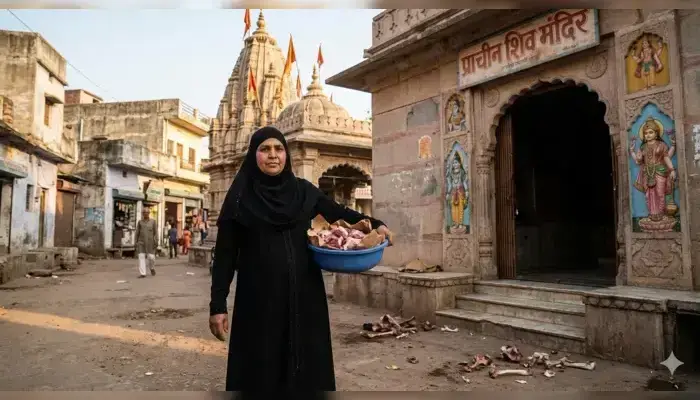
Case Summary
In Bhopal, Madhya Pradesh, Hindu temples were targeted for defilement by a Muslim woman who threw meat pieces near the sacred sites. This incident occurred in Loha Bazaar and Lakhera Bazaar, both in Bhopal's Kotwali police station area, on Thursday, 26 February 2026. The Muslim woman wearing a burqa dumped pieces of meat in the market area, near Hindu temples, particularly of Lord Shiva and a few Jain temples. This led to a commotion between the local Hindus and the Muslim woman. The locals stated that the Muslim woman had been continuously dumping meat pieces near Hindu temples for the past two months (December 2025). A video of the commotion went viral on the internet. The Muslim woman was seen wearing gloves with blood and meat stains. When the Hindu traders confronted her regarding the dumping of meat pieces near temples, she claimed that she worked for an NGO and was feeding dogs. During the argument, there was also talk of calling 112. Some people were heard saying they would keep the woman's car keys and go to the police station first to discuss the matter. A crowd gathered at the scene, and a heated exchange ensued between the two sides. Following this, the Muslim perpetrator apologised on the spot and promised to be more careful in the future. Regarding this matter, officials of the Hindu Utsav Samiti and Hindu traders reached the Kotwali police station and submitted a memorandum. Committee president Chandrashekhar Tiwari said that traders were angry due to the throwing of pieces of meat in front of shops and temples in the market area of Old Bhopal. He said that there are Jain temples and a Shiva temple located in the area, where devotees keep coming. In such a situation, such activities hurt religious beliefs. Under the leadership of senior vice president Anil Chaudhary, a memorandum was submitted demanding strict action against the woman concerned. Kashiram Kushwaha, Town Inspector of the Kotwali police station under Bhopal Police, stated that the Muslim woman in question had been counselled in the past. A dispute arose this time as well. He added that complaints had been received from both the Muslim woman and the Hindu organisations. At the time of writing this report, the matter was being investigated, and further action would be decided based on the facts.
Why it is Hate Crime ?
This case has been added to the tracker under the primary category- Attack on Hindu religious representations. The subcategory selected is- Desecration of Hindu religious symbol. Icons and symbols or a religious representation of a spiritual ideal are widely revered in Hinduism. Iconography is of vital significance in the Hindu milieu. It helps connect people’s spiritual beliefs with the real world. Iconography within the Hindu faith takes several shapes and forms. Murtis are of most significance to Hindus, to which daily rituals, prayers and offerings are done. Besides the murtis, there are several other symbols which have deep significance in the Hindu faith – the Om and Swastika for example. Since these Hindu religious symbols hold paramount importance in Hinduism, any desecration of symbols, icons, murtis, religious representations and manifestations, is driven by animosity towards the faith itself which manifests itself through these murtis, icons and symbols. Therefore, any desecration of these Hindu religious symbols and representations is considered religiously motivated hate crimes under this category. The other subcategory selected is- Attack on Temples. In Hinduism, a temple is the abode of the Deity. The Deity in the Temple is consecrated, thereby, making it a real, breathing entity. Hindus believe that not just the Deity but the temple premises itself are sacred to Hindus since Hindus hold the faith that the entire Temple space is an amalgamation of the divine energy of the deity. Given the central significance of Temples in Hindu Dharma, any attack against a Hindu Temple or its peripheral premises is an attack on the faith itself and is born out of animosity towards the faith, of which, the Temple is a central tenet. Any manner of attack against a Temple and/or its premises would therefore be considered a religiously motivated hate crime. The other subcategory selected is- Defiling religious customs. Sanatan Dharma is not a religion of one book, which is to say that while it has religious scriptures that form the central tenets of the faith, there are several traditions followed through thousands of years, mostly passed from generation to generation orally. There are several such customs and traditions that are followed by various Hindus and Hindu sects. Defiling of these traditions and customs is a breach of an individual or group’s religious practices. Such practices can range from dietary restrictions like not eating non-vegetarian food for a certain period of the year, not eating non-vegetarian food at all, not eating beef since the cow is considered holy in Hinduism, the sanctity of religious customs followed in the house (like many ISCKON devotees), etc. Any malicious action leading to the breach of such traditions or defilement of these traditions owing to animosity towards the faith or for the sake of activism stems not only from the lack of faith in the religion itself but also from disregard for the faith of the devotees who follow the customs/traditions and implicit bias against the faith, the tradition itself. Since these specific traditions are central to the faith of the devotees of that specific sect of Hindus, any non-compliance with these traditional rules would be considered a religiously motivated hate crime. This incident constitutes a hate crime because it involved the deliberate dumping of meat pieces near Hindu temples by a burqa-clad Muslim woman. The choice of location directly adjacent to sacred sites like the Shiva temple demonstrates premeditated targeting of Hindu worship spaces. This act exploits religious taboos against meat near temples, showing intent to provoke outrage and humiliate devotees. Such religiously motivated provocation elevates it beyond a minor dispute, qualifying it as a hate crime motivated by religious animosity. In Hinduism, temples serve as sacred spaces of worship where deities, particularly Lord Shiva, command profound reverence. The Muslim woman's actions in dumping meat near a Shiva temple and other Hindu shrines are deeply offensive and sacrilegious, as they contaminate areas meant for ritual purity. This reflects a profound disregard for the Hindu faith, driven by underlying animosity towards its practices. The incident exemplifies a calculated insult to religious sentiments, warranting classification as a hate crime motivated by hatred of Hindus. Far from mere law and order violation, it dishonours customs tied to temple sanctity and devotional observance, intentionally wounding religious dignity. The dumping of meat near these Hindu temples reveals behaviour far beyond insensitivity: it constitutes a conscious, targeted affront to deeply held religious sentiments. By selecting temple vicinities in a Hindu-majority market, the act sows communal intimidation, violating the Hindu community's dignity through deliberate pollution of sacred sites. This fits religiously motivated hate crimes, as it leverages symbolic desecration to assert dominance and incite fear among worshippers. The act clearly aimed to defile temple sanctity and ignite religious outrage. In Hindu Dharma, a temple embodies the living deity, not merely a building; desecrating it with blood-stained meat dumped by a burqa-clad woman amounts to a direct assault on the faith. Targeting Hindu temples specifically underscores religious animosity, transforming a personal act into a hate crime that threatens collective spiritual security. Despite the perpetrator claiming that she fed dogs for an NGO, her repeated offences, evidenced by prior police counselling, and precise choice of temple-adjacent locations, prove targeted malice and animosity towards Hindus. This pattern confirms hate-driven intent over innocent error. Therefore, this case is classified as a religiously motivated hate crime and is included in the Hinduphobia Tracker within the hate crime database. Disclaimer: The Hinduphobia Tracker records incident dates based on when the hate crime commences, rather than media reporting or confrontation dates. In this Bhopal case, locals reported the Muslim woman dumping meat pieces near Hindu temples continuously for the past two months prior to the 26 February 2026 confrontation. Accordingly, for precise documentation, an indicative incident date of 26 December 2025 is recorded, marking the estimated onset of this religiously motivated pattern of temple desecration.


Case Status
Complaint filed


Perpetrators Details
Perpetrators
Muslim Extremists
Perpetrators Range
One Person
Perpetrators Gender
female
 Sources




