Sacred Hindu temple vandalised, namaz offered inside its premises by Muslim man in Telangana
 Medchal Malkajgiri, Telangana, India
  24 February, 2026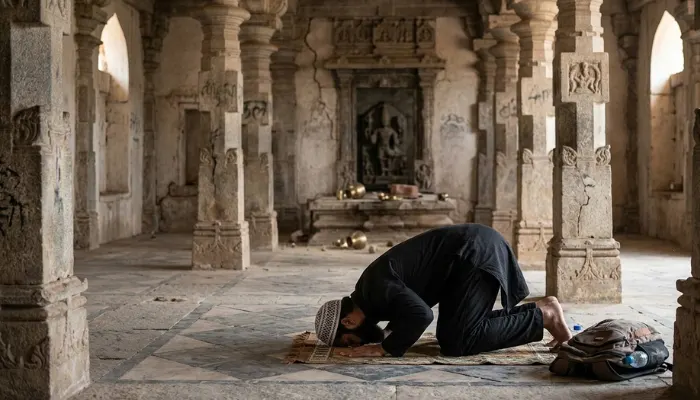
Case Summary
In the Pratapasingaram area of Medchal-Malkajgiri district in Telangana, a Hindu temple dedicated to Lord Ayyappa, a sacred Hindu deity, was vandalised and namaz (Islamic prayers) was offered inside its premises by a Muslim man. According to media reports, this occurred on Wednesday night (25 February 2026). The accused Muslim man entered the sacred temple premises and vandalised it severely. After this, he began offering namaz (Islamic prayers) inside the temple premises. Following this, he was spotted by Hindu locals and severely beaten. A video of the attack is going viral on social media. According to locals, upon learning of the vandalism at the temple and the hurting of religious sentiments, people gathered at the scene and apprehended the accused. The angry crowd assaulted him, after which the police were called to control the situation. Upon receiving information, Medipally police arrived at the scene and took the accused into custody and took him to the police station. The police stated that due to the seriousness of the case, all aspects of the incident were being investigated. At the time of writing this report, the accused is being questioned, and eyewitness statements are being recorded. Additional police forces have been deployed in the area to maintain law and order situation.
Why it is Hate Crime ?
This case is being added to the tracker under the primary category- Attack on Hindu religious representations. The subcategory selected is- Attack on Temples. In Hinduism, a temple is the abode of the Deity. The Deity in the Temple is consecrated, thereby, making it a real, breathing entity. Hindus believe that not just the Deity but the temple premises itself are sacred to Hindus since Hindus hold the faith that the entire Temple space is an amalgamation of the divine energy of the deity. Given the central significance of Temples in Hindu Dharma, any attack against a Hindu Temple or its peripheral premises is an attack on the faith itself and is born out of animosity towards the faith, of which, the Temple is a central tenet. Any manner of attack against a Temple and/or its premises would therefore be considered a religiously motivated hate crime. The other subcategory selected is- Breaking rules of place of worship. Sanatan Dharma is not a religion of one book, which is to say that while it has religious scriptures that form the central tenets of the faith, there are several traditions followed through thousands of years, mostly passed from generation to generation orally. One of these oral traditions or written traditions is the rules of specific temples. Certain temples have rules which are traditional rules, dependent on the worship of the presiding deities. These rules and traditions have been followed for thousands of years whether they find scriptural mention or not. Such traditions are based on the nature and rules of worship of the presiding deity of that temple. Any non-compliance of these traditions owing to animosity towards the faith or for the sake of activism stems not only from the lack of faith in the presiding deity but also disregard for the faith of the devotees of that deity/temple and implicit bias against the faith, the tradition and the deity itself. Since these specific traditions are central to the faith of the devotees of that specific temple and presiding deity, any non-compliance with these traditional rules would be considered a religiously motivated hate crime. The other subcategory selected is- Defiling religious customs. Sanatan Dharma is not a religion of one book, which is to say that while it has religious scriptures that form the central tenets of the faith, there are several traditions followed through thousands of years, mostly passed from generation to generation orally. There are several such customs and traditions that are followed by various Hindus and Hindu sects. Defiling of these traditions and customs is a breach of an individual or group’s religious practices. Such practices can range from dietary restrictions like not eating non-vegetarian food for a certain period of the year, not eating non-vegetarian food at all, not eating beef since the cow is considered holy in Hinduism, the sanctity of religious customs followed in the house (like many ISCKON devotees), etc. Any malicious action leading to the breach of such traditions or defilement of these traditions owing to animosity towards the faith or for the sake of activism stems not only from the lack of faith in the religion itself but also from disregard for the faith of the devotees who follow the customs/traditions and implicit bias against the faith, the tradition itself. Since these specific traditions are central to the faith of the devotees of that specific sect of Hindus, any non-compliance with these traditional rules would be considered a religiously motivated hate crime. This incident exemplifies a blatant hate crime, where a Muslim man vandalised a Hindu temple dedicated to Lord Ayyappa and then brazenly offered namaz within its sacred premises. The deliberate choice of a Hindu place of worship as the target reveals intent rooted in religious prejudice, transforming an act of destruction into a direct assault on the Hindu faith. For Hindus, a temple represents far more than mere stone and mortar; it stands as a living, breathing sanctuary pulsating with divine energy, a profound abode where the gods reside among their devotees. Here, families gather across generations to seek solace in times of joy and sorrow, perform intricate rituals like aarti and puja that nourish the soul, and forge unbreakable bonds with deities such as Lord Ayyappa, who embodies devotion and strength. Therefore, the act of vandalising the temple is an attack on the Hindu faith itself. This desecration inflicts profound emotional wounds, evoking a visceral grief as believers confront the violation of spaces where they have whispered lifelong prayers. It pierces the heart of their religious sentiments, leaving Hindu communities not just pained and betrayed, but acutely vulnerable and fearful, watching their most cherished places of worship morph into battlegrounds for hatred and intolerance. Following the vandalism, the perpetrator compounded the outrage by offering namaz inside the temple, flouting every sacred rule that has governed such spaces for millennia. Hindu temples adhere to strict, time-honoured protocols meticulously outlined in ancient scriptures like the Agamas, sacred texts that prescribe rituals for consecration, maintenance of purity through daily cleansings, and unwavering exclusivity to Hindu worship practices such as chanting mantras and making offerings of flowers, incense, and prasad. These rules ensure the temple remains a vibration of holiness, insulated from external impurities. Introducing namaz, an entirely alien practice from another faith, blatantly shatters these divine ordinances, polluting the sanctified atmosphere with incongruent sounds and postures, and turning what was once a consecrated site humming with bhajans into a profane stage unfit for any Hindu devotion. This act of offering namaz further defiles Hindu customs, overwriting sacred traditions with an imposition that reeks of dominance. It symbolises a brazen bid for Islamic supremacy over a Hindu temple, especially after its desecration, as if to claim victory in a religious conquest. Such symbolism screams of the perpetrator's malice, marking this as an unmistakable religiously motivated hate crime. From the initial vandalism to the provocative namaz, every step follows the clear patterns of a hate crime: targeting a religious symbol, desecrating it, and asserting Islamic superiority. Henceforth, this case is being added to the hate crime database of the Hinduphobia Tracker.


Case Status
Arrested


Perpetrators Details
Perpetrators
Muslim Extremists
Perpetrators Range
One Person
Perpetrators Gender
male
 Sources




