Hindus brutally attacked by Muslim mob for opposing illegal temple land encroachment in Bangladesh
 Chittagong District, Bangladesh
  24 February, 2026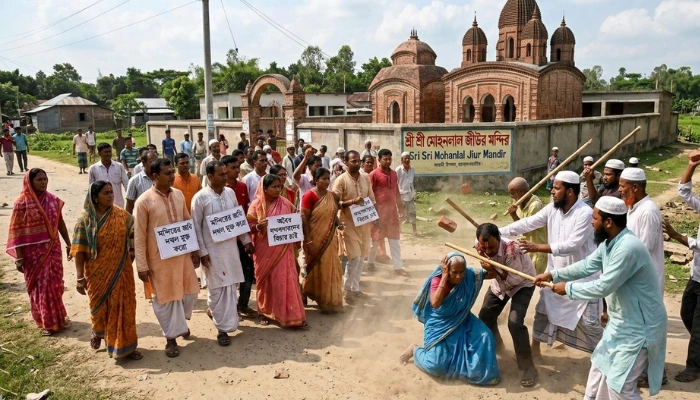
Case Summary
In Aruail, Brahmanbaria, Chittagong, Bangladesh, Hindus were subjected to brutal physical attack by a Muslim mob for opposing the illegal encroachment of a sacred temple's land. This entire dispute concerned the Sri Sri Mohanlal temple, a historic temple in the area. According to media reports, the Muslim attackers were identified as Shahid Miya and his 25 accomplices. The accused had illegally encroached upon the temple land, and this led to a long-standing dispute between the Muslim perpetrators and local Hindus. To protest the encroachment, the local Hindus took out a protest procession at 2.15 p.m. on 25 February 2026. The Hindus formed a human chain and demanded that the temple land be freed from encroachment. They took out a protest procession from the Sri Sri Mohanlal temple. At one point, they went to the occupied land and started shouting slogans. At that time, the accused Shahid Miya and his accomplices stopped the procession. Following this, bricks and stones were thrown at the Hindu protesters. They were also attacked with sticks by the Muslim men. As a result, 10 Hindus, including a woman, were brutally injured. They later sought treatment at the Sarail Upazila Health Complex. The temple committee leaders stated that while the case regarding the temple site was ongoing, the accused Shahid Miya threw sand there and occupied it. In addition, soil was thrown on the canal. They were attacked when they tried to form a human chain demanding protection of the temple site. A Local Hindu, Yadav Ghosh, said, "We are helpless. Even though we came to form a human chain, we are now victims of attacks. We want justice." However, denying the attack, Shahid Miya claimed, "He did not throw soil at the temple site. What appears to be a canal is actually land. None of them attacked the human chain. A group is working behind this." Upazila Parishad Chairman Mosharraf Hossain said, "There is an ongoing dispute between the two parties over the land. Both parties claim it as their own. The case is ongoing in the court, so a settlement could not be reached. However, Shahid has been prohibited from occupying the canal. However, he (Shahid) filled the canal at night instead of during the day." Sarail Police Station Officer-in-Charge Manjur Quader Bhuiyan said that no one had filed a written complaint about the incident so far; however, action would be taken if any were received. A fresh wave of anti-Hindu violence followed the 13th National Parliamentary Election 2026 in Bangladesh, reinforcing a recurring pattern of post-poll violence targeting Hindu minorities. Within days of the announcement of results, Hindu families in districts such as Noakhali, Rangpur, Nilphamari, Sylhet, Thakurgaon, and Dinajpur reported coordinated attacks involving arson, looting, assault, and vandalism of temples and homes. In several instances, Hindu homes were selectively targeted, looted, and families were threatened with displacement. This escalation of violence against Hindus in Bangladesh unfolded in three distinct phases: first, following the ouster of Sheikh Hasina’s government in August 2024; second, after the death of Sharif Osman Bin Hadi in December 2025; and third, in the immediate aftermath of the 13th National Parliamentary Election 2026. This electoral violence unfolded against the broader backdrop of sustained anti-Hindu hostility that had persisted since the ouster of the Sheikh Hasina government in August 2024. During that period, multiple reports documented attacks on Hindu homes, temples, and religious institutions, alongside intimidation campaigns, arson, and mob assaults targeting minority neighbourhoods. The Hinduphobia tracker has recorded 336 such incidents against the Hindu minority, underscoring the scale and persistence of anti-Hindu violence during this period. A further escalation occurred following the death of Sharif Osman Bin Hadi, a Muslim political activist and student leader known for his anti-Hindu and anti-India rhetoric. Hadi had been involved in political unrest after the fall of the Hasina government and was killed in Dhaka on 18 December 2025 during clashes. In the aftermath of his death, Hindu communities were blamed and subsequently targeted in retaliatory violence. Hindu homes were selectively set ablaze in multiple localities, forcing families to flee and leaving many displaced. The attacks appeared patterned rather than sporadic, with Muslim mobs focusing on Hindu neighbourhoods, properties, and religious symbols. Among the victims was Dipu Chandra Das, who was lynched to death and his body was set ablaze by a Muslim mob over false blasphemy allegations. The Hinduphobia tracker documented 51 incidents of anti-Hindu violence in the period following Hadi’s death alone. Such incidents underscore the vulnerability of the Hindu minority amid rising communal hostility and the weaponisation of religious accusations. Reports further indicated that posters and written materials calling for the extermination of Hindus were displayed in public spaces, signalling an alarming normalisation of genocidal rhetoric. When combined with acts of arson, vandalism, assault, and targeted intimidation, these developments suggest a coordinated environment of hostility aimed at terrorising the Hindu community and reinforcing majoritarian dominance.
Why it is Hate Crime ?
This case is being added to the tracker under the primary category- Attack on Hindu religious representations. The subcategory selected is- Encroachment or illicit takeover of temple land or land near temple. In Hinduism, a temple is the abode of the Deity. The Deity in the Temple is consecrated, thereby, making it a real, breathing entity. Hindus believe that not just the Deity but the temple premises itself are sacred to Hindus since Hindus hold the faith that the entire Temple space is an amalgamation of the divine energy of the deity. Not only the Temple but the Temple premises in its entirety are considered sacred by Hindus. In several cases, the premises of the Temple and/or religious centre are illicitly taken over by institutions belonging to other faiths – like the Waqf board or the Church. Other times, the temple property, land or the property of religious centres are illicitly encroached by non-Hindu groups. Any illicit take over or encroachment is a crime an initio, however, when non-Hindu groups illicitly take over or encroach the sacred land of Hindus, it is an affront to the Hindu community and is therefore classified as a religiously motivated hate crime under this category. Another primary category selected is- Attack not resulting in death. The subcategory is- Attacked for opposing radicals or trying to save victim. In several cases, Hindus are attacked for opposing religiously motivated crimes being committed against a fellow Hindu or simply for voicing an opinion opposing radical elements, who either have in the past or continue to persecute Hindus. In such cases, the initial attack against the victim, against which the Hindu was trying to defend the victim, would also need to be classified as a religiously motivated hate crime. Since the initial crime itself was religiously motivated and the subsequent crime of attempting to save the victim or speaking against the radical elements ends up inviting a violent attack, it would also be classified as a religiously motivated hate crime under this category. This case stands as a clear instance of a religiously motivated hate crime, as the Muslim perpetrators deliberately targeted a Hindu temple and its land for illegal encroachment. For Hindus, a temple holds profound spiritual significance, serving as a sacred abode for deities where devotees connect with the divine through worship, rituals, and community gatherings. The temple land forms an integral part of this ecosystem, considered equally sacred and holy, encompassing spaces for festivals, processions, and daily offerings that sustain religious life. By attempting to encroach upon it, the Muslim perpetrators directly undermined the religious sanctity of Hindu temples, revealing malicious intent aimed at Hindu religious sites. This act not only desecrated holy ground but also restricted Hindus from freely worshipping and practising their rituals, stripping them of their right to preserve their faith. Such targeted interference transforms this into an undeniable hate crime driven by religious animosity. When the Hindus responded with a legal and peaceful protest, simply organising a procession to reclaim their sacred space, they faced brutal assault from Muslims. This reaction exposes how mere opposition to radical encroachment and efforts to protect their temple provoked extreme violence against Hindu minorities. The perpetrators did not tolerate Hindus asserting their rights; instead, they unleashed aggression precisely because the victims defended their religious heritage. Punishing peaceful advocacy for faith in this way marks it as a hate crime, where religious identity became the trigger for retaliation. The violence escalated to severe levels, with 20 to 25 Muslims hurling bricks, stones, and wielding sticks against the unarmed Hindu protesters. This left 10 Hindus, including a vulnerable woman, brutally injured and requiring medical treatment. The sheer scale and ferocity reflect deep contempt and hatred for Hindus and their religious identity, especially since the attack followed the victims' stand against encroachment on their sacred temple. No other motive justifies such disproportionate brutality; it stemmed from animus towards Hindus defending their holy site, cementing this as a religiously motivated hate crime. This incident unfolded in Bangladesh shortly after the 13th National Parliamentary Elections in 2026, intensifying further following the death of Osman Hadi and the subsequent exile of Sheikh Hasina. Bangladesh has a documented history of violence and discrimination against its Hindu minority community. The timing and broader political context heighten the vulnerability of Hindu minorities to religiously motivated hate crimes, making the religious character of this attack even more evident. Given that this case meets the parameters of a religiously motivated crime, it is being added to the hate crime database of the tracker. Disclaimer: The Hinduphobia Tracker records the dates of incidents based on when the crime occurs rather than when it is reported by the media. However, in this case, media reports did not state the exact date when the temple encroachment began. They only stated the date when the Hindu protesters were attacked, which was 25 February 2026. Henceforth, this date is selected as the indicative incident date for documentation purposes only. In this case, the perpetrator count has been selected as 26 because the main perpetrator, Shahid Miya and his 25 accomplices carried out the attack. Henceforth, it is recorded as 26.
Victim Details
Total Victim
10
Deceased
0
Gender
- Male 9
- Female 1
- Third Gender 0
- Unknown 0
Caste
- SC/ST 0
- OBC 0
- General 1
- Unknown 9
Age Group
- Minor 0
- Adult 0
- Senior Citizen 0
- Unknown 10


Case Status
Complaint not filed


Perpetrators Details
Perpetrators
Muslim Extremists
Perpetrators Range
From 10 to 100
Perpetrators Gender
male
 Sources




