Hindu widow targeted by Muslim man posing as Hindu, subjected to assault, forced beef consumption and blackmail after discovering perpetrator's real identity
 Chennai, Tamil Nadu, India
  23 February, 2023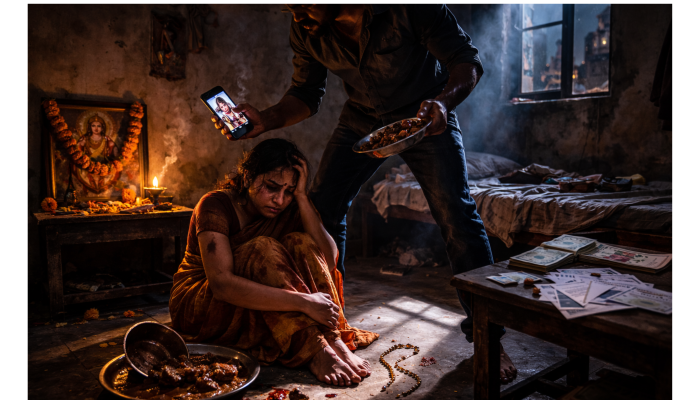
Case Summary
A Hindu widow from Golaghat district, Assam was deceived into marriage by a Muslim man who concealed his religious identity and presented himself as a Hindu man named Raj. During the course of the marriage, she was physically assaulted, forced to eat beef, blackmailed using private videos and had both her savings and salary extorted. She was hospitalised as a result of the physical assault. The victim, a young Hindu widow, travelled to Chennai in 2023 in search of employment so that she could support her daughter. There she met a man who introduced himself as Raj and stated that he was from Sri Bhumi district in Assam. He assisted her in settling into life in an unfamiliar city and gradually gained her trust over several months. He later proposed marriage, presenting himself as a source of stability for her and her child. The two were married in a Hindu temple in Chennai. As the relationship progressed, he began pressuring her into a physical relationship. On one occasion, he arrived at her room carrying a bottle of phenyl and threatened suicide if she refused. She felt compelled to comply under pressure. The early days of the marriage appeared normal. However, the victim grew concerned when her husband displayed hostility towards her performing puja, a Hindu prayer ritual, in the home. After six months of marriage, she discovered that he was not a Hindu and that his real name was Abdul Haque. Upon revealing his true identity, Abdul Haque’s behaviour changed markedly. He purchased beef from the market, cooked it and forced her to eat it. When she refused, he beat her severely, resulting in hospitalisation. At the hospital, she was made to state that her injuries had been caused by an accident. Abdul Haque also recorded private videos of her on his mobile phone and used these recordings to blackmail her. He took all of her savings and regularly demanded her full salary. Abdul Haque later abandoned the victim and returned to his home in Assam. He continued to threaten to circulate her private videos unless she sent him money, which she did for several months out of fear. After enduring prolonged physical abuse, blackmail and mental harassment, the victim filed a First Information Report (FIR) on 24 February 2026 at Sri Bhumi district police station in Assam against Abdul Haque. Authorities confirmed that the FIR had been registered and that an investigation was underway.
Why it is Hate Crime ?
The primary category for this case is "Crimes against women in relationships and other sexual crimes". The subcategory here is "Man pretends to be Hindu". The tertiary categories here are "Marries as per Hindu rituals", "Name changed", "Wears symbols of Hinduism" and "Raped and/or murdered after Hindu women finds out real identity". When a non-Hindu man pretends to be a Hindu to deceive a Hindu woman into a relationship, the act is seen as triggered by malafide intentions. In some cases, the woman eventually accepts the man’s original religious identity and converts after the man’s identity is revealed. These cases could be argued as cases of religious brainwashing and a result of the pressure a woman feels after getting into a relationship with a man. The woman, it can be argued, also changed her religious identity because of the stigma she believes she might face if she chooses to walk out of a deceptive relationship. However, for the purpose of documenting hate crimes, the cases in this subcategory are limited to those where there is explicit violence aimed at religious conversion against the wishes of the victim (force-feeding beef, blackmailing with intimate videos, rape on refusal to convert, etc), or if the woman herself complains of the man’s religious deception. In such cases, it is established that the deception of the non-Hindu man had a specific aim of religious conversion or targeting of the victim due to her Hindu religious identity, therefore, making it a religiously motivated hate crime. Another sub-category for this case is "Desecration of Hindu symbols in relationships". When Hindu women are in a relationship with non-Hindu men, there are cases where the woman faces insult and desecration of her faith (Hinduism) and its symbol because of the inherent disregard for polytheism of the non-Hindu partner. Such relationships may be consensual with the religious identity of the non-Hindu man known to the victim. Somewhere along the relationship, the non-Hindu man starts desecrating the religious symbols of the Hindu partner out of spite for her faith. Such cases are driven by specific religious motivations and against the religious identity of the victim and are therefore qualified as hate crimes. One other sub-category that this case qualifies for is "Forced conversion after marriage". The tertiary category here is "Forced to eat beef". In such cases, a non-Hindu man marries a Hindu woman, and the force/pressure to convert to any Abrahamic faith, like Islam, begins after marriage. In such cases, typically, two patterns emerge. First, when the relationship is consensual, and the religious identity of the perpetrator is known to the Hindu woman in the relationship. The marriage could be under the Special Marriages Act, where neither parties are required to convert their religion for the marriage to be considered legitimate. While the victim in such cases enters matrimony assuming that religious identity is not a barrier, the non-Hindu man starts to pressure the woman to convert her religion after marriage. The second is when the woman gets into a marriage with the man, pretending to share her faith. Later, when the truth is revealed, the man starts pressuring the woman to convert her religion and give up her religious identity. In both situations, there is application of force by the perpetrator, including the denial of the woman’s religious rights. Some of the means by which the woman is forced/pressured to convert include force-feeding beef, being forced to read the Kalma, being forced to wear a hijab, forced to undergo Halala, etc. There are several instances where, after marriage, the woman voluntarily converts to Islam. Such cases are often argued to be a result of religious brainwashing, however, for the purpose of documenting religiously motivated hate crimes, in the absence of the victim complaining of forced conversion, such cases do not form a part of the database. Another sub-category for this case is "Assault or threat upon refusal to convert". When Hindu women are in a relationship with non-Hindu men, there are cases where the woman faces threats or assault after she refuses to convert and change her religious identity owing to pressure/force by the non-Hindu man. Such relationships may be consensual with the religious identity of the non-Hindu man known to the victim. Somewhere along the relationship, the non-Hindu man starts pressurizing the Hindu woman to convert to Islam and upon her refusal, assaults or threatens the victim. Such cases are driven by specific religious motivations and against the religious identity of the victim and are therefore qualified as hate crimes. Cases where the Hindu woman converts to Islam and does not file a complaint about the force or threat, are not considered a part of the hate tracker, even though, it may be argued that the woman was brainwashed or threatened to convert to Islam. Another category here is "Leaves Hindu partner upon refusal to convert". When Hindu women are in a relationship with non-Hindu men, there are cases where the woman faces pressure/threats/violence to convert and change her religious identity by the non-Hindu man. However, when the Hindu woman refuses to convert, the non-Hindu man ends the relationship or divorces the woman, as the case might be. Such relationships may be consensual with the religious identity of the non-Hindu man known to the victim. Somewhere along the relationship, the non-Hindu man starts pressuring the Hindu woman to change her religious identity and upon her refusal, ends the relationship. Cases where the Hindu woman converts to Islam and does not file a complaint about the force, or threat after she refuses to convert to Islam, are not considered a part of the hate tracker. One other sub-category for this case is "Blackmailed to convert". When Hindu women are in a relationship with non-Hindu men, there are cases where the woman is blackmailed to convert her religion, owing to her religious identity of being a Hindu. Such relationships may be consensual with the religious identity of the non-Hindu man known to the victim, however, there could be cases where the relationship is not consensual and the non-Hindu man starts blackmailing a Hindu woman to convert her religion. In these cases, it is often seen that the Hindu woman is blackmailed with intimate photos and/or videos, threats of harm to her or her family, threats of violence etc. Such cases are driven by specific religious motivations and against the religious identity of the victim and are therefore qualified as hate crimes. Another sub-category here is "Brainwashed and/or groomed". The tertiary category here is "Rape and sexual assault/harassment". In several cases, a Hindu woman and/or minor is sexually harassed and/or assaulted with a religious motive. For example, in a case in Kausambi, UP, a Hindu girl was raped by non-Hindu perpetrators. During the assault, the victim pleaded to 'spare her in the name of Bhagwan'. The perpetrators then asked her to plead in the name of Allah. This clearly indicates a religious motive for the crime and evidences the religious animosity the perpetrators harbored against the victim owing to her religious identity. Such cases would be added to this tertiary category since the religious animosity makes the crime a hate crime. This case qualified as a hate crime on the basis that a Hindu widow from Golaghat, Assam was deliberately targeted by a Muslim man who concealed his religious identity, deceived her into marriage, and then subjected her to sustained physical violence, forced religious desecration, sexual coercion, blackmail and financial extortion. From the initial deception to the abuse that followed the revelation of his true identity, the perpetrator’s conduct was intertwined with the religious identities of both parties. The victim was targeted as a Hindu woman, and the abuse she endured repeatedly struck at her Hindu beliefs and practices. The perpetrator spent several months in Chennai cultivating the victim’s trust before introducing the idea of marriage. He positioned himself as a dependable and supportive figure in the life of a vulnerable Hindu widow who was alone in an unfamiliar city, far from her home in Assam. By presenting himself as Raj, a Hindu man from the same state, he created a sense of familiarity and safety. This sustained concealment of his true identity as Abdul Haque demonstrated a calculated strategy of grooming a vulnerable Hindu woman into marriage. The victim was denied the ability to make an informed choice, as the relationship was founded entirely on deception. The deception extended beyond a false name. He actively presented himself as a Hindu and married the victim in a Hindu temple in Chennai according to Hindu rites. By participating in a Hindu marriage ceremony, he used a sacred religious institution as a vehicle for fraud. The appropriation of Hindu matrimonial rituals for the purpose of deception represented a violation of the sanctity attached to Hindu marriage customs and deepened the betrayal experienced by the victim. Hostility towards the victim’s Hindu religious practices became evident soon after marriage, when he objected to her performing puja, a Hindu prayer ritual, in the home. Preventing her from practising her faith within her own household marked an early attempt to suppress her religious identity. The victim’s distress at being unable to perform her customary prayers in her own home reflected the psychological harm caused by this interference. After six months of marriage, when the victim discovered that her husband’s real name was Abdul Haque and that he was not Hindu, his conduct escalated sharply. He purchased beef, cooked it and forced her to consume it. In Hindu belief, the cow is sacred and the consumption of beef constitutes a grave religious violation. Forcing a Hindu woman to eat beef immediately after revealing his true identity amounted to a targeted assault on her religious identity. When she refused, he beat her so severely that she required hospital treatment. Even while hospitalised, she was compelled to state that her injuries were accidental, further denying her protection and recourse. The perpetrator recorded private videos of the victim and used them to blackmail her and extort money. During the marriage, he took all of her savings and regularly seized her entire salary. After abandoning her and returning to Assam, he continued to threaten to release the private videos unless she sent him money, which she did for months out of fear. This sustained financial and psychological coercion prolonged her trauma and left her in financial hardship. Throughout the relationship, the perpetrator’s conduct represented a continuous assault on the victim’s Hindu religious identity. He exploited Hindu marriage rituals to deceive her, suppressed her practice of puja, forced her to consume beef in violation of her faith, inflicted physical violence when she resisted, and used blackmail and extortion to maintain control. Each act targeted her as a Hindu woman and compounded the harm inflicted upon her dignity, faith and personal security. The selection of a young Hindu widow who was living alone in a distant city, separated from her support network, reflected a deliberate choice of a victim in a vulnerable position. Her circumstances made her particularly susceptible to prolonged deception and coercion. The targeting was not incidental but focused on a Hindu woman whose vulnerability could be exploited to facilitate sustained abuse. Given that this case met the parameters of a religiously motivated hate crime, it was added to the hate crime database of the Hinduphobia tracker. Disclaimer: The Hinduphobia Tracker records incident dates based on when a crime occurred, or a victim's ordeal began, rather than when the media reported it. In this case, media reports indicate that the victim's ordeal began approximately in 2023, when she first met the perpetrator in Chennai. Since no exact date was available for when the ordeal began, February 24, 2023 has been used as the placeholder incident date, with February 24 chosen as it is the date the FIR was filed and 2023 chosen as it is the year the victim's ordeal began. This was recorded for documentation purposes only. Disclaimer: The Hinduphobia Tracker records incident locations based on where the crime occurred or where the victim's ordeal began. In this case, the victim is originally from Golaghat district, Assam, and the FIR was filed in Sri Bhumi district, Assam. However, Chennai, Tamil Nadu has been recorded as the place of incidence as it is the city where the victim and the perpetrator first met, where the relationship was established through deception, and where the marriage took place. Chennai is therefore the location where the victim's ordeal began. This was recorded for documentation purposes only.
Victim Details
Total Victim
1
Deceased
0
Gender
- Male 0
- Female 1
- Third Gender 0
- Unknown 0
Caste
- SC/ST 0
- OBC 0
- General 0
- Unknown 1
Age Group
- Minor 0
- Adult 0
- Senior Citizen 0
- Unknown 1


Case Status
Complaint registered


Perpetrators Details
Perpetrators
Muslim Extremists
Perpetrators Range
One Person
Perpetrators Gender
male
 Sources




