Minor Hindu student targeted for her faith; Muslim teacher at missionary school throws away Hanuman Chalisa, hurls anti-Hindu abuse
 Kutch district, Gujarat, India
  10 February, 2026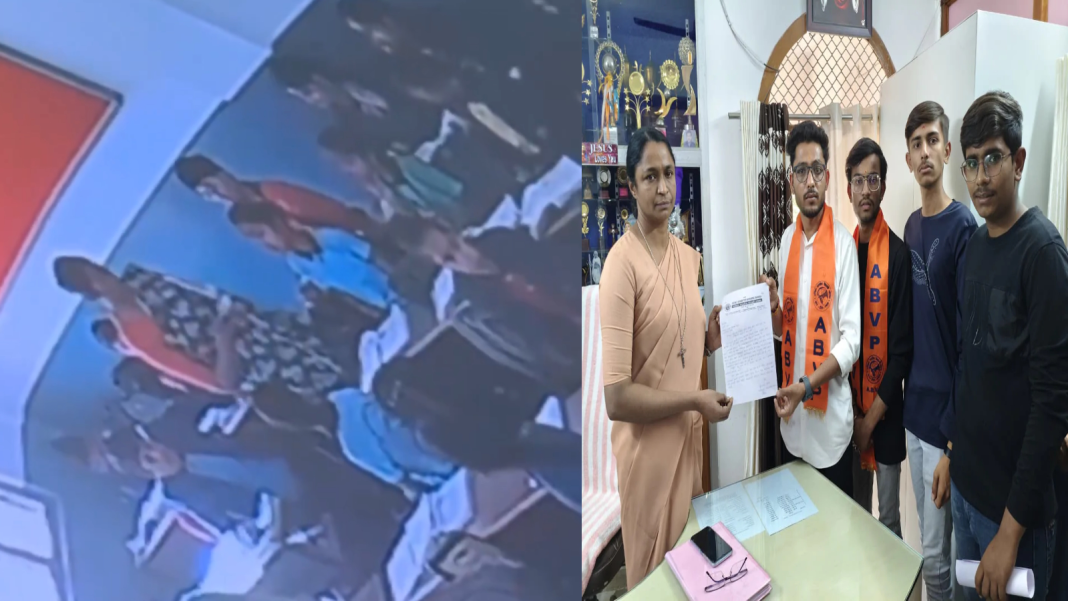
Case Summary
A minor Hindu female student was subjected to religious humiliation and abuse by a Muslim female teacher in a missionary-run school in the Kutch district of Gujarat. The accused Muslim teacher disrespectfully threw away a Hanuman Chalisa booklet that the Hindu child carried to school. The teacher had also scolded the child and made derogatory comments about Hindu religious rituals while taking away the Hanuman Chalisa. This incident occurred at Archana St Xavier’s School in Nakhatrana in Kutch. The Hindu victim was a class 6 student. As per some local groups, the incident took place on 11th February 2026. The Hindu student was sitting in the classroom with a small Hanuman Chalisa booklet when the Muslim teacher entered. Soon after noticing it, the Muslim teacher took the booklet from the child and disrespectfully threw it aside. The entire incident was recorded on the school’s CCTV cameras, which went viral on social media. After the matter came to light, members of the Vishwa Hindu Parishad (VHP) and the Akhil Bharatiya Vidyarthi Parishad (ABVP), two Hindu organisations, reached the school and raised objections over the incident. Representatives from the two groups, along with police officials, spoke with the students in the classroom to understand what had happened. Members of the VHP stated that the Hindu students told them that the Muslim teacher had scolded the Hindu child and made derogatory comments about Hindu religious rituals while taking away the Hanuman Chalisa. They further stated that after the incident, the student was pressured inside the school and made to record a video saying that nothing inappropriate had happened. The organisations later submitted a memorandum to the local education officer demanding strict action against the teacher as well as accountability from the school management. Protests by parents and activists continued until the school administration announced that the teacher had been relieved from duty. Despite this step, Hindu organisations maintained that removing the teacher alone was not enough since the incident took place within the school premises. They insisted that a formal legal case should be registered so that similar incidents would not occur in the future. Kutch Division Minister of Vishwa Hindu Parishad Chandubhai Raiyani stated that the school initially tried to prevent the matter from becoming public. According to him, smaller incidents had taken place earlier as well, but were handled internally without wider attention. He said that in this case, too, efforts were made to settle the issue quietly and that the student and her parents were put under pressure. Raiyani stated that the child was made to record a video denying the incident, and that there were concerns raised about the student’s future if the matter continued. He added that action was taken only after CCTV footage surfaced and protests intensified. Raiyani also mentioned that the school had faced controversy earlier. He referred to a past case where a teacher collected money from students by promising to take them to a sports academy and later disappeared, after which police action was taken. Activists connected with Hindu organisations expressed concern about increasing religious conversion activities in Nakhatrana and nearby rural areas. They said missionary groups frequently visited remote regions, and therefore, incidents inside missionary-run schools were closely watched by local communities. The school administration confirmed that the concerned teacher was no longer working at the institution. However, the school claimed that it was not obligated to initiate further legal action since the teacher had already been removed from service. The school also claimed that no religious remarks were made during the incident. According to the administration, the teacher handled subjects like mathematics and science, which did not involve religious discussions. School representatives suggested that the situation had already been addressed through internal action. On the other hand, Hindu organisations continued to stand by the students’ version of events, saying children present in the classroom stated that anti-Hindu comments were made at the time the Hanuman Chalisa was taken away. At the time of write of writing this report, the school considered the matter closed after relieving the teacher, but protests from Hindu organisations and parents had not completely stopped. They argued that legal proceedings were necessary to set a clear example and ensure respect for students’ religious beliefs within educational institutions. Parents involved in the protests said the issue was not only about one incident but about creating confidence that children’s faith and sentiments would be respected inside schools. Organisations stated that they would continue to pursue the matter with education authorities and local administration until further action was taken. The incident had now become a topic of discussion across the region, with many awaiting clarity on whether authorities would step in and initiate formal proceedings following the protests and demands raised by Hindu community groups.
Why it is Hate Crime ?
This case is added to the tracker under the first primary category- Attack not resulting in death. The subcategory selected is- Attacked for Hindu identity. In several cases, Hindus are attacked merely for their Hindu identity without any perceived provocation. A classic example of this category of religiously motivated hate crime is a murder in 2016. 7 ISIS terrorists were convicted for shooting a school principal in Kanpur because they got ‘triggered’ seeing the Kalava on his wrist and tilak that he had put. In this, the Hindu victim had offered no provocation except for his Hindu religious identity. The motivation for the murder was purely religious, driven by religious supremacy. Such cases where Hindus are targeted merely for their religious identity would be documented as a hate crime under this category. The second primary category selected is- Attack on Hindu religious representations. The subcategory selected is- Desecration of Hindu religious symbols. Icons and symbols or a religious representation of a spiritual ideal are widely revered in Hinduism. Iconography is of vital significance in the Hindu milieu. It helps connect people’s spiritual beliefs with the real world. Iconography within the Hindu faith takes several shapes and forms. Murtis are of most significance to Hindus, to which daily rituals, prayers and offerings are done. Besides the murtis, there are several other symbols which have deep significance in the Hindu faith – the Om and Swastika for example. Since these Hindu religious symbols hold paramount importance in Hinduism, any desecration of symbols, icons, murtis, religious representations and manifestations, is driven by animosity towards the faith itself which manifests itself through these murtis, icons and symbols. Therefore, any desecration of these Hindu religious symbols and representations is considered religiously motivated hate crimes under this category. The third primary category selected is- Hate Speech against Hindus. The subcategory selected is- Anti-Hindu slurs, mocking faith. Anti-Hindu slurs and the deliberate mocking of the Hindu faith owing to religious animosity involve the usage of derogatory terms, stereotypes, or offensive references to religious practices, symbols, or figures. One of the common anti-Hindu slurs used against Hindus is “cow-worshipper” and “cow piss drinker”. The intention of using this term is to demean and mock Hindus as a group and their religious beliefs since Hindus consider the cow holy. Additionally, some symbols and the slurs attached to them have a historical context that exacerbates the insult, hate, stereotyping, dehumanisation and oppression against Hindus. Cow worship has been used for centuries to denigrate Hindus, insult their faith and oppress Hindus specifically as a religious group. There has been overwhelming documentation about how cow slaughter has been used to persecute Hindus with cow meat being thrown in temples and places of worship. There has also been overwhelming documentation where cow meat (beef) has been force-fed to Hindus to either forcefully convert them to Islam or denigrate their faith. Apart from cow worship, the Swastika – which holds deep religious significance for the Hindus – has also been misinterpreted and distorted to use as a slur against Hindus. Similarly, the worship of the Shivling has been used by supremacist ideologies and religions to denigrate Hindus owing to religious animosity. Such slurs and denigration stem out of inherent animosity and hate towards Hindus and their faith, therefore, it is categorised as hate speech targeted at Hindus specifically owing to their religious identity. The fourth primary category selected is- Restriction/ban on Hindu practices. The subcategory selected is- Restriction on expression of Hindu identity. An example of the state-affected prejudicial and targeted orders against the Hindu community would be a government denying the right of a Hindu or a group of Hindus to hold a religious procession owing to the animosity of non-Hindu groups. Denial of the religious right of the Hindus to assuage the non-Hindu group which harbours animosity to a point where it could lead to violence against Hindus is not only a failure of law and order but is a prejudicial order against Hindus, denying them their fundamental rights to express their religious identity. An example of a hate crime against Hindus by a non-Hindu would be a non-Hindu institution forcing its Hindu employees to abandon religious symbols that a Hindu would wear as an expression of faith owing to inherent prejudice against the faith professed by the victim or a non-Hindu group of people restricting a Hindu group from constructing a place of worship simply because the demography of the area in which the temple is being built is dominated by non-Hindus. Such actions are driven by religious animosity and/or prejudice against Hindus and their faith and would therefore be categorized as a hate crime. The fifth primary category selected is- Predatory Proselytisation. The subcategory selected is- Proselytisation by grooming, brainwashing, manipulation or subtle indoctrination. The tertiary categories selected are- Conversion of minor, Pattern of targeting Hindus. Religious brainwashing essentially means the often subtle and forcible indoctrination to induce someone to give up their religious beliefs to accept contrasting regimented ideas. Religious grooming or brainwashing also involves propaganda and manipulation. It involves the systematic effort, driven by religious malice and indoctrination, to persuade “non-believers’ to accept allegiance, command, or doctrine to and of a contrasting faith. Cases of such grooming or brainwashing are far more nuanced than direct threats, coercion, inducement and violence. In such cases, it is often seen that there is repeated, subtle and continual manipulation of the victim to induce disaffection towards their own faith and acceptance of the contrasting faith of the perpetrator. While subtle indoctrination is widely acknowledged as predatory, an element which is often understated in such conversions or the attempts of such conversion is the role of loyalty and trust which might develop between the perpetrator and the victim. Fiduciary relationships are often abused to affect such religious conversion. For example, an educator transmitting religious doctrine of a competing faith to a Hindu student. The Hindu student is likely to accept what the teacher is transmitting owing to existence of the fiduciary relationship. The exploitation of the fiduciary relationship to religiously indoctrinate victims would also be included in this category. Since the underlying animosity towards the victim’s faith forms the basis of predatory proselytization, such cases are considered religiously motivated hate crimes. In this case, a Hindu minor girl, a student at a missionary school in Kutch district, Gujarat, faced religious humiliation and abuse from a Muslim teacher who disrespectfully threw away her Hanuman Chalisa booklet. The teacher also hurled anti-Hindu remarks against Hindu religious rituals and faith. This case, therefore, meets multiple parameters of a religiously motivated hate crime. The young Hindu girl was selectively targeted purely for her religious identity; the teacher did not reprimand her for any misbehaviour or wrongdoing. She simply carried her Hanuman Chalisa to school, unaware of any prohibition. If the teacher truly objected to religious scriptures in school, she could have politely asked the girl not to bring it, informed her parents, or escalated it to the authorities. Instead, she singled out the Hindu child, scolded her harshly, and abused her solely for her faith, marking this as a blatant, religiously motivated hate crime. The deliberate targeting of a vulnerable Hindu victim underscores its nature as hate-driven persecution. Throwing away the Hanuman Chalisa amounts to desecration of a sacred Hindu religious symbol. The Hanuman Chalisa is a revered devotional hymn composed by the poet-saint Tulsidas, chanted by millions of Hindus daily for protection, strength, and devotion to Lord Hanuman, a symbol of unwavering faith and courage. Any act of desecration or disrespect towards it wounds the deepest sentiments of Hindus. Here, the Muslim perpetrator snatched the booklet from the Hindu girl's hands and discarded it callously, showing utter contempt for her sacred religious text. This deliberate violation of a holy symbol, with no regard for the Hindu victim's beliefs, constitutes a clear religiously motivated hate crime. While snatching the Hanuman Chalisa, the Muslim teacher spewed derogatory remarks against the Hindu faith and its rituals, laying bare the religiously motivated intent of the crime. This was no mere enforcement of school rules; it stemmed from deep-seated religious malice and animosity. Abusing a young Hindu child for her faith, denigrating her religious rituals in front of her and other students, amounts to hate speech and psychological assault. Such contempt for Hinduism's sacred practices reveals the perpetrator's profound prejudice against the Hindu religion and its adherents. Hindu faith and rituals command deep reverence among devotees; attacking them so viciously confirms the act as a religiously motivated hate crime. Overall, this incident crushed a simple religious expression of the child's Hindu identity. She most likely carried the Hanuman Chalisa to school as a personal token of faith, much like any child might carry a cherished item. Yet the Muslim teacher suppressed and trampled this innocent display of devotion. Restricting a minor's right to express her religious identity, while targeting her faith specifically, epitomises a hate crime. It sends a chilling message of intolerance, dehumanising the victim for simply being Hindu. Such acts are a deliberate effort to erase the victim's religious identity and expression. Such an act is deeply disrespectful and is an attack on the core values and practices of Hinduism. The message such actions send is that Hindu symbols and expressions are not welcome in the school and that these symbols would be forcibly removed if Hindu students display them. This not only violates a Hindu child’s fundamental right to practise and express her religion but also creates an atmosphere of fear and suppression, where Hindu children may feel compelled to conceal their faith. Such actions are common tactics in environments where subtle or overt pressure is used to alienate Hindu children from their religious identity. It serves as the first step in a larger pattern of grooming, where consistent ridicule, punishment, and forced removal of Hindu symbols and practices make a child more susceptible to abandoning their faith and embracing another under pressure. These are deliberate actions to facilitate the gradual suppression of Hindu practices to erode the child’s confidence in her own religion over time, normalising the idea that Hindu identity must be hidden or discarded to fit in. These are meant to alienate Hindu children from their own faith. Such actions are rooted in bias and disdain for Hinduism, its adherents, and its practices, making it a religiously motivated hate crime. Thirdly, it is important to note here that the victim was a minor, which means the element of consent and genuine change of conscience was missing ab initio. Minors, due to their young age and lack of maturity, are particularly vulnerable to manipulation and coercion. They may not have the ability to fully understand the implications of religious humiliation or to recognise such deception and brainwashing attempts, and the perpetrator purposely targeted and exploited this vulnerability of the victim. Here, it is also important to mention that in 2022, a massive controversy erupted in Karnataka, which took a national form, after Muslim women insisted that they should be allowed to wear burqas and hijabs in their schools and classrooms. At that time, the argument given by several politicians, social commentators, Hindu activists and even the judiciary was that schools have the right to enforce uniform rules, since wearing uniforms brings harmony and equality in the classroom, and therefore, schools not allowing girls to wear hijab in the classroom is not religious discrimination, but merely an enforcement of widely accepted uniform norms. The argument was also that overt religious symbols like the Hijab can be restricted under the school's policy of uniformity. Pseudo-seculars and leftist groups may argue that a similar line of reasoning should be applied in this case. However, it becomes important to mention here that most uniform codes focus on standardising clothing and accessories like shoes, belts, and hair. A Hanuman Chalisa booklet does not change the appearance of the uniform itself or disrupt the classroom, nor is a overt religious symbol. This religious symbol is benign and does not cause harm, raising serious concerns about the motivations behind such enforcement. The actions of the Muslim teacher amount to religious discrimination and are consistent with the framework of a hate crime, where the Hindu child was penalised solely for adhering to her Hindu religious practices. Additionally, the fact that the Hindu student was pressured inside the school and made to record a video denying that anything inappropriate had happened further proves this as a hate crime. This coercive tactic, silencing a minor Hindu victim through intimidation and forced retraction, is a classic hallmark of the perpetrator attempting to evade accountability for religiously motivated acts. By manipulating the vulnerable child to contradict her own traumatic experience, the school and teacher revealed their awareness of the incident's gravity and their complicity in suppressing Hindu voices. Such gaslighting not only compounds the original humiliation but also entrenches the hate crime by obstructing justice and perpetuating fear among Hindu students. Another point to also address is that this religious desecration of the Hanuman Chalisa booklet, humiliation of the Hindu child for her religious identity, and denigrating remarks against Hindu faith and rituals occurred in front of other Hindu minor students as well. This amplifies the religious motivation of the crime, as publicly targeting Hindu symbols, restricting Hindu faith, and singling out Hindu students for their beliefs in an educational institution exploits the teacher's position of power. These young Hindu children feel terrified to express their religious identity, fearing persecution, targeting, and humiliation. Consequently, they become far more susceptible to religious conversion, viewing Hindu identity as a source of constant vulnerability. Such public acts enable large-scale erosion of the Hindu faith among minors, turning a single incident into systematic intimidation of an entire group of Hindu victims. Overall, since this case meets several parameters of a religiously motivated crime, it is being added to the hate crime database of the Hinduphobia Tracker. Disclaimer: In this case, although, the Hinduphobia Tracker acknowledges that several Hindu students present in the school were also affected by the religious humiliation and anti-Hindu remarks made by the Muslim teacher, since the total number of victims has not been specified, the victim count is being recorded as one, referring to the minor Hindu girl student who had brought the Hanuman Chalisa. This is a conservative estimate, mentioned for documentation purposes only.
Victim Details
Total Victim
1
Deceased
0
Gender
- Male 0
- Female 1
- Third Gender 0
- Unknown 0
Caste
- SC/ST 0
- OBC 0
- General 0
- Unknown 1
Age Group
- Minor 1
- Adult 0
- Senior Citizen 0
- Unknown 0


Case Status
Complaint filed


Perpetrators Details
Perpetrators
Muslim Extremists
Perpetrators Range
One Person
Perpetrators Gender
female
 Sources




