Hindu religious event attacked, attendees subjected to brutal assault and casteist slurs by Muslim mob in Bulandshahr, Uttar Pradesh
 Bulandshahr, Uttar Pradesh, India
  22 February, 2026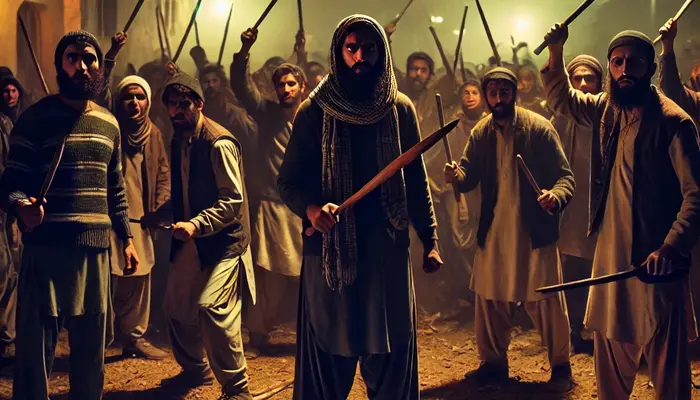
Case Summary
In Bulandshahr, Uttar Pradesh, a Hindu religious event organised by a Dalit Hindu family was attacked, and the attendees and family members were assaulted by a Muslim mob of nearly 64 men over the DJ music being played. The perpetrators also hurled casteist slurs at the Hindu victims. This occurred in Ginora Sheikh village on 23 February 2026. The Hindu family had organised a Kua Pooja (well worship ceremony) and Jagran, an all-night devotional vigil with bhajans and prayers to honour deities, on the occasion of the birth of a new child in their family. During this event, a DJ was playing. Meanwhile, some members of the Muslim community objected to the DJ's sound. Following this, an argument quickly ensued between the two communities, which later escalated into a physical attack on the Hindu family and attendees. The Hindu family stated that as the dispute escalated, a few dozen Muslim men entered their home and physically assaulted and pushed the attendees, mostly women present there. During this, the perpetrators also hurled casteist slurs at the Dalit Hindus. Upon receiving information, the police arrived at the scene and brought the situation under control. Senior officials also took the matter seriously. City Superintendent of Police Shankar Prasad stated that a case had been registered against 14 named and 50 unidentified Muslim men. He added that an adequate police force had been deployed in the village and peace was being maintained. Police said that the situation was completely under control and no one would be allowed to disturb law and order.
Why it is Hate Crime ?
This case is being added to the tracker under the primary category- Attack not resulting in death. The subcategory selected is- Attack against Hindu devotees. Hindu devotees are a few of the easiest targets of religiously motivated hate crimes because during the festival/procession/puja etc, for non-Hindus it is easy to profile their victims on the basis of religion. Hindu devotees come under attack on several occasions by individual non-Hindus or mobs of non-Hindus owing to their animosity against Hinduism, its symbols and tradition/practices. There are several instances of Hindu devotees being attacked while they worship in temples or temporary religious structures, during religious processions, doing bhajan/kirtan/puja in their own homes, in the residential society etc. These attacks are perpetrated by non-Hindus primarily because of their animosity towards Hindus and their faith. In some cases, the trigger for the violence may be non-religious, however, there are two elements that make these hate crimes. First, the Hindus who come under attack are attacked violently while indulging in religious activity. Whether they are in a place of worship or not is immaterial to the crime. When individuals are attacked while indulging in religious practices, the attack in itself is a hindrance to their freedom to practice religion and therefore constitutes a hate crime. Secondly, religious supremacist doctrines and ideologies deem religious practices of Hindus to be offensive ab initio since they are considered “sinful” by these ideologies, worthy to be annihilated by force or coercion. Driven by these religious supremacist ideologies and doctrines, the attacks against Hindu devotees stem from intrinsic animosity towards Hinduism. In some cases, the trigger for the violence may be non-religious, however, it develops into a religiously motivated crime during the course of the violence. Since these attacks stem from animosity towards Hindus and Hinduism, they are considered religiously motivated hate crimes under this category. The other subcategory selected is- Communal Clash/Attack. Communal clash is a form of collective violence that involves clashes between groups belonging to different religious identities. For a communal clash between Hindus and non-Hindus to qualify as a religiously motivated hate crime, the trigger of the violence itself would have to be anti-Hindu in essence. For example, if there is a Hindu religious procession that comes under attack from a non-Hindu mob and after the initial attack, Hindus retaliate in self-defence, leading to a communal clash between the two religious communities. While at a later stage, both communities are involved in the clash/violence, the initial trigger of the violence was by the non-Hindu mob against the Hindus and therefore, it could safely be termed as an anti-Hindu violence. Further, the trigger would also have to be religiously motivated. In the cited example, the attack by the non-Hindu mob was against religious processions and therefore, can be concluded to be religiously motivated. In some cases, the trigger may be non-religious, however, it develops into religious violence against Hindus at a later stage. In such cases too, the foundational animosity towards Hindus becomes the motivating factor of the crime and therefore, it would be classified as a religiously motivated hate crime against Hindus under this category. Another primary category selected is- Hate Speech against Hindus. The subcategory selected is- Anti-Hindu slurs, mocking faith. Anti-Hindu slurs and the deliberate mocking of the Hindu faith owing to religious animosity involve the usage of derogatory terms, stereotypes, or offensive references to religious practices, symbols, or figures. One of the common anti-Hindu slurs used against Hindus is “cow-worshipper” and “cow piss drinker”. The intention of using this term is to demean and mock Hindus as a group and their religious beliefs since Hindus consider the cow holy. Additionally, some symbols and the slurs attached to them have a historical context that exacerbates the insult, hate, stereotyping, dehumanisation and oppression against Hindus. Cow worship has been used for centuries to denigrate Hindus, insult their faith and oppress Hindus specifically as a religious group. There has been overwhelming documentation about how cow slaughter has been used to persecute Hindus with cow meat being thrown in temples and places of worship. There has also been overwhelming documentation where cow meat (beef) has been force-fed to Hindus to either forcefully convert them to Islam or denigrate their faith. Apart from cow worship, the Swastika – which holds deep religious significance for the Hindus – has also been misinterpreted and distorted to use as a slur against Hindus. Similarly, the worship of the Shivling has been used by supremacist ideologies and religions to denigrate Hindus owing to religious animosity. Such slurs and denigration stem out of inherent animosity and hate towards Hindus and their faith, therefore, it is categorised as hate speech targeted at Hindus specifically owing to their religious identity. Another primary category selected is- Attack on Hindu religious representations. The subcategory selected is- Defiling religious customs. Sanatan Dharma is not a religion of one book, which is to say that while it has religious scriptures that form the central tenets of the faith, there are several traditions followed through thousands of years, mostly passed from generation to generation orally. There are several such customs and traditions that are followed by various Hindus and Hindu sects. Defiling of these traditions and customs is a breach of an individual or group’s religious practices. Such practices can range from dietary restrictions like not eating non-vegetarian food for a certain period of the year, not eating non-vegetarian food at all, not eating beef since the cow is considered holy in Hinduism, the sanctity of religious customs followed in the house (like many ISCKON devotees), etc. Any malicious action leading to the breach of such traditions or defilement of these traditions owing to animosity towards the faith or for the sake of activism stems not only from the lack of faith in the religion itself but also from disregard for the faith of the devotees who follow the customs/traditions and implicit bias against the faith, the tradition itself. Since these specific traditions are central to the faith of the devotees of that specific sect of Hindus, any non-compliance with these traditional rules would be considered a religiously motivated hate crime. This incident was a clear instance of a religiously motivated hate crime, as a Muslim mob of nearly 64 men targeted and attacked a Hindu religious event organised by a Dalit Hindu family, and also hurled casteist slurs at the victims, marking a clear act of communal violence driven by religious animosity. The event centred on Kua Pooja, a sacred Hindu ritual involving the worship of wells to invoke blessings for prosperity, fertility, and family well-being, deeply rooted in agrarian Hindu traditions, and Jagran, an all-night devotional vigil with bhajans and prayers to honour deities, often held for auspicious occasions like the birth of a child. By storming this religious celebration and assaulting the Hindu devotees, including the Dalit family hosting it and their attendees, the perpetrators directly violated the victims' religious celebrations and their religious expression. This targeted attack on a vulnerable Dalit Hindu family's sacred observances, under the pretext of DJ music noise, exemplified a hate crime, as it weaponised religious identity to intimidate and suppress Hindu practices. The Muslim perpetrators, a mob of 64 men, launched a brutal assault on women and other devotees present, underscoring the premeditated and disproportionate nature of the attack. What began as an objection to DJ music swiftly escalated into a coordinated invasion of the family home, where the mob physically pushed, beat, and terrorised mostly female attendees during a peaceful religious gathering. Such overwhelming numbers of perpetrators and the severity of the assault revealed planning and intent, transforming a minor dispute into a violent siege rooted in religious animosity towards the Hindu community. The sheer brutality under the flimsy pretext of the DJ's sound amplified the religious motivations, as the mob singled out Hindu worshippers in their own space, exploiting numerical superiority to dominate and humiliate them based on faith. In this case, the perpetrators hurled casteist slurs at the victims while carrying out the attack. Here, it could be argued by some that a caste-specific slur was aimed at the victims' micro-identity of belonging to the Dalit section of the Hindu community and not their Hindu identity itself. However, as far as Abrahamic religions are concerned, the micro-identities of caste, region, and language are secondary. It is the religious identity that drove the animosity of the perpetrators against the Hindu victims. In this case, the hurling of caste-specific slurs was done to humiliate the victims and abuse them for their faith identity rather than their caste. Henceforth, this made the religiously motivated nature of the act crystal clear. Overall, attacking this religious event defiled and desecrated a sacred Hindu observance, profaning its rituals and shattering the sanctity of Kua Pooja and Jagran. The Muslim mob's invasion turned a joyous family milestone into a site of terror, trampling holy symbols and disrupting religious prayers, acts tantamount to a hate crime. By desecrating these traditions central to Hindu identity, the perpetrators aimed to instil fear, deter future observances, and assert Islamic dominance, fulfilling the hallmark of a hate crime: intimidation through religiously motivated violence and desecration. Given that this case met the parameters of a hate crime, it was added to the hate crime database of the Hinduphobia Tracker.


Case Status
Complaint registered


Perpetrators Details
Perpetrators
Muslim Extremists
Perpetrators Range
From 10 to 100
Perpetrators Gender
male
 Sources




