Hindu siblings assaulted for playing bhajans; Hindu homes stone-pelted by Muslim mob of 500 people in Kamareddy, Telangana
 Kamareddy, Telangana, India
  19 February, 2026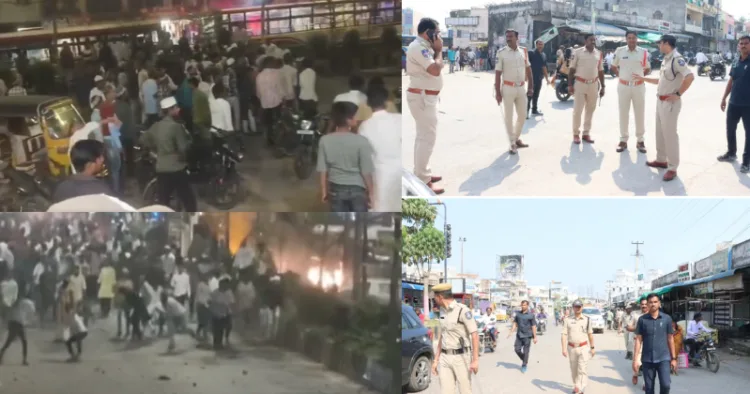
Case Summary
In Banswara in Kamareddy district of Telangana on 20th February 2026, a Hindu woman was targeted and abused for playing bhajans of Durga Devi by a Muslim man named Muzammil. When the victim's brother opposed it, he was assaulted by a large group of Muslim men. This further led to communal violence where a mob of 500 Muslims started stone-pelting at Hindu homes in the area, causing religious tensions. According to media reports, the incident began when a Hindu woman played a song dedicated to Durga Devi inside the Reliance Mart store, which drew objections from a Muslim employee, Muzammil, who asked her to stop and hurled abusive remarks for playing religious songs. After this, the woman informed her family about the verbal altercation. When her brother arrived to question the matter, he was attacked by a group of Muslim men, supporters of the Muslim employee, triggering tensions. Residents stated that a large crowd, estimated locally at around 500 Muslims, gathered and began stone-pelting at roadside establishments and Hindu homes. The unrest led to protests and calls for action against those involved. Kamareddy Superintendent of Police M. Rajesh Chandra downplayed the communal nature of the incident by claiming that the episode originated from an argument at the Reliance Mart between a customer and a salesgirl, and that the matter was later viewed through a communal lens because the individuals belonged to different communities. He claimed that the case was related to harassment of a salesgirl by a customer, for which a First Information Report was registered and the accused was taken into custody. Police also detained individuals involved in the assault following the incident. The Superintendent of Police further said that after the incident, groups gathered near the police station from both Hindu and Muslim sides, creating tension, and that some anti-social elements resorted to stone-pelting. A police constable sustained bleeding injuries and underwent treatment. Based on CCTV footage, the police identified 42 persons involved in stone-pelting and registered cases under serious sections. Authorities warned that strict action would be taken against anyone attempting to disturb communal harmony, forcibly shut shops, or spread provocative messages on social media. Special forces were deployed and pickets established at multiple locations across Banswara to maintain order. Bharatiya Janata Party Telangana President N. Ramchander Rao strongly condemned what he described as the Congress government's cowardly action and appeasement politics in illegally arresting Bharatiya Janata Party and Hindu organisation leaders who had called for a bandh in protest against the incident in Banswara involving an attempt to assault a Hindu woman. He demanded the immediate release of those detained and called for strict action against the actual culprits, accusing the state government of acting against those raising their voice while failing to deal firmly with offenders. Later, around 10 pm on 22nd February 2026, Rao was placed under house arrest ahead of his proposed visit to Kamareddy and Banswara to meet those affected, with the party stating that the move was intended to prevent him from reaching the ground. The Bharatiya Janata Party Telangana unit criticised the handling of the situation, stating bias and failure to act firmly against those responsible for violence. Former Banswara Member of Legislative Assembly and Bharatiya Janata Party leader Y. Laxminarayana was detained by police. In a video statement, he stated partiality in police action, questioned supporters of the accused Muzammil, and raised concerns over attacks on roadside establishments, urging strict action against those involved. Dr Ravinuthala Shashidhar, Vishva Hindu Parishad spokesperson, said on X: "Looks like Revanth Reddy has already implemented Sharia law in Telangana. In Banswara, Kamareddy district, Telangana, a Hindu woman played a Durga Devi song in Reliance Mart, which rattled an Islamist employee who told her to stop it. She alerted her brother about this, when he came to question that extremist, he along with few other Islamists attacked both brother and sister, within minutes gathered 500 fellow Jihadists and attacked the Hindu homes in the neighbourhood."
Why it is Hate Crime ?
The primary category selected in this case is- Attack not resulting in death. The subcategory selected is- Attacked for Hindu identity. In several cases, Hindus are attacked merely for their Hindu identity without any perceived provocation. A classic example of this category of religiously motivated hate crime is a murder in 2016. 7 ISIS terrorists were convicted for shooting a school principal in Kanpur because they got ‘triggered’ seeing the Kalava on his wrist and tilak that he had put. In this, the Hindu victim had offered no provocation except for his Hindu religious identity. The motivation for the murder was purely religious, driven by religious supremacy. Such cases where Hindus are targeted merely for their religious identity would be documented as a hate crime under this category. The other subcategory selected is- Attacked for opposing radicals or trying to save victim. In several cases, Hindus are attacked for opposing religiously motivated crimes being committed against a fellow Hindu or simply for voicing an opinion opposing radical elements, who either have in the past or continue to persecute Hindus. In such cases, the initial attack against the victim, against which the Hindu was trying to defend the victim, would also need to be classified as a religiously motivated hate crime. Since the initial crime itself was religiously motivated and the subsequent crime of attempting to save the victim or speaking against the radical elements ends up inviting a violent attack, it would also be classified as a religiously motivated hate crime under this category. The other subcategory selected is- Communal Clash/Attack. Communal clash is a form of collective violence that involves clashes between groups belonging to different religious identities. For a communal clash between Hindus and non-Hindus to qualify as a religiously motivated hate crime, the trigger of the violence itself would have to be anti-Hindu in essence. For example, if there is a Hindu religious procession that comes under attack from a non-Hindu mob and after the initial attack, Hindus retaliate in self-defence, leading to a communal clash between the two religious communities. While at a later stage, both communities are involved in the clash/violence, the initial trigger of the violence was by the non-Hindu mob against the Hindus and therefore, it could safely be termed as an anti-Hindu violence. Further, the trigger would also have to be religiously motivated. In the cited example, the attack by the non-Hindu mob was against religious processions and therefore, can be concluded to be religiously motivated. In some cases, the trigger may be non-religious, however, it develops into religious violence against Hindus at a later stage. In such cases too, the foundational animosity towards Hindus becomes the motivating factor of the crime and therefore, it would be classified as a religiously motivated hate crime against Hindus under this category. Another primary category selected is- Hate Speech against Hindus. The subcategory selected is- Anti-Hindu slurs, mocking faith. Anti-Hindu slurs and the deliberate mocking of the Hindu faith owing to religious animosity involve the usage of derogatory terms, stereotypes, or offensive references to religious practices, symbols, or figures. One of the common anti-Hindu slurs used against Hindus is “cow-worshipper” and “cow piss drinker”. The intention of using this term is to demean and mock Hindus as a group and their religious beliefs since Hindus consider the cow holy. Additionally, some symbols and the slurs attached to them have a historical context that exacerbates the insult, hate, stereotyping, dehumanisation and oppression against Hindus. Cow worship has been used for centuries to denigrate Hindus, insult their faith and oppress Hindus specifically as a religious group. There has been overwhelming documentation about how cow slaughter has been used to persecute Hindus with cow meat being thrown in temples and places of worship. There has also been overwhelming documentation where cow meat (beef) has been force-fed to Hindus to either forcefully convert them to Islam or denigrate their faith. Apart from cow worship, the Swastika – which holds deep religious significance for the Hindus – has also been misinterpreted and distorted to use as a slur against Hindus. Similarly, the worship of the Shivling has been used by supremacist ideologies and religions to denigrate Hindus owing to religious animosity. Such slurs and denigration stem out of inherent animosity and hate towards Hindus and their faith, therefore, it is categorised as hate speech targeted at Hindus specifically owing to their religious identity. This case constitutes a blatant religiously motivated hate crime, as a Hindu woman endured targeted abuse from a Muslim employee in Banswara, Telangana, solely for playing bhajans dedicated to Goddess Durga. These devotional songs honour Durga, the fierce divine mother revered across Hinduism as the ultimate protector against evil and embodiment of shakti (power), integral to Hindu worship and cultural life. The Muslim perpetrator could have addressed any discomfort with the religious music in the store by politely requesting her to stop or escalating to store management; instead, he unleashed abusive tirades against her for this innocent expression of faith. This verbal assault targeted her precisely for her Hindu religious identity, amounting to hate speech that weaponised her devotion into grounds for humiliation. Such intolerance for a Hindu woman's simple act of playing sacred songs exposes the perpetrator's bigotry towards Hindu religious expression, rendering the incident an unambiguous attack driven by religious animosity. Furthermore, the abuse directed at Hindu religious songs over their mere playing reveals the perpetrator's inability to tolerate public expressions of Hindu faith. Bhajans to Durga represent joyous affirmations of Hindu spirituality, yet the Muslim employee transformed this into a flashpoint for aggression, signalling profound contempt for Hinduism's audible presence in everyday spaces. This knee-jerk hostility to devotional music underscores a deliberate effort to silence and marginalise Hindu practices, elevating a private moment of piety into a battleground for religious dominance. The choice to abuse rather than ignore or report marks this as hate speech rooted in prejudice against Hindus, confirming the crime's religiously motivated core. When the victim's brother intervened to confront the abuser, the Muslim perpetrator and his Muslim accomplices launched a vicious physical assault on him. Attacking a Hindu man merely for defending his sister, who had already fallen victim to religiously motivated targeting, illustrates how Muslims extend their violence to any Hindu who resists their religious intolerance. This pattern of punishing Hindus for upholding their own against faith-based attacks reveals the perpetrators' sweeping hatred towards the entire Hindu community and its protective instincts. Such retaliatory brutality solely for solidarity in the face of anti-Hindu aggression cements this as a hate crime, where religious identity alone provoked the escalation. Attacking them over their religious identity and expression reveals the true religiously motivated hatred behind the crime. The violence rapidly snowballed into communal savagery, as a mob of 500 Muslims gathered to stone-pelt roadside establishments, and Hindu homes and residents across Banswara, terrorising the area. This mass mobilisation and widespread destruction stemmed directly from the initial religious provocation, showcasing the mob's collective depth of hatred for Hindus and their devotional expressions. By laying siege to public spaces and Hindu homes in response to Durga bhajans, the perpetrators sought to assert Islamic supremacy over public life, intimidating the entire Hindu community into submission. This orchestrated reign of terror exemplifies religiously motivated hate crime at scale, transforming personal bigotry into neighbourhood-wide persecution. The police response further illuminated institutional bias compounding the hate crime, as authorities arrested BJP leaders and Hindu activists protesting the assault via a bandh call, while downplaying the Muslim perpetrators' religious motivations. This crackdown on Hindus voicing outrage over anti-Hindu violence demonstrates prejudice against the Hindu community, shielding Muslim aggressors and punishing victims' advocates. By framing the episode as mere customer-staff friction and detaining Hindu organisation members who rallied for justice, law enforcement enabled the religious animosity to fester unchecked. Such discriminatory handling amplifies the incident's status as a hate crime, exposing systemic reluctance to confront anti-Hindu aggression head-on. Furthermore, the police's downplaying of the communal nature of the crime is not limited to this case. The police, in many such cases, where the motive behind the crime is obvious but not explicitly mentioned, deny that the crime committed was in any way motivated by a religious bias or say that there was ‘no communal angle’ to the crime. Several factors are generally at play here. Many a time, the police downplay incidents of low-level communal crime because it is their jurisdiction that comes under question. The police also often say that there was ‘no communal angle’ to a crime when there was one because they wish to ensure that, owing to the crime already committed, there is no further flare-up in the area. However, only a police statement, for instance, cannot be enough to determine whether there is a communal angle present in the crime that has been committed. In fact, to determine whether the crime is communal in nature or not, we need to give emphasis to the ground realities. For example, in the case of Rinku Sharma, the Bajrang Dal activist who was mercilessly stabbed in his house in front of his family members in Delhi’s Mangolpuri area in the year 2021, the leftist media and the leftist ecosystem had tried to peddle that there was no communal angle to the crime. Even the police denied that the crime was communal in nature. However, Opindia, a news portal, spoke to several people who were on the ground with the family of Rinku Sharma, and they were told that the communal tension in the area is palpable. The family of Rinku Sharma had said that the Muslims of the area held a grudge against Rinku ever since he celebrated the Ram Mandir verdict. Like the case of Rinku Sharma, those cases where even if the police have denied a communal angle or the leftist media have gone on an overdrive to peddle the ‘no communal angle’ trope, the ground reality, like the victim’s family or relative's testimonies, make it clear that there was an obvious religious bias that led to the crime, will be documented in this tracker. By the same logic, the victims' testimony that they were targeted and attacked for playing songs for Durga Devi, while Hindu homes were selectively stone-pelted by the Muslim mob, clarifies the crime's communal nature and exposes police bias against Hindu victims of hate crimes. Overall, since this case meets all parameters of a hate crime, it is added to the hate crime database of the Hinduphobia Tracker. Disclaimer: In this case, several Hindu homes were targeted alongside the two Hindu siblings who were attacked and abused. However, as the total number of victims is unspecified, only the two siblings are counted as victims here. This conservative estimate (victim count: 2) is recorded for documentation purposes only.
Victim Details
Total Victim
2
Deceased
0
Gender
- Male 1
- Female 1
- Third Gender 0
- Unknown 0
Caste
- SC/ST 0
- OBC 0
- General 0
- Unknown 2
Age Group
- Minor 0
- Adult 2
- Senior Citizen 0
- Unknown 0


Case Status
Case sub-judice


Perpetrators Details
Perpetrators
Muslim Extremists
Perpetrators Range
From 10 to 100
Perpetrators Gender
male
 Sources




