Hindu wedding procession attacked by Muslims near mosque over DJ music in Rautahat, Nepal
 Narayani Zone, Nepal
  18 February, 2026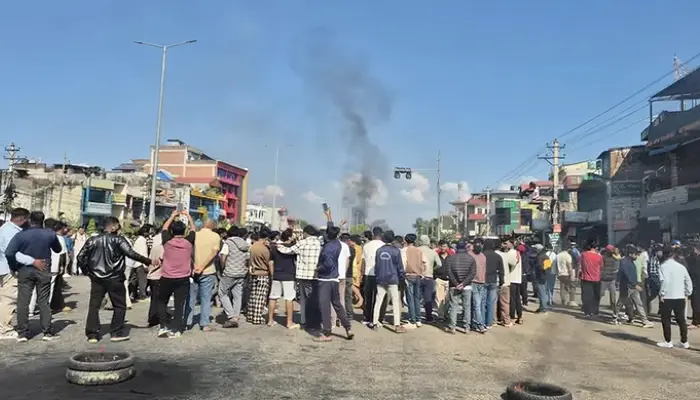
Case Summary
In the Sabgadha village of Rautahat District, Nepal, communal violence broke out after a Hindu wedding procession was attacked by members of the Muslim community for playing DJ music while passing near a local mosque. According to reports, on 19 February 2026, a Hindu wedding procession, accompanied by traditional music and a DJ, was moving through the area. During this time, it passed near a local mosque, where members of the Muslim community were performing their evening prayers. Members of the Muslim community came out and confronted the procession, claiming that the music disrupted their prayers. A verbal altercation ensued, which then escalated into violence as individuals from the Muslim side brutally assaulted the DJ team of the wedding procession, heightening religious tensions in the locality. By the morning of 20 February 2026, the dispute again reignited, leading to stone-pelting and brick-hurling between the Hindu and Muslim communities. The situation rapidly deteriorated into chaos and violence, with both sides engaging in violent exchanges that left the area tense and volatile. In response, the local administration deployed more than 250 security personnel, including officers from Nepal Police, the Armed Police Force, and the Nepali Army, to restore order. Dozens of tear gas shells were fired to disperse the clashing groups and bring the violence under control. Senior security officials reached the scene to supervise operations and prevent further escalation. Chief District Officer Dinesh Sagar Bhusal confirmed the incident and described it as deeply unfortunate, stating that such events disrupted social harmony. He said that the situation had been brought under control and that dialogue between the two communities was being facilitated to normalise conditions. Authorities continued close monitoring of the area while initiating further investigation into the incident, and residents were urged to maintain peace as efforts toward bilateral discussions remained ongoing.
Why it is Hate Crime ?
This case is being added to the tracker under the primary category - Attack not resulting in death. Within it, the sub-category selected is - Communal Clash/Attack. Communal clash is a form of collective violence that involves clashes between groups belonging to different religious identities. For a communal clash between Hindus and non-Hindus to qualify as a religiously motivated hate crime, the trigger of the violence itself would have to be anti-Hindu in essence. For example, if there is a Hindu religious procession that comes under attack from a non-Hindu mob and after the initial attack, Hindus retaliate in self-defence, leading to a communal clash between the two religious communities. While at a later stage, both communities are involved in the clash/violence, the initial trigger of the violence was by the non-Hindu mob against the Hindus and therefore, it could safely be termed as an anti-Hindu violence. Further, the trigger would also have to be religiously motivated. In the cited example, the attack by the non-Hindu mob was against religious processions and therefore, can be concluded to be religiously motivated. In some cases, the trigger may be non-religious, however, it develops into religious violence against Hindus at a later stage. In such cases too, the foundational animosity towards Hindus becomes the motivating factor of the crime and therefore, it would be classified as a religiously motivated hate crime against Hindus under this category. The other sub-category selected here is - Attacked for Hindu identity. In several cases, Hindus are attacked merely for their Hindu identity without any perceived provocation. A classic example of this category of religiously motivated hate crime is a murder in 2016. 7 ISIS terrorists were convicted for shooting a school principal in Kanpur because they got ‘triggered’ seeing the Kalava on his wrist and tilak that he had put. In this, the Hindu victim had offered no provocation except for his Hindu religious identity. The motivation for the murder was purely religious, driven by religious supremacy. Such cases where Hindus are targeted merely for their religious identity would be documented as a hate crime under this category. The subcategory selected is- Attack for crossing 'Muslim area'. One of the reasons that Hindus get attacked unprovoked specifically by Islamists is for crossing ‘Muslim areas’. Essentially, Muslim mobs often attack Hindus crossing or present in certain areas which have a majority Muslim population. It has often been cited as one of the reasons to blame Hindus for attacks against themselves, signalling that Hindus displaying religious symbols, taking our religious processions or crossing any area which is dominated by Muslim residents is a provocation in and of itself. These areas are mostly ghettoized areas where mobs mobilize quickly to attack Hindus for a variety of reasons like playing music during a religious procession, crossing a mosque, wearing a tilak or any other religious symbol in a Muslim-dominated area, praying at a local temple in that area etc. There have been cases where the few local Hindus of that area have been attacked on their way to the Temple for prayers as well, simply because the area is considered a Muslim-dominated area. Several times, it is entirely possible that the immediate trigger for the violence against Hindus was non-religious in nature, however, the violence became religiously motivated in nature because the area was Muslim dominated and the residents on the whole harboured animosity towards Hindus, evidenced from the actions of the mob, the slogans, and the nature of the attack. Such crimes are motivated by the religious identity of the victims and are therefore classified as hate crimes under this category. This case stands as a clear instance of religiously driven communal hostility, as a Hindu wedding procession in Sabgadha village was confronted and violently attacked for playing DJ music while it was passing near a mosque by members of the Muslim community. The objection raised by members of the Muslim community to the playing of music during a Hindu wedding procession triggered a verbal altercation that escalated into physical assault on members of the DJ team accompanying the procession. The subsequent stone-pelting and brick-hurling between the two groups transformed a celebratory and cultural occasion into a site of communal violence. The focal point of the confrontation was the playing of traditional wedding music and a DJ, while it was passing near a local mosque, where evening prayers were going on. The Muslim community took issue with the fact that a Hindu wedding procession was going on during the time the Muslims were having their evening prayers. The attempt to interrupt or object to the expression of Hindu identity in public places simply because Muslims were having their prayers reflected not only religious animosity but also an exclusionary behaviour, the notion that the presence or visibility of Hindu identity must be curtailed because they were having their prayers. Such conduct demonstrated religious animosity and disrespect towards Hindu cultural activities and an assertion that one form of worship, Islamic worship, should override or silence another. This dominance over public areas demonstrates religious animosity towards Hindus, making it a clear, religiously motivated hate crime. The fact that this attack occurred right near the mosque sharpened the religiously motivated nature of the crime to a glaring point. Muslims often treat areas around mosques, dargahs, or madrassas as exclusive zones reserved solely for their community, calling them 'Muslim areas', where non-Muslims face exclusion and control over public movement. This disturbing assertion of Islamic supremacy allowed perpetrators to dictate how Hindus could pass through, viewing the procession's DJ as an intolerable intrusion on their turf. Thus, even a Hindu wedding procession in a public area became an affront in what they claimed as Muslim space, leading to violence, a frenzy of religious exclusion. Such attacks amount to outright communal assaults on Hindus, where mere visibility of the Hindu faith, like a wedding procession, in public spaces triggers savage violence against Hindu participants. This pattern of brutality whenever Hindu processions cross perceived Muslim boundaries exposes systemic hatred, rendering every stone a weapon of religious supremacy and a blatant hate crime. Furthermore, the communal hostility did not subside after the initial confrontation but carried over into the following day, when tensions reignited and escalated into organised stone-pelting and brick-hurling by the Muslim community. The continuation of violence beyond the immediate dispute indicated that the incident was not confined to a momentary disagreement but was rooted in sustained religious hostility, which then developed into a broader communal confrontation. The sustained aggression against Hindus reinforced the religious dimension of the clash. This incident met the parameters of a religiously motivated communal clash, as a Hindu wedding procession became the focal point of violence after objections were raised to the playing of music near a mosque during prayers. Given that the violence arose directly from the public performance of a Hindu wedding custom and was rooted in religious animosity, the case has been added to the hate crime database of the tracker.


Case Status
Unknown


Perpetrators Details
Perpetrators
Muslim Extremists
Perpetrators Range
Unknown
Perpetrators Gender
unknown
 Sources




