Hindu religious procession stone-pelted near mosque, devotees attacked by Muslims in Bagalkot, Karnataka
 Bagalkot, Karnataka, India
  18 February, 2026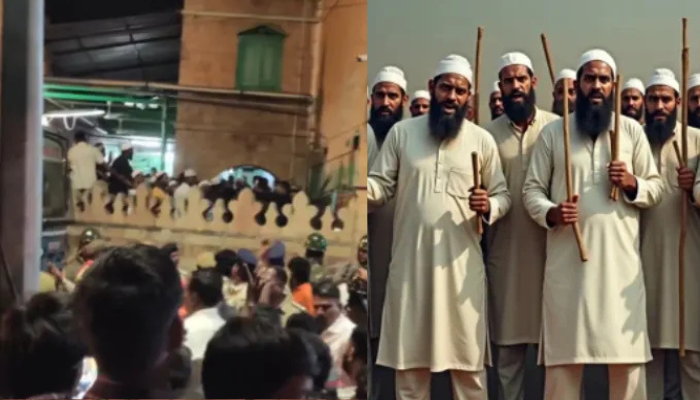
Case Summary
In Bagalkot, Karnataka, a Hindu religious procession, marking the birth anniversary of Chhatrapati Shivaji Maharaj, a revered Hindu king of the Maratha empire, was attacked and stone-pelted by members of the Muslim community, while it was passing near a mosque. The incident occurred on 19 February 2026, on the occasion of Shivaji Jayanti, marking the birth anniversary of Chhatrapati Shivaji Maharaj. The Maratha Hindu community organised a procession, which began at the fort's Amba Bhavani temple, travelled through the main road to Basaveshwara Circle, then passed through Vallabhbhai Chowk and headed towards the fort. When the procession was passing through the Killa Oni area and was passing near a mosque, it was pelted with stones and slippers by Muslims from the mosque. This triggered widespread panic among the participants, escalating communal tensions in the area. During the commotion, a police officer deployed for the security of the procession was attacked by Muslims. The Hindu activist, Prakash Arakeri, also sustained a head injury and was shifted to a private hospital in Bagalkot. Tension spread rapidly in the surrounding localities, and additional police forces were deployed to prevent further escalation. Bagalkot Superintendent of Police Siddharth Goel stated that CCTV and video footage were being examined to identify those responsible and that additional security had been deployed across the town. As a precautionary measure, prohibitory orders under Section 144 of the Criminal Procedure Code were imposed in Old Bagalkot, Navanagar and Vidyagiri until midnight on 24 February 2026. Security was tightened around Panka Mosque and Kottaleshwara Temple, with senior officers stationed on the ground to monitor the situation. The authorities appealed to residents to maintain calm and refrain from spreading rumours, while assuring that those responsible for the violence would be identified and arrested.
Why it is Hate Crime ?
This case has been added to the tracker under the primary category- Attack not resulting in death. Within it the sub-category selected is - Attack on religious procession. The outward celebration and display of religious symbols in an intrinsic part of Hinduism. Religious processions on various festivals are age-old traditions and a way to manifest faith and form a part of the religious practices of Hindus. On several occasions, such religious processions come under attack by non-Hindu mobs, in a manifestation of their animosity towards Hinduism and their practices. The reasons cited for such violent attacks are many and range from crossing a non-Hindu resident-dominated area to playing loud music, crossing from an area where there is a religious structure of another faith etc. The violent attacks are triggered by the outward display of religiosity by Hindus. The attacks are mainly a manifestation of religious supremacist doctrine which believes that idolatry, essentially the Hindu faith, is one that deserves to be annihilated since the very tenets of Hinduism, its practices and traditions are considered a sin in those doctrines. Since these attacks emanate from intrinsic and doctrinal animosity towards Hindus and Hinduism, it is considered a religiously motivated hate crime under this category. The other sub-category selected here is - Attack against Hindu devotees. Hindu devotees are a few of the easiest targets of religiously motivated hate crimes because during the festival/procession/puja etc, for non-Hindus it is easy to profile their victims on the basis of religion. Hindu devotees come under attack on several occasions by individual non-Hindus or mobs of non-Hindus owing to their animosity against Hinduism, its symbols and tradition/practices. There are several instances of Hindu devotees being attacked while they worship in temples or temporary religious structures, during religious processions, doing bhajan/kirtan/puja in their own homes, in the residential society etc. These attacks are perpetrated by non-Hindus primarily because of their animosity towards Hindus and their faith. In some cases, the trigger for the violence may be non-religious, however, there are two elements that make these hate crimes. First, the Hindus who come under attack are attacked violently while indulging in religious activity. Whether they are in a place of worship or not is immaterial to the crime. When individuals are attacked while indulging in religious practices, the attack in itself is a hindrance to their freedom to practice religion and therefore constitutes a hate crime. Secondly, religious supremacist doctrines and ideologies deem religious practices of Hindus to be offensive ab initio since they are considered “sinful” by these ideologies, worthy to be annihilated by force or coercion. Driven by these religious supremacist ideologies and doctrines, the attacks against Hindu devotees stem from intrinsic animosity towards Hinduism. In some cases, the trigger for the violence may be non-religious, however, it develops into a religiously motivated crime during the course of the violence. Since these attacks stem from animosity towards Hindus and Hinduism, they are considered religiously motivated hate crimes under this category. The other sub-category selected here is - Attacked for crossing 'Muslim area'. One of the reasons that Hindus get attacked unprovoked specifically by Islamists is for crossing ‘Muslim areas’. Essentially, Muslim mobs often attack Hindus crossing or present in certain areas which have a majority Muslim population. It has often been cited as one of the reasons to blame Hindus for attacks against themselves, signalling that Hindus displaying religious symbols, taking our religious processions or crossing any area which is dominated by Muslim residents is a provocation in and of itself. These areas are mostly ghettoized areas where mobs mobilize quickly to attack Hindus for a variety of reasons like playing music during a religious procession, crossing a mosque, wearing a tilak or any other religious symbol in a Muslim-dominated area, praying at a local temple in that area etc. There have been cases where the few local Hindus of that area have been attacked on their way to the Temple for prayers as well, simply because the area is considered a Muslim-dominated area. Several times, it is entirely possible that the immediate trigger for the violence against Hindus was non-religious in nature, however, the violence became religiously motivated in nature because the area was Muslim dominated and the residents on the whole harboured animosity towards Hindus, evidenced from the actions of the mob, the slogans, and the nature of the attack. Such crimes are motivated by the religious identity of the victims and are therefore classified as hate crimes under this category. The other sub-category selected is - Communal clash/attack. Communal clash is a form of collective violence that involves clashes between groups belonging to different religious identities. For a communal clash between Hindus and non-Hindus to qualify as a religiously motivated hate crime, the trigger of the violence itself would have to be anti-Hindu in essence. For example, if there is a Hindu religious procession that comes under attack from a non-Hindu mob and after the initial attack, Hindus retaliate in self-defence, leading to a communal clash between the two religious communities. While at a later stage, both communities are involved in the clash/violence, the initial trigger of the violence was by the non-Hindu mob against the Hindus and therefore, it could safely be termed as an anti-Hindu violence. Further, the trigger would also have to be religiously motivated. In the cited example, the attack by the non-Hindu mob was against religious processions and therefore, can be concluded to be religiously motivated. In some cases, the trigger may be non-religious, however, it develops into religious violence against Hindus at a later stage. In such cases too, the foundational animosity towards Hindus becomes the motivating factor of the crime and therefore, it would be classified as a religiously motivated hate crime against Hindus under this category. This case stood as a clear instance of a religiously motivated hate crime because a Hindu religious procession marking the birth anniversary of Chhatrapati Shivaji Maharaj, a revered Hindu king, was attacked and stoned while passing near a mosque by members of the Muslim community. Shivaji Jayanti commemorates the birth anniversary of Chhatrapati Shivaji Maharaj, the 17th-century founder of the Maratha Empire. Hindus revere him as a protector of Hinduism and the Hindu community, crediting him with establishing Hindavi Swarajya, a sovereign Hindu kingdom, through daring guerrilla tactics and unyielding defence of temples, cows, and Hindu honour against relentless Mughal oppression and Islamic imperialist campaigns in the 17th century. Therefore, attacking such a procession was not just a random attack; it was targeted violence against a Hindu religious procession engaged in commemorative observance. The fact that the procession moved peacefully through its designated public routes and violence erupted specifically when it passed in front of the mosque demonstrates that the violence stemmed from religious hostility rather than a neutral public order dispute. The act of Muslim perpetrators pelting stones and slippers at devotees during Shivaji Jayanti celebrations demonstrated clear disrespect for Hindu religious processions. Their deliberate assault despite knowing Chhatrapati Shivaji Maharaj's significance to Hindus exposed deep-seated contempt for Hindu religious icons. One Hindu activist suffered brutal head injuries from the stone-pelting, underscoring the intent to terrorise participants during this cherished Hindu observance. This targeted violence transformed a sacred procession into a battlefield, marking it as a religiously motivated hate crime. The fact that this attack occurred right near the mosque sharpened the religiously motivated nature of the crime to a glaring point. Muslims often treat areas around mosques, dargahs, or madrassas as exclusive zones reserved solely for their community, calling them 'Muslim areas', where non-Muslims face exclusion and control over public movement. This disturbing assertion of Islamic supremacy allowed perpetrators to dictate how Hindus could pass through, viewing the procession's bhajans and DJ as an intolerable intrusion on their turf. Thus, even a procession on Shivaji Jayanti became an affront in what they claimed as Muslim space, leading to attack and stone pelting, a frenzy of religious exclusion. Such dominance over public areas screamed animosity towards Hindus, cementing this as a clear, religiously motivated hate crime. Such attacks amount to outright communal assaults on Hindus, where mere visibility of the Hindu faith, like a festival procession, in public spaces triggers savage violence against devotees and their traditions. This pattern of brutality whenever Hindu processions cross perceived Muslim boundaries exposes systemic hatred, rendering every stone a weapon of religious supremacy and a blatant hate crime. Given that this case met multiple parameters of a religiously motivated offence, it was added to the hate crime database of the Hinduphobia Tracker. Disclaimer: In this case, the victim count is recorded as one, referring specifically to Hindu activist Prakash Arekere, who was clearly identified as sustaining injuries from the violence perpetrated by the Muslim community. The Hinduphobia Tracker acknowledges that multiple Hindu devotees were targeted during the attack, but since only one victim was explicitly named and the total number remains unspecified, this count refers solely to Prakash Arekere. This represents a conservative estimate, as the actual victim count could be significantly higher.
Victim Details
Total Victim
1
Deceased
0
Gender
- Male 1
- Female 0
- Third Gender 0
- Unknown 0
Caste
- SC/ST 0
- OBC 0
- General 0
- Unknown 1
Age Group
- Minor 0
- Adult 1
- Senior Citizen 0
- Unknown 0


Case Status
Unknown


Perpetrators Details
Perpetrators
Muslim Extremists
Perpetrators Range
Unknown
Perpetrators Gender
unknown
 Sources




