Hindu idols vandalised, temple priest and caretaker attacked by mob in Muzaffarnagar, Uttar Pradesh
 Muzaffarnagar, Uttar Pradesh, India
  16 February, 2026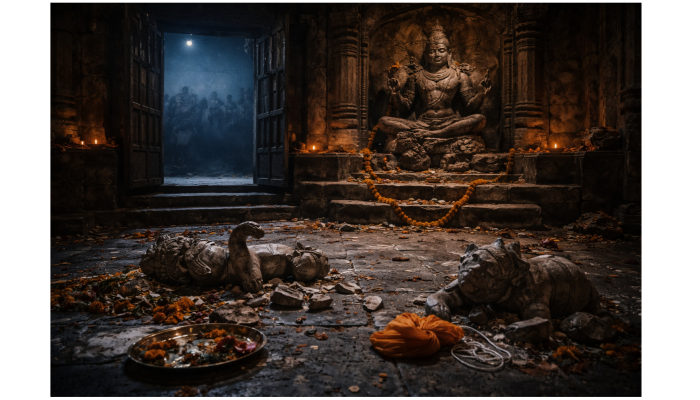
Case Summary
On the night of 17 February 2026, a Hindu temple faced targeted vandalism as a mob of 30 people desecrated idols of Lord Kartikeya and Nandi and even tried to damage the idol of Lord Shiva. The accused also attacked the temple worker (sevadar) and the temple priest, Mahant Pushkar Nath. The perpetrators also attempted to rip off his janeu and forcibly remove his turban. This occurred in the Shri Shivnath Mandir in Harsauli village, Shahpur tehsil (administrative sub-division) of Muzaffarnagar. On the day of the incident, after the evening aarti (prayer ceremony), devotees had returned to their homes. The temple priest, Mahant Pushkar Nath, had stepped out to distribute prasad (sacred food offering) in the village while the sevadar remained at the temple. At around 8 PM, three men, Pintu, Ajay, and Kalua alias Kallu, arrived at the temple in an intoxicated state and attempted to enter. They were denied entry. The three then called for the sevadar. When he did not respond, they abducted him, took him to a secluded location, and assaulted him. Upon receiving a phone call about the incident, the temple priest returned to the temple. Shortly after, the perpetrators brought the sevadar back, now accompanied by a mob of approximately 25-30 people. The mob was armed with weapons like pistols. The mob beat the sevadar again in front of the temple priest. When Mahant Pushkarnath intervened, the mob assaulted him as well, pulling off his saffron turban and attempting to break his janeu (a sacred thread worn by Hindu men). The mob then chased him with a country-made pistol and stones. Villagers who had gathered at the scene intervened, and Pushkar Nath escaped. The mob then fled after issuing death threats. During the assault, the mob also broke the idols of Lord Kartikeya and Nandi inside the temple. An attempt was also made to break the main idol of Lord Shiva, which was prevented. The entire sequence of events was captured on the temple's CCTV cameras, with footage showing over two dozen people dragging and beating the sevadar. At 3 AM, Mahant Pushkar Nath filed a written complaint at the police station, naming Pintu, Ajay, and Kalua as perpetrators. Police deployed forces around the temple in response to communal tension in the area. By 18 February 2026, three named perpetrators, Sohanbir alias Pintu, Ajay, and Arun alias Kalua, were arrested. Efforts to identify the remaining members of the mob through CCTV footage continued.
Why it is Hate Crime ?
The primary category for this case is- Attack on Hindu religious representations. The sub-category for this is- Desecration of Hindu religious symbols. Icons and symbols or a religious representation of a spiritual ideal are widely revered in Hinduism. Iconography is of vital significance in the Hindu milieu. It helps connect people’s spiritual beliefs with the real world. Iconography within the Hindu faith takes several shapes and forms. Murtis are of most significance to Hindus, to which daily rituals, prayers and offerings are done. Besides the murtis, there are several other symbols which have deep significance in the Hindu faith – the Om and Swastika for example. Since these Hindu religious symbols hold paramount importance in Hinduism, any desecration of symbols, icons, murtis, religious representations and manifestations, is driven by animosity towards the faith itself which manifests itself through these murtis, icons and symbols. Therefore, any desecration of these Hindu religious symbols and representations is considered religiously motivated hate crimes under this category. The other subcategory for this case is- Attack on Temples. In Hinduism, a temple is the abode of the Deity. The Deity in the Temple is consecrated, thereby, making it a real, breathing entity. Hindus believe that not just the Deity but the temple premises itself are sacred to Hindus since Hindus hold the faith that the entire Temple space is an amalgamation of the divine energy of the deity. Given the central significance of Temples in Hindu Dharma, any attack against a Hindu Temple or its peripheral premises is an attack on the faith itself and is born out of animosity towards the faith, of which, the Temple is a central tenet. Any manner of attack against a Temple and/or its premises would therefore be considered a religiously motivated hate crime. The other subcategory selected is- Breaking rules of place of worship. Sanatan Dharma is not a religion of one book, which is to say that while it has religious scriptures that form the central tenets of the faith, there are several traditions followed through thousands of years, mostly passed from generation to generation orally. One of these oral traditions or written traditions is the rules of specific temples. Certain temples have rules which are traditional rules, dependent on the worship of the presiding deities. These rules and traditions have been followed for thousands of years whether they find scriptural mention or not. Such traditions are based on the nature and rules of worship of the presiding deity of that temple. Any non-compliance of these traditions owing to animosity towards the faith or for the sake of activism stems not only from the lack of faith in the presiding deity but also disregard for the faith of the devotees of that deity/temple and implicit bias against the faith, the tradition and the deity itself. Since these specific traditions are central to the faith of the devotees of that specific temple and presiding deity, any non-compliance with these traditional rules would be considered a religiously motivated hate crime. Another primary category this case falls under is- Attack not resulting in death. The sub-category here is- Attacked for Hindu identity. In several cases, Hindus are attacked merely for their Hindu identity without any perceived provocation. A classic example of this category of religiously motivated hate crime is a murder in 2016. 7 ISIS terrorists were convicted for shooting a school principal in Kanpur because they got ‘triggered’ seeing the Kalava on his wrist and tilak that he had put. In this, the Hindu victim had offered no provocation except for his Hindu religious identity. The motivation for the murder was purely religious, driven by religious supremacy. Such cases where Hindus are targeted merely for their religious identity would be documented as a hate crime under this category. The other subcategory selected is- Attacked for opposing radicals or trying to save victim. In several cases, Hindus are attacked for opposing religiously motivated crimes being committed against a fellow Hindu or simply for voicing an opinion opposing radical elements, who either have in the past or continue to persecute Hindus. In such cases, the initial attack against the victim, against which the Hindu was trying to defend the victim, would also need to be classified as a religiously motivated hate crime. Since the initial crime itself was religiously motivated and the subsequent crime of attempting to save the victim or speaking against the radical elements ends up inviting a violent attack, it would also be classified as a religiously motivated hate crime under this category. This case constituted a clear instance of a religiously motivated hate crime, as the perpetrators desecrated idols of Hindu deities, namely Lord Kartikeya and Nandi and attempted to damage Lord Shiva's idol. Hindu idols embody divine presence for devotees, serving as focal points for worship, prayer, and spiritual connection central to religious practice and community identity. They are highly revered as manifestations of the divine by devotees. Therefore, attacks on these sacred religious symbols inflict profound emotional trauma, deliberately wounding Hindu sentiments by violating what devotees hold most holy. Such targeted desecration constituted an assault not just on individual idols but on the Hindu temple itself and its entire ecosystem of rituals, priesthood, and religious devotion, as idols formed an inseparable part of it. This exposed raw religious animosity designed to humiliate the Hindu community and suppress their faith through calculated sacrilege. The perpetrators entered the temple premises in an intoxicated state, shattering fundamental temple sanctity. Temples maintain strict codes of conduct, no alcohol, no intoxicants, to preserve purity as sacred spaces for divine communion, where devotees approach with clean bodies and minds. Intoxicated entry defiles this holiness, mocking Hindu reverence for ritual cleanliness. Their deliberate disregard for sacred temple rules signalled deep contempt for Hindu norms, escalating the violation into a hate crime rooted in religious animosity. The brutal assault on the temple caretaker, or sevadar, laid bare the perpetrators' religious animosity directed squarely at his Hindu identity, as he served as the devoted guardian of sacred worship. Dragging him to a remote, isolated spot for a savage beating was no random act but a calculated move to terrorise those who selflessly uphold Hindu rituals and temple sanctity day after day. When Mahant Pushkarnath bravely intervened to shield the sevadar, risking his own safety to protect a fellow Hindu servant of the faith, the enraged mob swiftly turned their violence upon the priest as well, underscoring how Hindus who stand firm against anti-Hindu radicals face ruthless retaliation. This chilling pattern, singling out caretakers for their visible devotion and then pummelling priests who dare defend them, stamped every vicious blow as religiously motivated, a direct assault on the very essence of Hindu identity and communal resilience. Perpetrators then escalated their savagery by attempting to forcibly rip off the Mahant's saffron turban, a profound symbol of his spiritual authority, renunciation of worldly ties, and lifelong dedication as a Hindu priest guiding devotees through sacred rites. They also sought to desecrate his janeu, the sacred thread draped across his shoulder, which marks a Hindu man's initiation into Vedic wisdom, purity, and an unbreakable covenant with dharma worn through every ritual and prayer. Such deliberate, hands-on tearing at these sacred religious symbols of priestly dignity and faith was not mere chaos but a brazen bid to strip him of his religious stature in the most humiliating way imaginable. This targeted desecration of personal Hindu symbols revealed the mob's deep-seated animosity towards Hindu victims and their faith, making it a hate crime. Some may claim that intoxication drove the violence, but evidence disproves this. Why target only the sevadar, drag him away, summon a mob of 30, vandalise Hindu idols, assault the Mahant, and desecrate his turban and janeu if mere drunkenness sufficed? This coordinated escalation, from isolation assault to temple invasion, revealed premeditated religious hatred, not alcohol's haze. The mob's unified focus on Hindu symbols, personnel, and spaces underscored severe religious animosity driving the hate crime. Since this case met the parameters of a religiously motivated hate crime, the Hinduphobia Tracker added it to its hate crime database.
Victim Details
Total Victim
2
Deceased
0
Gender
- Male 2
- Female 0
- Third Gender 0
- Unknown 0
Caste
- SC/ST 0
- OBC 0
- General 2
- Unknown 0
Age Group
- Minor 0
- Adult 2
- Senior Citizen 0
- Unknown 0


Case Status
Case sub-judice


Perpetrators Details
Perpetrators
Unknown
Perpetrators Range
From 10 to 100
Perpetrators Gender
male
 Sources




